The balanced scorecard (BSC) is a widely used performance measurement framework for strategic planning. It is so popular, in fact, that The KPI Institute’s latest State of Strategy Management Practice report found that 40% of respondents from Middle Eastern companies were using it. Why is that the case? It’s likely in the name—the BSC offers a balanced perspective of a company’s performance, focusing not just on financial gains but the various aspects of value creation as well. This enables companies who use it to establish sustainable business practices that can meet long-term goals without sacrificing short-term improvements.
What Is the BSC?
In 1992, Robert Kaplan and David Norton dreamed of a better way. Aware of the limitations of traditional practices that focused solely on financial indicators such as return on investment (ROI) to measure a company’s performance, the two designed a tool that incorporated non-financial variables to paint a more holistic, comprehensive picture. Thus, the balanced scorecard was born.
The BSC was further refined by connecting performance metrics directly to strategy, which marked a formal link between strategic goals and performance measurement. In 1996, it became a performance management system (PMS) that effectively integrated the various crucial aspects of an organization—i.e. strategic processes, resource allocation, budgeting and planning, goal setting, and employee learning.
By 2001, the BSC had outgrown its original form, no longer seen as a mere management tool but instead as an all-encompassing strategic management and control system. The BSC has continued to evolve alongside the ever-changing priorities of the business world. In 2021, many companies began integrating environmental and social dimensions into their BSCs to reflect their triple bottom line strategies.
The BSC gives managers a view of the business from four crucial perspectives. Each perspective deals with an integral aspect of the organization and answers a specific question:
Customer Perspective: How Do Customers See Us?
Companies typically have a mission statement that encapsulates how they interact with customers. For example, e-commerce platform Etsy’s mission statement is “Keep Commerce Human.” This sentiment informs the way the company does business, which places importance on leaving a positive economic, social, and ecological impact.
The BSC holds companies accountable to their mission statements by translating them into specific measures that must be followed. For Etsy, one aspect to consider would be the diversity of its workforce, which falls under social impact. To address this, the company has taken measures such as increasing the presence of underrepresented communities in its seller community by interviewing candidates from those backgrounds. This has enabled the company to stay true to its mission and show customers that it walks the talk.
Internal Perspective: What Must We Excel At?
Balance is the primary focus of the BSC—it’s in the name, after all. Thus, the framework doesn’t only take into account the way customers perceive the company, but it also considers what the latter does to shape this perception. This is composed of the various operational and organizational processes that drive the company.
By giving managers an internal perspective, they can identify, track, and measure the processes that yield the most benefits and close the gaps on the ones that fall short.
Learning and Growth Perspective: Can We Continue to Improve and Create Value?
The business landscape is constantly shifting, and in order to keep pace with its changes, businesses must consistently learn and innovate. That is the importance of this perspective, which states that a company’s value hinges on its ability to improve. In any industry, competition can be fierce, which means companies must always find new ways to stand out.
Financial Perspective: How Do We Look to Shareholders?
Among the four perspectives, this is perhaps the most straightforward. Put simply, it indicates if a company is profitable. Although financial performance is no longer the end-all, be-all measure of a company’s success, it still plays a crucial role in determining whether a company is simply surviving or thriving. Shareholders understandably value profitability, and they won’t keep investing in a company that doesn’t produce ROI.
The BSC is by nature a holistic framework, meaning each part is interconnected to the others. This is why it’s important to take a balanced (pun intended) approach when considering the four perspectives. If one side is prioritized over the others, it could lead to the formation or widening of inefficiency gaps that impede business growth and success.
As previously mentioned, the BSC is quite popular. This is due to the myriad of benefits that it brings to organizations that use it wisely. The most obvious benefits of the BSC are twofold. First, it consolidates the seemingly disparate aspects of a business in a single report, leading to increased efficiency in performance reporting and measurement as well as faster decision-making. Second, the BSC helps mitigate suboptimization by making managers consider the entirety of the company’s operational measures, demonstrating whether one objective was achieved at the cost of another.
A more concrete example of the BSC benefiting companies can be seen in how Apple uses the framework. By shifting its focus from innovating its products to also paying mind to customer satisfaction by establishing it as one of the company’s core tenets, the tech giant was able to improve its already stellar reputation by catering to its customers’ desires. Apple also values core competencies, employee commitment and alignment, market share, and shareholder value. Together, these indicators make up the metrics of their BSC.
World-renowned electronic company Philips is also known for its use of the BSC, using a bespoke version of the framework to fit its organizational needs. The company’s focus is on its employees, and it uses the BSC to ensure that each member of its workforce has a clear understanding of the company’s strategic policies and long-term vision.
What Does the Future Hold?
There must be a stronger emphasis on customization as companies realize that there is no such thing as a one-size-fits-all approach to performance management. This aligns with the proliferation of new advancements in artificial intelligence (AI) and machine learning (ML), technologies that must be integrated into the BSC lest the framework fall behind the ever-shifting realities of the business world. Regardless of the future, the BSC appears poised to remain a vital tool for companies of all sizes and in all industries.
Interested in learning more about the BSC? Browse our articles here.
How are strategic objectives defined in the government today? In this interview, Dana Alsaaid unveils the meticulous approach and initiatives that her organization employs to align strategic planning with a nation’s overarching goals and how she navigates the complexities of strategy execution in the public sector.
In your position as Director of Corporate Performance Management, how do you approach the strategic planning process to align with the goals of the Ministry of Economy and Planning? Can you discuss any initiatives or methodologies you’ve implemented to enhance the efficiency and effectiveness of strategy planning within the organization?
The journey of strategic planning in the ministry mainly involves identifying strengths and potential risks—as a base for planning—along with the vision of leaders, which sets the general direction of the strategy. To improve the efficiency and effectiveness of this planning process, we believe in the importance of top management’s engagement and continuous feedback through collaborative workshops as well as leveraging available data analytics tools. We use the famous Balanced Scorecard (BSC) in preparation for proper and efficient execution.
What common issues have you noticed in strategy execution, and how should they be addressed?
Issues in strategy execution start at the beginning, which is in strategy formulation. A lack of clarity makes it difficult to implement a vision. A lack of alignment and buy-in would negatively impact any rollout of strategies. Along with those factors, limited resources in the budget or people affect how execution takes place.
Trends
In light of global economic shifts and geopolitical uncertainties, how can organizations create resilient strategies that can withstand external disruptions?
Since the world is becoming extremely dynamic, organizations should regularly conduct scenario planning exercises to identify potential disruptions and develop contingency plans. Diversified supply chains can play a pivotal role in handling those disruptions. Meanwhile, fostering a culture of agility that embraces change would lead to better adaptation.
What do you see as the most promising ways artificial intelligence (AI) can further impact corporate strategy, and what steps should companies take to remain at the forefront of AI-driven strategic advancements?
AI is revolutionizing corporate strategy by offering a powerful tool to enhance decision-making, optimize operations, and gain a competitive edge. It can assist in ideation during the strategy planning phase and lead to significant gains in efficiency through sufficient resource allocation to meet strategic goals. Organizations would do well to establish AI strategies and invest in AI infrastructure to enable the intended strategic advancements.
Does your organization use strategic foresight to enhance future readiness? If not, please detail the organization’s approach to planning in the short, medium, and long term.
For future readiness, our organization is conducting horizon scanning to identify opportunities and risks, whether globally or locally, to share key insights as inputs when planning for possible scenarios. In Saudi Arabia, the Ministry of Economy and Planning is leading the Sustainability and UN SDGs file, a main pillar for long-term planning that benefits future generations.
Strategy and Performance Management Practices
Do you see any application of AI to facilitate strategic planning or performance measurement? Is your organization using any such tool, possibly in certain areas of the organization?
Studies have been launched in the ministry to incorporate AI in modules and monitoring systems that facilitate decision-making by providing data-driven insights that can identify hidden patterns and trends for a more comprehensive understanding of the global economic setting. Moreover, AI would be hugely utilized in predictive analytics modules to forecast required economic targets.
How are strategic objectives defined in your organization, including the research process, involved stakeholders, and other pertinent details?
The process of defining strategic objectives is crucial in strategy planning since it translates the vision and mission of the organization into its goals. It should consider both the external scanning of opportunities and threats and the internal assessment of capabilities and resources. To ensure proper definition, both senior leaders and functional managers should be involved in incorporating the strategic direction and operational understanding in the process.
How do you balance long-term planning and short-term priorities?
This is a common challenge that organizations face, and it requires balancing between setting future direction and ensuring immediate success. The key element to this relationship is prioritization based on the impact and value of the initiatives, which helps to ensure that resources are allocated to the most impactful initiatives with the most suitable value.
In your experience, what is the most important tool for managing strategy, and why? How do you communicate strategy to different stakeholders within the organization to ensure a high level of awareness of priorities for both frontline employees and management positions?
First of all, I believe that the main principle in effective strategy management is engaging stakeholders in the planning phase. This ensures that objectives are achievable and the stakeholders are engaged in the execution. BSCs have proven to be effective in managing strategies for their cohesiveness.
It is also critical to properly communicate the right message to all levels of employees. Therefore, the messages should be tailored to all the different levels of expertise and communicated through multiple channels. A main component of such communication is the ability to incorporate it into everyday work and show every employee’s contribution to the implementation of the strategy.
What approaches or methodologies have you found effective in fostering cross-functional collaboration and ensuring that all departments work cohesively towards strategic goals?
In my experience, fostering a culture of teamwork, open communication, and shared accountability with a clear definition of common goals is the key to effectively ensuring cross-functional collaboration. Once this culture is established, a regular evaluation of the effectiveness of cross-functional collaboration will guide the efforts toward the organization’s strategic goals.
What critical skills and competencies should professionals develop to excel in strategic management?
For professionals to navigate the complexities of strategy, they should fully understand their respective industry and its operations. Additionally, analytical thinking and foresight competencies are critical to driving the competitive advantage. More importantly, strategy professionals should be able to manage change and communicate effectively with stakeholders.
**********
Editor’s Note: This article was originally published in Performance Magazine Issue No. 29, 2024 – Strategy Edition.
About the Practitioner:Dana Alsaaid is a strategy professional with expertise in strategy execution and key performance indicators (KPIs). She holds a Master’s Degree in Health Administration from George Mason University, Fairfax, Virginia. Currently, she serves as the Director of Corporate Performance Management in the Ministry of Economy and Planning of Saudi Arabia.
One of the most important factors in running a successful business is strategy implementation, where general, strategic objectives are translated into precise activities that involve bringing ideas to fruition. Operational performance is used to measure the effectiveness and efficiency of these activities in achieving strategic goals and objectives. Meanwhile, governance provides the structure and rules needed to monitor performance and achieve objectives, which requires good planning, resource allocation, and management.
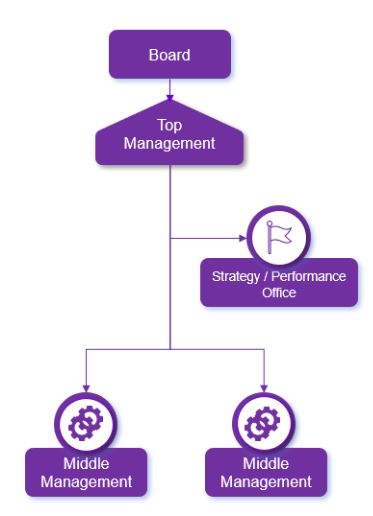
Governance mechanisms are critical to guiding, monitoring, and improving strategy planning and execution. Roles and accountabilities should be clear: the board of directors sets the company strategy, goals, and overall direction. Top management ensures the strategy is translated and cascaded to the lower managerial levels. Middle management is critical to ensure the implementation of strategic objectives.
Upon receiving clear direction from the top management, middle managers should also set clear responsibilities and metrics. Metrics should be set to monitor success impartially. Clear roles and their coordination could also be ensured by appointing a strategy/performance office responsible for overseeing the strategy process, contributing to setting strategic objectives, and coordinating performance measurement.
Organizational Hierarchy | Source: The KPI Institute – C-KPI Course
The purpose of governance is to ensure that an organization continuously fulfills its mission by coordinating its strategy with its operational goals, procedures, and standards. Procedures and processes are essential to the success of an organization, as these help ensure that resource allocation is done properly, with all stakeholders having a clear role in how the organization’s objectives are achieved. In the case of a company where multiple projects run at the same time in various areas, this is especially important. Confusion, overlap, and miscommunication may arise in these situations, therefore, clear rules, guidelines, and accountabilities should be set up.
Reliable, comprehensive financial and non-financial information is at the core of governance, as it serves decision-making. Reporting procedures are crucial to ensure the right processes are set up to disclose the necessary data to the stakeholders, with mechanisms for regular reporting to share performance data and progress updates. Performance reporting is important as it disseminates information, communicates progress, forecasts progress, and updates status to stakeholders.
Moreover, decisions are taken based on the information received, and an organized process for review and decision-making, such as regular strategic review meetings or performance review sessions could be implemented. Periodic performance reviews measured against objectives should be conducted to analyze gaps, identify areas for improvement, and initiate corrective actions.
Governance cannot be properly implemented without the adequate behaviors of people. Since emotions play a large role in shaping behavior, it becomes all the more crucial for leaders to facilitate buy-in from the organization. Leaders should provide trust, guidance, and direction, instilling the necessary behaviors that support the organization’s objectives. Communication should be clear and consistent to provide clear direction.
As resistance is natural given the fear of the unknown or the perceived negative changes, it is important to address employee concerns and provide support. Some of the potential barriers are removed when support is provided to ensure that employees understand the strategy, their roles, and how their performance contributes to strategic objectives.
In conclusion, governance is indispensable for an organization’s success and reputation. By establishing clear structures, processes, and accountability mechanisms, governance ensures that the company operates in alignment with its objectives, values, and legal obligations. It provides a framework for effective decision-making, safeguarding the interests of shareholders, employees, customers, and other stakeholders. To summarize, governance isn’t merely a corporate formality—it’s the cornerstone of organizational excellence and trust in the modern business world.
For more in-depth articles about strategy, click here.
In today’s dynamic business landscape, the success of any organization hinges on its ability to execute its strategies effectively. A well-crafted strategy can set the direction for growth and innovation, but its potential is realized only when it is translated into action through meticulous execution. Central to this process is the role of employees, who are the driving force behind turning strategic visions into tangible results.
Employee performance is a pivotal factor in the success of any organization. To achieve excellence, companies must focus on setting clear strategies and executing them effectively. This article will delve into best practices for driving employee performance, emphasizing strategy execution.
Strategic alignment: Effective strategy execution begins with aligning individual roles and responsibilities with the overarching organizational strategy. By clearly communicating the company’s goals and vision, employees gain a deeper understanding of how their contributions directly impact the larger picture. This alignment fosters a sense of purpose and promotes a collective commitment to achieving shared objectives.
Clear communication and cascading goals: A well-executed strategy demands clear communication across all levels of the organization. Leaders play a vital role in disseminating the strategic direction, ensuring that every team member knows their role in the grand scheme. The practice of cascading goals from top to bottom ensures that each employee’s performance objectives are in harmony with the organization’s strategic imperatives. It is important to regularly communicate the big picture to emphasize the importance of individual contributions.
Metrics and performance tracking: Measuring employee performance is essential for gauging strategy execution effectiveness. Implementing performance metrics and key performance indicators (KPIs) provides a quantifiable way to assess progress. Regular reviews allow adjustments to be made, ensuring the strategy remains on course. Visual tools, such as charts and tables, can help visualize performance trends and identify areas for improvement. Setting SMART (Specific, Measurable, Achievable, Relevant, Time-Bound) goals and KPIs that align with the overarching strategy provides employees with tangible targets and fosters a sense of accomplishment.
Empowerment and autonomy: Empowered employees are more likely to take ownership of their tasks and proactively seek ways to contribute to the strategy’s success. Providing employees the autonomy to make decisions within their roles fosters a sense of accountability and commitment. This empowerment not only boosts individual performance but also promotes innovation and adaptability.
Recognition and rewards: Acknowledging and celebrating accomplishments, both big and small, go a long way in motivating employees. Recognition reinforces the connection between their efforts and the organization’s success. Tangible rewards, whether financial or non-monetary, serve as incentives that drive heightened performance.
Avoiding common pitfalls
While striving for optimal strategy execution, it is vital to steer clear of common pitfalls. One such pitfall is underestimating the importance of ongoing training and development. A skilled workforce is more capable of executing strategies successfully. Additionally, neglecting to monitor progress can lead to deviations from the intended path.
In the pursuit of organizational success, effective strategy execution is paramount, and employee performance should be inherently tied to it. Employees’ commitment, enthusiasm, and performance can determine whether a strategy remains an abstract concept or a tangible reality. Organizations can unlock the full potential of their strategic visions by aligning employees with the strategy, fostering open communication, recognizing achievements, and empowering them with tools to succeed. As leaders cultivate an environment where strategy execution is a collective endeavor, they pave the way for sustained growth, innovation, and achievement of long-term goals.
*****************************
This article is written by Rami Al Tawil, Organizational Excellence Director at Al Saedan Real Estate Company, who holds a master’s degree in industrial engineering from Jordan University of Science and Technology. With 19 years of expertise spanning Strategy Planning, Performance Management, Business Improvement, and more, he excels in aligning employees with strategic visions for consistent performance improvement.
A common disappointment among managers in regards to measuring performance is that in practice, in many cases, the key performance indicators (KPIs) monitored do not seem relevant as they are not connected to the strategy.
To better understand how this problem can be addressed, we must first identify its possible causes:
1.The strategy is not translated into clear objectives – Nowadays, most organizations have a strategic plan in place for short and long terms. However, these plans may lack an important characteristic, the ability to clearly transmit what needs to be done and how success looks like.
To provide this clarity, strategic objectives must be concise. For example: Increase stakeholders’ satisfaction, Optimize the delivery process, Reduce recycling costs or Ensure market expansion.
Solution: Developing objectives using the SMART concept in mind is a good practice. Other important information such as timeframe, accountability, KPIs to measure the objective can be mentioned in an Objective Documentation Form.
2.KPI selection is done independently to the strategy – During the selection process, KPIs are not chosen to reflect the achievement of strategic objectives.
Solution: Consider these three questions when measuring performance:
What do I want to achieve?
How will I achieve it?
What are the best ways to measure / reflect the progress in reaching my objectives?
The third question indicates what KPIs are suited for your objectives. In most cases, there is more than one way to measure your goals. For example, given the objective ”Increase customer satisfaction,” the marketing manager may choose to measure % Customers satisfied or # Customer satisfaction index.
The decision to measure one KPI or the other will take into consideration things like budget allocated for the KPI’s activation (# Customer satisfaction index will require a multiple question survey that will be more expensive than measuring the percentage of satisfied customers), time to gather data and so on.
Using other KPI selection criteria can help managers shrink the list of possibilities, but remember that the main criteria is to ensure your KPI is linked to a strategic objective.
3.KPIs are not relevant, as we measure what is easy to measure – This is a very common pitfall that occurs during KPI selection workshops, choosing certain KPIs that we are familiar with, or those ones that are easier to measure.
Solution: To address this issue, keep in mind that the efforts to measure a KPI should not be greater than the benefits generated. However, the key criteria still focus on relevancy.
4.KPIs are not relevant, as we measure what is popular in the industry – In a similar way as mentioned above, managers may be tempted to measure the same KPIs that their competitors use.
Benchmarking is a helpful tool in measuring performance, but it must be used wisely. Comparing one company with another may be irrelevant even if they are in the same market, in the same industry and have a similar size, if they have different strategies.
Solution: Use benchmarking data, if it is available, as a reference point for your activities and make sure the comparisons you are making are relevant.
5.KPIs are not reviewed after every strategic planning cycle – Strategies change all the time, whether it happens in a well-structured way, like annual strategy reviews or informal, when managers responding to market changes start new projects. All the changes happening in the organization may put KPIs further and further from the business activities.
Solution: Reviewing the strategy should take place in an organized way, which ensures KPIs are recalibrated to the new strategic directions and there is consistency between what we measure and what we want to achieve. Strategy review should happen once a year, or even more often for really dynamic business environments or start-up companies and realigning KPIs should be a part of this process.
In time, the organization evolves and so do its KPIs, therefore some of them may be superseded (the entity is mature enough to measure a more complex KPI), for some we may choose to suspend them, as the issue they were monitored has been solved, while others may need to be refreshed (changing the calculation methodology).
The value generated by using KPIs is directly influenced by how relevant the data obtained from the performance measurement process is for business planning and decision-making.
Therefore, addressing the above-presented issues may significantly improve the current performance management framework within the organization. Use the GPA Unit performance measurement audit tool, which is provided for free and can offer you an overview of your current maturity level in your organization, in a specified area.
Never Lose Track of the Big Picture
If you feel that your strategy aligning is not quite up to par with the current practices in the business industries, and you would like to gain a better understanding of how KPIs interact with an organization’s strategy, from its design to its implementation, The KPI Institute offers you a 3-day course, Applied Strategy and Business Performance Improvement with KPIs, which will act as a roadmap to the improvement of your long-term organizational performance.
You will explore the foundation of a successful business strategy and then translate it into actionable objectives. The solution for a higher success rate is to set quantifiable objectives and accordingly, use the right KPIs. The course provides the needed Measurement Framework to properly select the relevant KPIs, to document them and gather data.
Moreover, if after you have finished our course, you believe that this topic is something of interest to you and would like to gain in-depth knowledge and earn a specialization in Strategy and Business Planning, we offer you our Certified Strategy and Business Planning Professional certification course, which will help improve long-term organizational performance, through the use of strategic planning tools.
Participants will explore the framework that provides the foundation of a successful business strategy, focusing on the main components of a strategy and practicing the development of an efficient strategic plan. The course will also provide insights on the fundamental principles and methods for communicating strategy across the organization.
Furthermore, for those interested in other resource types, we offer you a wide array of webinars on strategy & strategic planning, which will serve as video guides to help you never lose sight of the connection between your strategy and KPIs!