Most organizations struggle to make their strategy work for them, not against them.
Leadership teams invest time defining clear goals, yet months later, progress feels disconnected. Teams stay busy, but outcomes don’t reflect the original intent.
The issue rarely lies in the strategy itself; instead, it emerges in the space between planning and execution, where goals are expected to translate into action but often don’t.
This gap forms because strategy is typically defined at the top but not effectively translated downward. As it moves across departments and teams, it loses clarity, context, precision, and urgency. What begins as a focused direction becomes fragmented efforts, with each part of the organization interpreting priorities according to its specific needs.
Why Employees Feel Disconnected from Strategy
A significant portion of employees don’t fully understand their company’s strategy or how their work contributes to it. This lack of clarity creates a ripple effect. People default to what they believe matters, which often leads to redundant efforts or misplaced priorities. Without a clear line of sight between daily tasks and long-term goals, work becomes activity-driven rather than outcome-driven.
The activity becomes the outcome in and of itself.
This disconnect also impacts motivation. When individuals can’t see how their contributions fit into a larger purpose, engagement drops, and whilst teams may still perform their roles as expected, without alignment, their efforts rarely compound into little more than droll progress at best.
The Cost of Misalignment in Daily Operations
Misalignment is not always obvious at first.
It shows up subtly in duplicated work or conflicting priorities that beget delays caused by constant clarification and reclarification.
Over time, these small inefficiencies accumulate into larger organizational challenges. Departments begin optimizing for their own success metrics, often at the expense of broader company goals.
Instead of moving in one direction, the organization pulls itself apart. Meetings increase, coordination becomes more complex, and leadership spends more time realigning than advancing strategy. The result is a system where effort is high, but impact remains limited.
Understanding Cascading Goals and Why They Matter
What Cascading Goals Actually Do
Cascading goals provide a structured way to connect high-level strategy with everyday work. Rather than keeping objectives at the leadership level, they break them down into actionable goals for departments, teams, and individuals. This process ensures that strategic priorities don’t remain abstract but become part of daily execution.
The purpose is not simply to distribute goals downward but to create alignment across the organization. Each level interprets and translates the strategy in a way that fits its role, while still maintaining a clear connection to the bigger picture.
How the Cascade Works in Practice
The cascading process typically follows a logical flow. Leadership defines a small set of clear, measurable strategic goals. Departments then translate these into functional objectives based on how they contribute to those goals. Teams further refine these into specific KPIs they can control, and managers connect those KPIs to individual responsibilities.
When this process is done correctly, every layer of the organization understands its role in achieving the overall strategy. There is no ambiguity about priorities, and each action contributes to a shared outcome.
Why Alignment Depends on More Than Structure
While the structure of cascading is important, alignment ultimately depends on communication and transparency. Employees need to understand not just what they are doing, but why it matters. Without this context, even well-defined goals can lose their impact.
Effective cascading also requires two-way communication. Teams must be able to provide feedback, highlight constraints, rearrange objectives, and adapt goals when necessary. This balance between direction and flexibility is what turns cascading from a rigid system into a practical one.
Where Cascading Breaks Down (and What Causes It)
Misaligned KPIs and Conflicting Priorities
One of the most common issues in organizations is misaligned KPIs. Teams often define success based on what they can measure easily, rather than what supports the overall strategy. This leads to situations in which different departments work toward goals that unintentionally conflict.
A company might aim to improve customer experience, while individual teams focus on speed, cost reduction, or output volume. Each goal may seem valid in isolation, but without alignment, they create friction instead of progress.
Silos, Ownership Gaps, and Communication Failures
Siloed thinking emerges when departments operate without visibility into each other’s goals. This lack of coordination leads to duplicated efforts and delayed outcomes. At the same time, unclear ownership creates confusion about who is responsible for driving specific results.
Communication plays a central role in both of these challenges. When strategic goals are inconsistently reinforced or not clearly explained, teams are left to interpret them on their own. This results in fragmented execution and ongoing misalignment.
Overcomplication and Lack of Follow-Through
Another common breakdown occurs when organizations overcomplicate their cascading systems. Too many layers create confusion rather than clarity. Employees struggle to prioritize, and focus becomes diluted.
Even when goals are well defined, they often fail due to a lack of follow-through. Without regular reviews, audits, updates, analyses, and adjustments, alignment weakens over time. Strategy becomes static, while the business environment continues to change.
Building Alignment Through Effective Cascading
Keeping Goals Focused and Visible
Effective cascading starts with simplicity. Organizations that limit their strategic goals to a small, focused set are more likely to maintain alignment. Clear goals make it easier for teams to understand priorities and translate them into action.
Visibility is equally important. When goals are accessible through shared dashboards or centralized systems, alignment becomes part of daily work. People are more likely to stay focused when they can see how their efforts connect to broader objectives.
Creating Accountability and Continuous Alignment
Alignment is not achieved solely through goal-setting. It requires ongoing management. Regular performance reviews and feedback loops help ensure that goals remain relevant and achievable. These moments of reflection allow teams to identify misalignment early and adjust accordingly.
Clear ownership also strengthens accountability. When individuals understand their responsibilities and how they contribute to team outcomes, execution becomes more consistent. Accountability shifts from being enforced to being naturally embedded in the system.
Balancing Structure with Flexibility
While cascading provides structure, it should not limit adaptability. Organizations need to remain flexible as priorities evolve. This means allowing teams to adjust goals, refine KPIs, and respond to new challenges without losing alignment with the overall strategy.
The most effective systems combine structured goal-setting with continuous feedback and collaboration. This approach ensures that alignment is maintained, even as conditions change.
Final Thoughts
Organizations rarely fail because of poor strategy. More often, they fail because the strategy never fully connects to execution. Without alignment, even the best plans remain theoretical, while teams continue working without a shared direction.
Cascading goals address this challenge by creating a clear link between high-level objectives and everyday actions. They provide structure, improve visibility, and help organizations move as a cohesive system rather than a collection of independent parts.
When alignment is achieved, the difference is noticeable. Work becomes more focused, collaboration improves, processes interlink, and progress becomes measurable. Strategy stops being something discussed in meetings and starts becoming something that actively drives results. In the end, cascading is not just a process. It is a way of ensuring that every effort within an organization contributes to a common purpose.
The balanced scorecard (BSC) is a widely used performance measurement framework for strategic planning. It is so popular, in fact, that The KPI Institute’s latest State of Strategy Management Practice report found that 40% of respondents from Middle Eastern companies were using it. Why is that the case? It’s likely in the name—the BSC offers a balanced perspective of a company’s performance, focusing not just on financial gains but the various aspects of value creation as well. This enables companies who use it to establish sustainable business practices that can meet long-term goals without sacrificing short-term improvements.
What Is the BSC?
In 1992, Robert Kaplan and David Norton dreamed of a better way. Aware of the limitations of traditional practices that focused solely on financial indicators such as return on investment (ROI) to measure a company’s performance, the two designed a tool that incorporated non-financial variables to paint a more holistic, comprehensive picture. Thus, the balanced scorecard was born.
The BSC was further refined by connecting performance metrics directly to strategy, which marked a formal link between strategic goals and performance measurement. In 1996, it became a performance management system (PMS) that effectively integrated the various crucial aspects of an organization—i.e. strategic processes, resource allocation, budgeting and planning, goal setting, and employee learning.
By 2001, the BSC had outgrown its original form, no longer seen as a mere management tool but instead as an all-encompassing strategic management and control system. The BSC has continued to evolve alongside the ever-changing priorities of the business world. In 2021, many companies began integrating environmental and social dimensions into their BSCs to reflect their triple bottom line strategies.
The BSC gives managers a view of the business from four crucial perspectives. Each perspective deals with an integral aspect of the organization and answers a specific question:
Customer Perspective: How Do Customers See Us?
Companies typically have a mission statement that encapsulates how they interact with customers. For example, e-commerce platform Etsy’s mission statement is “Keep Commerce Human.” This sentiment informs the way the company does business, which places importance on leaving a positive economic, social, and ecological impact.
The BSC holds companies accountable to their mission statements by translating them into specific measures that must be followed. For Etsy, one aspect to consider would be the diversity of its workforce, which falls under social impact. To address this, the company has taken measures such as increasing the presence of underrepresented communities in its seller community by interviewing candidates from those backgrounds. This has enabled the company to stay true to its mission and show customers that it walks the talk.
Internal Perspective: What Must We Excel At?
Balance is the primary focus of the BSC—it’s in the name, after all. Thus, the framework doesn’t only take into account the way customers perceive the company, but it also considers what the latter does to shape this perception. This is composed of the various operational and organizational processes that drive the company.
By giving managers an internal perspective, they can identify, track, and measure the processes that yield the most benefits and close the gaps on the ones that fall short.
Learning and Growth Perspective: Can We Continue to Improve and Create Value?
The business landscape is constantly shifting, and in order to keep pace with its changes, businesses must consistently learn and innovate. That is the importance of this perspective, which states that a company’s value hinges on its ability to improve. In any industry, competition can be fierce, which means companies must always find new ways to stand out.
Financial Perspective: How Do We Look to Shareholders?
Among the four perspectives, this is perhaps the most straightforward. Put simply, it indicates if a company is profitable. Although financial performance is no longer the end-all, be-all measure of a company’s success, it still plays a crucial role in determining whether a company is simply surviving or thriving. Shareholders understandably value profitability, and they won’t keep investing in a company that doesn’t produce ROI.
The BSC is by nature a holistic framework, meaning each part is interconnected to the others. This is why it’s important to take a balanced (pun intended) approach when considering the four perspectives. If one side is prioritized over the others, it could lead to the formation or widening of inefficiency gaps that impede business growth and success.
As previously mentioned, the BSC is quite popular. This is due to the myriad of benefits that it brings to organizations that use it wisely. The most obvious benefits of the BSC are twofold. First, it consolidates the seemingly disparate aspects of a business in a single report, leading to increased efficiency in performance reporting and measurement as well as faster decision-making. Second, the BSC helps mitigate suboptimization by making managers consider the entirety of the company’s operational measures, demonstrating whether one objective was achieved at the cost of another.
A more concrete example of the BSC benefiting companies can be seen in how Apple uses the framework. By shifting its focus from innovating its products to also paying mind to customer satisfaction by establishing it as one of the company’s core tenets, the tech giant was able to improve its already stellar reputation by catering to its customers’ desires. Apple also values core competencies, employee commitment and alignment, market share, and shareholder value. Together, these indicators make up the metrics of their BSC.
World-renowned electronic company Philips is also known for its use of the BSC, using a bespoke version of the framework to fit its organizational needs. The company’s focus is on its employees, and it uses the BSC to ensure that each member of its workforce has a clear understanding of the company’s strategic policies and long-term vision.
What Does the Future Hold?
There must be a stronger emphasis on customization as companies realize that there is no such thing as a one-size-fits-all approach to performance management. This aligns with the proliferation of new advancements in artificial intelligence (AI) and machine learning (ML), technologies that must be integrated into the BSC lest the framework fall behind the ever-shifting realities of the business world. Regardless of the future, the BSC appears poised to remain a vital tool for companies of all sizes and in all industries.
Interested in learning more about the BSC? Browse our articles here.
In today’s dynamic business landscape, enhancing employee performance is crucial for sustained success. To build high-performing teams, it’s important to establish the right framework and processes for performance measurement, including the selection and deployment of tools like key performance indicators (KPIs). But how can organizations successfully unlock employee potential through performance measurement?
Here is how renowned company Adobe transformed its employee performance strategies to obtain outstanding outcomes.
Case study: Adobe
Adobe’s transformation journey is a testament to the potential of strategic performance measurement and KPIs. Adobe has faced issues with its yearly performance evaluation process. These were:
Employees were frustrated with annual performance reviews as they found the process cumbersome and bureaucratic.
The process created barriers to teamwork since the experience of being rated and stack-ranked for compensation left many employees feeling undervalued.
Adobe estimated that a total of 80,000 hours of its managers’ time was required each year to conduct all of the reviews, the equivalent of nearly 40 full-time employees working year-round.
Adobe realized that it should not wait until the end of year to share feedback. So, the company made a surprising change that improved employee engagement and transformed the company culture.
Employee-centric approach: Adobe’s departure from traditional performance reviews towards a more frequent and less formal “check-in” process demonstrates its commitment to an employee-centric approach. These regular discussions—done at least once a quarter—provide a platform for managers and employees to engage in meaningful conversations about expectations, growth, and development. This shift reflects Adobe’s recognition that empowering employees with continuous feedback and opportunities for improvement is more effective in driving performance excellence than the conventional annual review model.
Setting clear, measurable goals: The new strategy adopted by Adobe focused on providing its staff with specific, measurable goals. Employees could clearly understand what was expected of them and how their performance would be assessed because these goals were cascaded down from the organizational and departmental goals and aligned with each other. Companies that have aligned goals tend to outperform organizations that lack a direct connection between top company priorities and employees’ individual aims.
Real-time performance insights: Adobe enabled its managers to give employees real-time insight into their performance by integrating technology. Adobe launched a digitally-enabled check-in, providing all employees and managers with a web-based destination to document their goals, development, and growth. Individual goals are documented in a centralized place, reviewed regularly, and can be updated in real-time by managers and employees alike. All of this made it possible for timely feedback and course correction, ensuring employees stayed on track with their objectives and KPIs year-round.
The results of the transformation were spectacular and resonated with employees—employee attrition dropped by 30% while involuntary departures rose by 50%. This change allowed managers to give more timely and useful feedback while empowering employees to take responsibility for their own advancement. The employees thus felt engaged, valued, and aligned with the company’s goals.
Lessons learned
What are the key takeaways from Adobe’s case? Performance measurement best practices should always include the following:
Alignment with organizational goals: A strong performance measurement approach starts by matching team objectives and individual objectives with the organization’s overarching mission. Employee performance becomes a key factor in the organization’s success when they are aware of how their work supports corporate objectives.
Keeping qualitative and quantitative metrics in balance: Effective performance measurement goes beyond simply counting numbers, as it needs a comprehensive understanding of an employee’s contributions and their influence on the expansion of the business. This is made possible by incorporating qualitative elements like engagement, collaboration, and innovation.
Continuous feedback and growth: Many businesses are using continuous feedback loops instead of the traditional annual reviews. Periodic performance reviews and regular check-ins encourage ongoing conversations between managers and employees, facilitate growth discussions, and identify areas that need improvement.
In conclusion, the modern business landscape demands a strategic approach to unlocking employee potential. Performance measurement and KPIs are not just tools but pathways to aligning individual aspirations with organizational goals, combining qualitative and quantitative insights for a thorough understanding of employee contributions, and motivating continual improvement through timely feedback. By adopting best practices and an employee-centric approach, businesses may begin on a journey that empowers their staff, inspires innovation, and drives them to sustainable success in the dynamic global marketplace.
********************
This article is written byMuhammad Ali Moustafa isa Business Management Consultant at The KPI Institute. He is a Certified KPI Professional (C-KPI) and Certified Performance Management Systems Audit Professional (C-PA). He has diverse professional experience in which he had the opportunity to work on advisory projects with different organizations, ranging from startups to multinationals.
Designing and implementing a Performance Management System (PMS) based on performance measurement tools such as key performance indicators (KPIs) is a thorough step-by-step process. It requires effective management of all the phases of the implementation process and proper allocation of responsibilities to all the stakeholders involved. With this, the KPI implementation project plan lays emphasis on conducting KPI selection workshops.
Whether or not the PMS within your organization is comprehensive, KPIs can be measured across organizational layers: Corporate/Organizational, Divisional, Departmental, or Individual/Employee levels in accordance with the organizational context. For these performance indicators to be measured in standardized tools, such as a balanced scorecard, they need to be selected, and such selection should occur during dedicated meetings.
Such meetings require the attendance of specifically allocated stakeholders to provide constructive insights and foster a corporate community culture based on continuous improvement. As a line of practice, the participants of these workshops hold positions, such as department heads, strategists, performance analysts, members of the performance management office, and allocated members of the Board, all based on their availability. Note that other members could attend the workshops as per company practice. Attendance at these important meetings requires an invitation, though.
The invitation is a crucial, pre-workshop phase, as it sets the tone, pace, and mindset of the delegates who will join the event. Such invitation is generally in the form of an email with quite some content and attached materials. The email aims to provide contextualization and reasoning behind the request to certain members of the organization to attend the workshops. It is a request that comes from the Strategy Office or the Performance Management Office or whoever oversees the Performance Management practices in the organization, at least two to three weeks in advance of the date of the event.
What should be included in the KPI selection workshops invitation?
Brief introduction about the upcoming workshop;
Logistical information such as date, time, and location of the event;
Detailed KPI selection workshop agenda;
Reading materials and corporate documentation attached
What are the key documents to be attached to mentally prepare our participants and make this workshop a success?
As a line of practice, it is recommended to share educational materials, prepared by the Performance Management Office, related to KPI selection, KPI Alignment practices, and Performance Measurement and Management tools. The delegates, whether or not they are practitioners in the field, are invited to go through the materials;
Strategic and Performance Management tools linked to previous performance cycles, such as Corporate Strategy Plan, Organizational Scorecards, Dashboards, and Portfolio of Initiatives, must be included.
In certain organizational contexts, a written note from top management and C-Suites may be added in order to highlight one factor: The involvement and support of top management in the design and implementation of the framework. This note could be very beneficial buy-in wise as well.
Setting the right tone and mindset in preparation for the workshop is very much advised. The delegates, especially after the workshops occur, will act as champions in disseminating knowledge and replicating the KPI best practices in their respective departments. Furthermore, it will support the ultimate purpose of securing the much-required buy-in from middle managers and employees across departments towards the PMS design.
If you would like to learn more about KPI selection practices and the follow-up activities to the KPI selection workshops, we kindly invite you to sign up for The KPI Institute’s Certified KPI Professional and Practitioner training course. It will lead you through all the phases of the KPI implementation project plan.
A well-functioning KPI measurement framework is more important then ever. In the fast-changing post-COVID-19 environment, organizations without a well-designed performance management system are not able to collect data-driven and real-time feedback, which is more important than ever because organizations need to make quick decisions as they respond to new challenges.
Organizations with no formal KPI measurement framework in place might consider implementing KPIs, and thisprocessstarts with a KPI implementation project plan.
The importance of a KPI implementation project plan
A KPI implementation project plan provides a structure for the implementation of an organization’s performance management system. Once the project plan is set, all types of activities would have a clear deadline and designated responsibilities.
Because a KPI implementation plan lays out all pertinent details, it promotes effective communication among the stakeholders of the project and reduces the impact of the project implementation gaps. Some of these gaps are the lack of buy-in from key stakeholders, unrealistic deliverables, and the inefficient assessment of organizational resources.
A good plan also serves as a compass for employees and other stakeholders in uncertain times because it guides stakeholders/employees towards reaching the strategic objectives of the organization.
Project planstages
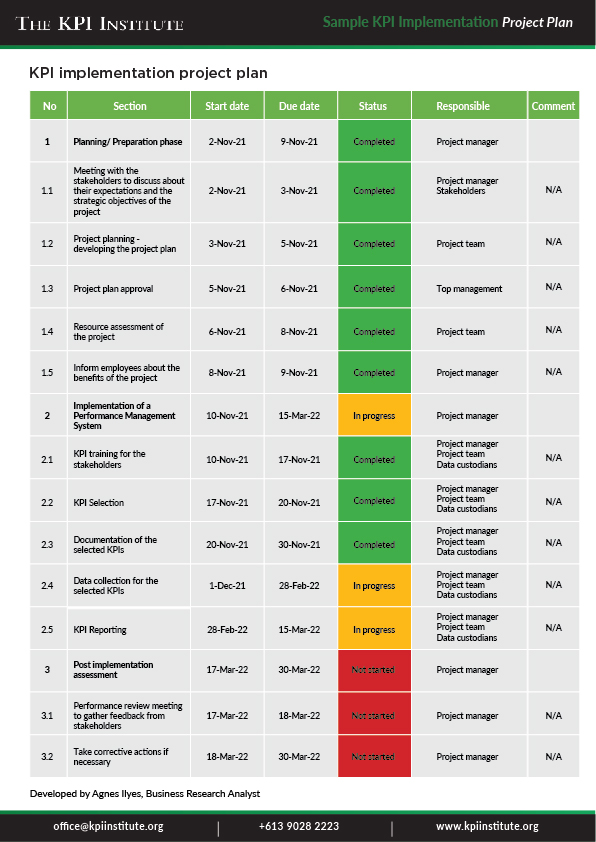
The most common elements of a KPI implementation project plan are key activities, deadline, responsibility, status, and comments.
A KPI implementation project plan must be aligned to the organizational strategy and objectives. Before the implementation starts, a meeting with the stakeholders of the project should be organized to discuss their expectations and make sure that everybody is on the same page. After the plan is developed by the project team incoordination withthe project manager, the resource assessment of the project needs to be created. Then, another meeting withall employees is necessary in order to share the vision and benefits of such a project and delineatethe first tasks to be finalized.
The second phase is the actual implementation of the performance management system. Start with proper training for the stakeholders to establish a common languageand to avoid any misunderstanding. The appropriate KPIs should be selectedin a KPI selection workshop. Then, they should bedocumented using a pre-defined, standardized template. Moreover, the data should be gathered and reported by the data custodians. The report should be presented with good visuals that are easy to interpret. Thiswill help ensure a clear and effective decision-making process.
During the post implementation assessment phase, aperformance review meeting should be conducted to gather feedback from internal stakeholders and analyze the situation and the progress of the result. It is also important to evaluate the possible corrective actions to be addressed in the performance management system.
KPI implementation project plan example:
Conclusion
In order to arrive at the benefits of a well-functioning KPI management system, companies need to understand how to efficiently implement it and to ensure that all employees have a clear picture of the whole system.