A Key Performance Indicator (KPI) is a measurable expression of the achievement of a desired level of results in an area relevant to the evaluated entity’s activity. This is the definition used by The KPI Institute, a global research, training, and consultancy organization with more than 22 years of experience in performance management.
In practical terms, a KPI is a measure used to evaluate progress toward an important organizational, departmental, team, or individual objective. A KPI is not simply any number an organization can track; it is a measure selected for its relevance to a desired result and its usefulness in evaluating and improving performance.
This guide examines:
What makes a measure a KPI and how the concept is defined within The KPI Institute’s performance management framework
How KPIs differ from metrics, measures, Performance Indicators (PIs), and Key Risk Indicators (KRIs)
How KPIs operate at corporate, departmental, team, and individual levels and connect performance to organizational objectives
Why KPIs matter for clarity, focus, improvement, engagement, communication, and organizational learning
The different types of KPIs, including leading and lagging indicators, strategic and operational KPIs, and count, percentage, and monetary measures
How KPIs fit within the Balanced Scorecard and its four perspectives for measuring and managing organizational performance
How to formulate a good KPI, from defining the objective to applying SMART criteria
How the KPI lifecycle works, including the establishment, use, review, and evolution of KPIs
Practical KPI examples by department, covering finance, human resources, sales and marketing, operations, and IT and service management
Common KPI mistakes and the performance management practices that can help organizations avoid them
What Is a Key Performance Indicator (KPI)?
The most cited definition of a KPI comes from The KPI Institute. The Institute defines a KPI as “a measurable expression for the achievement of a desired level of results in an area relevant to the evaluated entity’s activity.”
Break that down and three things stand out. First, a KPI has to be measurable. Second, it points to a desired result, not just an observation. Third, it only counts if it sits in an area that matters to whoever is being measured, whether that’s a company, a department, a team, or a single employee.
A KPI is not a stand-in for “anything you can count.” Website visits, email opens, or the number of meetings held in a week are data points. They only become KPIs once they connect to a specific objective and someone acts on the result. That connection to strategy is what separates a KPI from ordinary business data, and it’s also the single most common thing organizations get wrong.
KPIs Operate at Multiple Levels
A KPI rarely stands alone. It usually sits inside a chain that runs from the boardroom down to a single desk.
Corporate level: KPIs here back strategic alignment and executive decisions. Think $ Revenue Growth or % Market Share.
Departmental level: KPIs guide functional effectiveness inside a single team, such as % On-Time Delivery in operations or % Retention Rate in HR.
Individual level: Personal KPIs connect one person’s work to the bigger goal, such as # Projects De9/3/2026Slivered On Time for a project manager.
When these three levels are built correctly, a frontline employee can trace a straight line from their own KPI to a strategic objective on the board’s scorecard. That line of sight is one of the clearest signs of a mature performance system, and its absence is one of the clearest signs of a broken one.
KPI vs. Metric vs. Measure vs. Indicator
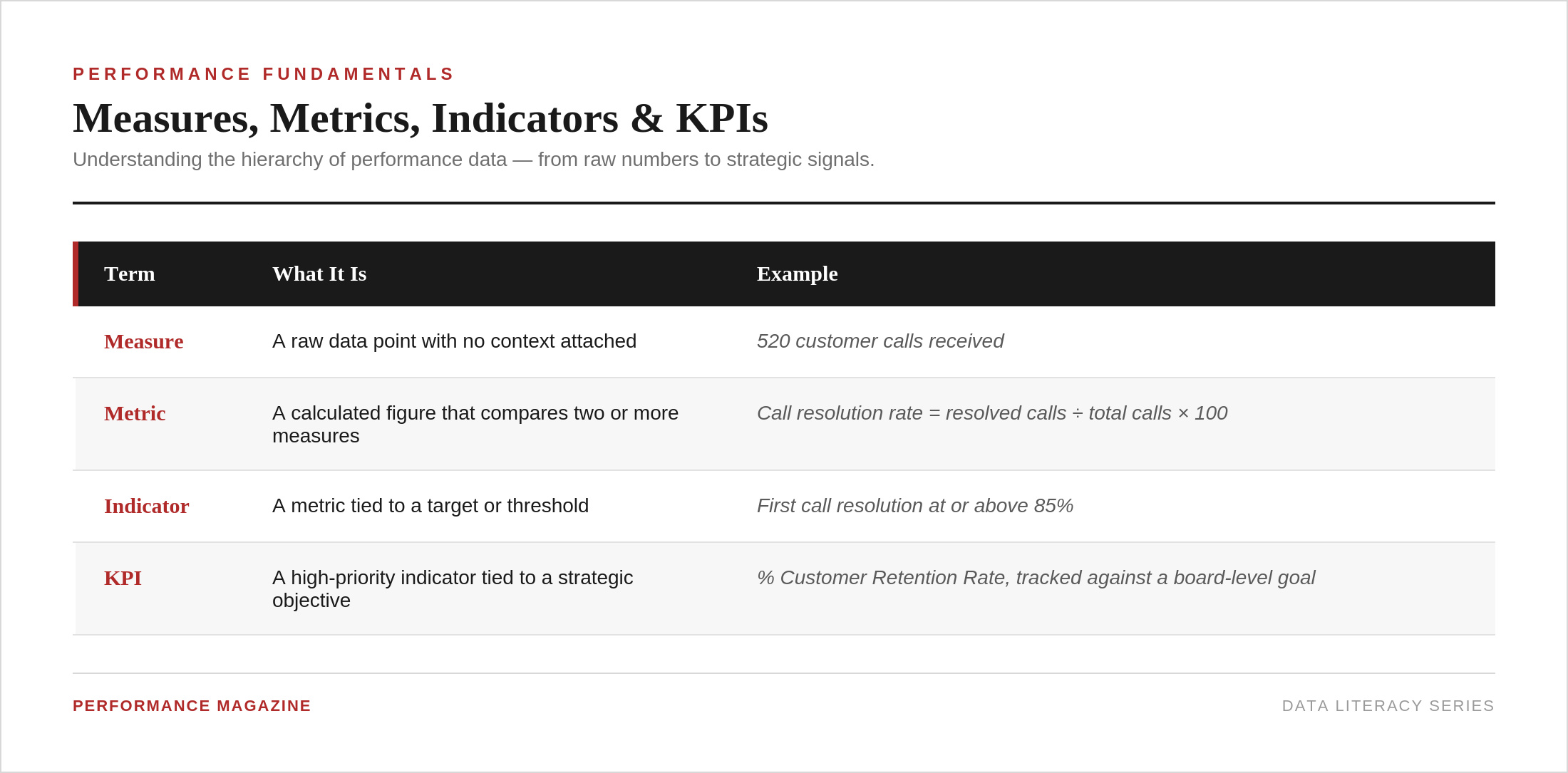
These four words get used as if they mean the same thing. They don’t, and mixing them up is one of the fastest ways to end up with a bloated, confusing dashboard.
Data moves up this chain: from raw measure, to metric, to indicator, to KPI. Most organizations track hundreds of metrics. Very few of those metrics deserve KPI status, because a KPI is reserved for the handful of numbers senior leadership actually uses to make decisions.
Where KRAs, PIs, and KRIs Fit In
The KPI Institute’s Body of Knowledge places KPIs inside a wider hierarchy of performance terms. Getting this right matters for anyone building a scorecard or a reporting structure.
Key Result Area (KRA): A broad domain where an organization has to perform well, such as Customer Experience or Operational Efficiency. A KRA is not measurable on its own; it needs indicators underneath it.
Key Performance Indicator (KPI): A high-priority, strategically significant measure tied to a KRA and reported to senior leadership.
Performance Indicator (PI): A supporting measure, relevant at the team or process level but not critical enough to reach the executive scorecard. Think # Daily Orders Processed rather than % Customer Retention Rate.
Key Risk Indicator (KRI): A forward-looking measure that flags a threat before it damages performance. Where a KPI asks “are we hitting our goals,” a KRI asks “what could stop us.”
Together, these terms form a structure that runs from strategic intent down to the data behind a single report. Companies that skip this structure tend to end up with dashboards full of numbers nobody uses.
Why KPIs Matter
A KPI is worth building only if it changes behavior. The KPI Institute’s research points to six areas where well-designed KPIs pay off.
Clarity. A KPI turns a vague ambition like “get better at customer service” into something concrete, such as % First Call Resolution. Teams stop guessing at what success looks like. Example: a retail chain that tracks $ Sales per Square Foot gets a single number that lines up real estate, merchandising, and store operations around one shared measure of location performance.
Focus. With a small set of KPIs in place, attention goes to what actually drives results instead of spreading across everything that can be counted. Example: a hospital that tracks # Average Patient Wait Time channels staff effort into the specific process fixes that shorten delays.
Improvement. A KPI trending in the wrong direction is a prompt for action, whether that means a root-cause review or a new initiative. Example: a software company watching # Issue Resolution Time climb can launch a code review process before customer satisfaction takes the hit.
Engagement. Employees who can see how their daily work moves a KPI tend to feel more ownership over the outcome than employees who only hear about targets secondhand. Example: a call center agent measured on % First Call Resolution understands their effect on customer loyalty, not just call volume.
Communication. KPIs give departments and executives a common language, which cuts down on the back-and-forth that happens when everyone reports numbers differently. Example: an ESG report built around # CO₂ Emissions per Product tells shareholders and customers a consistent story about environmental performance.
Learning. Over time, KPI trends and benchmarks become a record of what worked and what didn’t, and that record is worth more the longer an organization keeps it. Example: a marketing team reviewing a falling $ Cost per Lead across several campaigns can trace which tactics worked and repeat them.
Types of KPIs
KPIs get classified a few different ways, and it helps to know all three.
By timing. Leading indicators predict future performance (# Sales Pipeline Opportunities). Lagging indicators confirm what already happened (% Net Profit Margin). A balanced scorecard needs both, because leading indicators alone can be unreliable, and lagging indicators alone arrive too late to act on.
By scope. Strategic KPIs sit at the corporate level and matter to the board. Operational KPIs track a specific process or team, often on a weekly or monthly cycle, and roll up into the strategic picture.
By format. The KPI Institute’s naming convention tags every KPI with a symbol that signals what kind of number sits behind it:
# (count): # New Clients, # Incidents Resolved
% (rate or proportion): % Customer Satisfaction, % Employee Turnover
$ (monetary figure): $ Revenue per Employee, $ Cost per Unit
This small convention does a lot of work. Anyone who looks at a dashboard can tell at a glance whether they’re looking at a count, a rate, or a dollar figure, without reading the full label.
The Balanced Scorecard: Where Most KPIs Live
Kaplan and Norton introduced the Balanced Scorecard in a1992 Harvard Business Review article as a way to measure performance beyond financial results alone. It groups KPIs into four perspectives:
Financial: Revenue Growth Rate, Net Profit Margin, Return on Investment
Customer: Customer Satisfaction, Net Promoter Score, Customer Retention Rate
Internal Process: Process Cycle Time, Error Rate, Time to Market
People, Learning & Growth: Employee Engagement Score, Training Hours per Employee, Internal Promotion Rate
By 1996 the same framework had already expanded from measurement into strategy execution. Most modern KPI frameworks, including The KPI Institute’s own, still lean on this four-perspective structure because it forces a company to look past the income statement.
How to Write a Good KPI
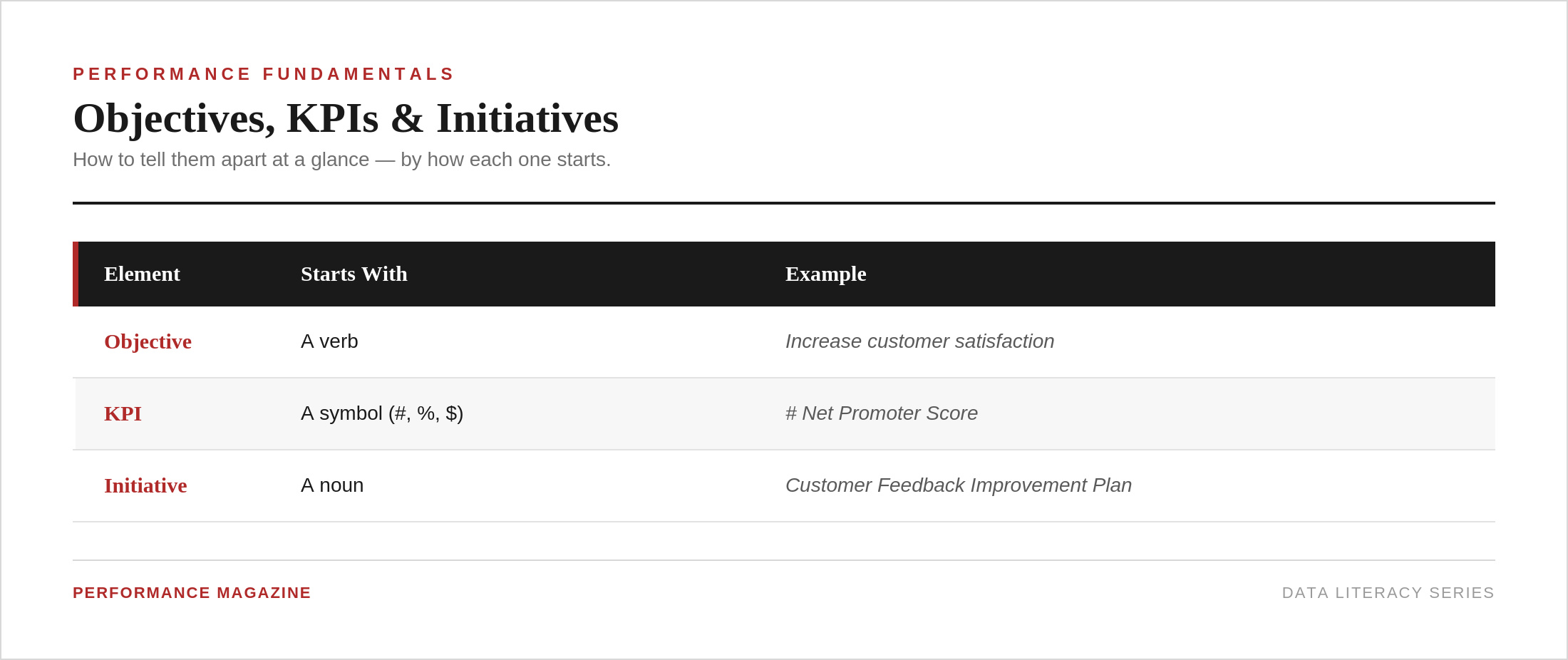
The KPI Institute recommends a consistent naming pattern that keeps objectives, KPIs, and initiatives from blurring together:
Once the objective is set, the KPI itself should meet the SMART test:
Specific: It measures one clear thing, not a vague ambition.
Measurable: The data behind it can be collected consistently.
Achievable: The target is a stretch, not a fantasy.
Relevant: It ties back to a real strategic priority, not a number that’s just easy to pull.
Time-bound: It has a reporting frequency and a deadline attached.
A KPI that fails even one of these tests tends to get ignored within a quarter.
The KPI Lifecycle
KPIs are not set-and-forget. The KPI Institute’s Body of Knowledge describes three stages every KPI moves through:
Establishment. The organization selects the KPI, documents it, and puts data collection in place.
Use. Data flows in on a regular cadence, and the KPI feeds into real decisions and reporting.
Evolution. Over time, a KPI is kept as-is, refreshed to stay relevant, suspended once it stops adding anything useful, or replaced by a more advanced measure. % Customer Satisfaction, for example, is often superseded by # Net Promoter Score as an organization matures.
Many companies skip the evolution stage, and that’s one of the most common mistakes in performance management. Plenty of organizations still track KPIs that made sense five years ago and haven’t been reviewed since.
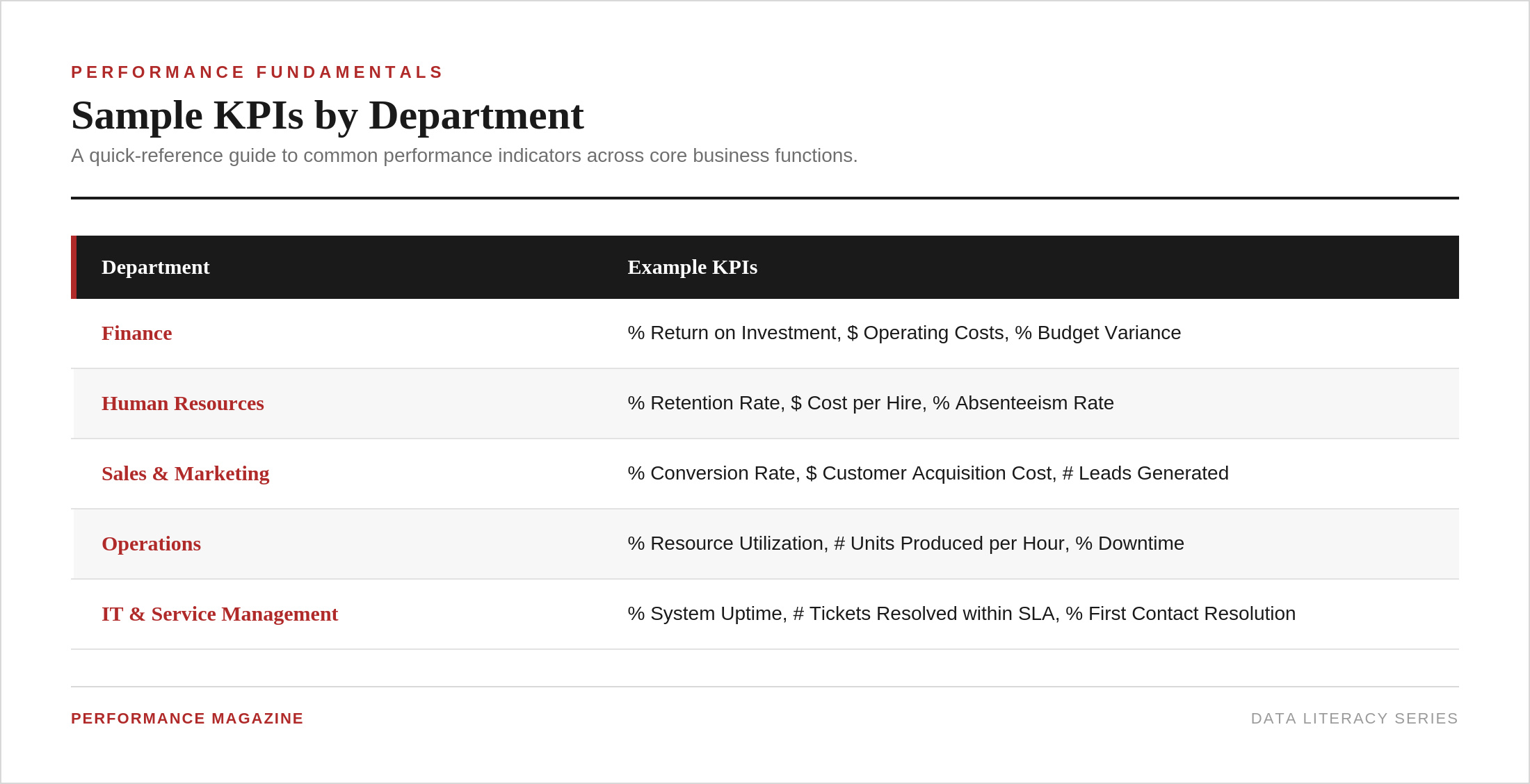
KPI Examples by Department
Most of these work best in combination rather than alone. Tracking # Tasks Completed alongside % Tasks Completed on Time and $ Value Generated per Task gives a fuller read on performance than any single number can.
Performance Measurement vs. Performance Management
These two terms get treated as synonyms, and they shouldn’t be. Neely et al. (1995) define a performance measurement system as a set of metrics used to quantify the efficiency and effectiveness of actions. Forza and Salvador (2000) go further, describing it as an information system that supports two functions: structuring communication around target setting, and collecting, processing, and delivering data on how people, processes, and business units are performing.
Performance measurement deals with the evaluation of results. Performance management deals with what happens next: the decisions, initiatives, and behavior changes built on top of that evaluation. One tracks the score. The other decides what to do about it.
The Balanced Scorecard is a good illustration of how the two ideas merge over time. Kaplan and Norton introduced it as a measurement tool in 1992. By 1996 it had grown into a strategic management system. By 2008 it sat inside a wider system for planning, execution, and organizational learning. A tool built to measure performance turned, over 16 years, into a system built to manage it.
Common KPI Mistakes
A few problems show up in nearly every organization that struggles with KPIs:
Measuring everything. Dashboards that carry 40 metrics dilute attention instead of sharpening it. A KPI list should be short enough that people remember it without looking it up.
Skipping alignment. When department KPIs aren’t linked to corporate objectives, teams end up optimizing for numbers that don’t move the business forward as a whole.
Weak documentation. A KPI without a documented formula, data source, owner, and reporting frequency is open to different interpretations by different people, and that alone can undermine trust in the number.
Stale data. A KPI that shows up weeks after the fact turns into a post-mortem rather than a tool for a live decision.
No data governance. Someone has to own data quality for each KPI, from the source system down to how often it gets refreshed. Without a named data custodian, small errors in a spreadsheet quietly turn into board-level decisions built on bad numbers.
Most of these mistakes trace back to the same root cause: a KPI system built around what’s easy to pull from an existing report, rather than what the organization actually needs to know.
Frequently Asked Questions
What does KPI stand for? KPI stands for Key Performance Indicator: a measurable value linked to a specific strategic or operational objective.
What is the difference between a KPI and a metric? A metric is any calculated figure built from raw data. A KPI is a small subset of metrics selected because it ties directly to a strategic goal and gets used by decision-makers. Every KPI is a metric, but not every metric is a KPI.
How many KPIs should an organization track? There’s no fixed number, but most performance management practitioners recommend keeping the list short, often somewhere between five and fifteen at the corporate level. More than that and the system tends to lose focus.
What makes a good KPI? A good KPI is specific, measurable, tied to a real objective, and something the organization can act on. If a KPI can’t change a decision, it’s not doing its job.
Is revenue a KPI? Revenue can be a KPI if it’s tied to a specific strategic target, such as $ Revenue Growth against a year-end goal. Without a target or an owner, it’s closer to a raw financial metric.
Who is responsible for setting KPIs in an organization? Top management sets the strategic direction and signs off on major KPIs, but the day-to-day design usually sits with a strategy or performance office, and department heads take ownership of the KPIs specific to their teams.
What is the difference between a KPI and a KRI? A KPI tracks progress toward a goal. A Key Risk Indicator (KRI) tracks the likelihood of something going wrong before it happens. Mature performance systems track both side by side.
What is the difference between a leading and a lagging KPI? A leading KPI predicts future performance, such as # Sales Pipeline Opportunities. A lagging KPI confirms a result that already happened, such as % Net Profit Margin. Leading indicators give teams time to act; lagging indicators tell them whether that action worked.
Can a KPI change over time? Yes, and it usually should. The KPI lifecycle covers exactly this: a KPI gets maintained while it’s still relevant, refreshed when its calculation needs adjusting, suspended once it stops adding anything useful, or replaced by a more advanced measure as an organization matures.
What is the difference between a KRA and a KPI? A Key Result Area (KRA) is a broad domain, such as Customer Experience or Financial Performance. It isn’t measurable by itself. A KPI is the specific, quantifiable measure placed underneath a KRA to track progress inside that domain.
Where to Go From Here
For a deeper look at any single part of KPI management, from documentation templates to lifecycle management to industry-specific examples, see:
How Can You Improve the Data Gathering Process for Your KPIs? – “An important component of performance measurement is represented by the data collection capability. However, when applied in the organizational context, this process is neither easy nor lacking obstacles, as practitioners often discover.”
How Can We Ensure Our KPIs Are Aligned With the Strategy? – “In many cases, the key performance indicators (KPIs) monitored do not seem relevant as they are not connected to the strategy. To better understand how this problem can be addressed, we must first identify its possible causes.”
How to Implement a KPI Measurement Framework – “A KPI implementation project plan provides a structure for the implementation of an organization’s performance management system. Once the project plan is set, all types of activities would have a clear deadline and designated responsibilities.”
Project Plan: Developing a Performance Management System Based on KPIs – “When formalizing and implementing a performance management system (PMS) based on key performance indicators (KPIs), there are multiple activities to be considered and many stakeholders to be engaged in the process. Therefore, you’ll need a project plan to make performance management an ongoing process within your organization.”
[Watch] KPI Selection Techniques – “Learn how KPI selection techniques can be implemented in practice and gain insights into the best practices for selecting KPIs.”
Advice on KPI Selection – “KPI selection is a process which seems simple, yet is inherently complex, due to the interdependencies involved. Here are 15 things to consider before embarking on this journey.”
[Watch] Overcoming KPI Selection Challenges: Applying KPI Selection Techniques – “What are the most important guidelines to follow when selecting KPIs for strategic objectives? What are the most efficient KPI Selection techniques, most recommended KPI selection environments, and some Value Flow Analysis technique examples?”
KPIs are not just about understanding and working with numbers. Using KPIs requires stakeholders to fulfill a vision and commit to ensuring success across all levels of their organization. If you would like to learn how to select the right KPIs for your organization, sign up for The KPI Institute’s Certified KPI Professional and Practitioner live online course today.
*********
Editor’s Note: This guide draws on The KPI Institute’s more than 20 years of research, expertise, and practical experience in performance management. Its core definitions, terminology, and frameworks are grounded in the Institute’s forthcoming KPI Body of Knowledge, developed under the leadership of Marcela Presecan, Head of Research at The KPI Institute.
“The greatest danger in performance measurement is not seeing too little, but believing you’ve finally seen everything.”
Nine KPI Lessons, One Underlying Problem
Throughout this series, we have explored what might seem like nine separate problems with measuring performance. Each article examined a different symptom, manifestation, paradox, or unexpected consequence of using KPIs to understand a complex organization. Viewed on their own, these issues seemed only loosely related. When viewed collectively, however, they tell a surprisingly coherent story.
Our journey began with the KPI Theatre, where we observed how the act of measurement changes behaviour. Once individuals know they are being observed, they instinctively begin to focus on what is visible. This is not necessarily because they are engaged in manipulation or deceit, but simply because human attention is finite and people attend to that which attracts attention. Slowly, performance shifts from being good to looking good.
Then, we examined Goodhart’s Law to see what happens when that observation becomes a target.
What began as a useful indicator of performance becomes, over time, the objective itself. People stop asking whether the organization is serving its purpose and start asking if the numbers look OK. The simple act of optimizing has quietly replaced the process of understanding.
It would seem natural that if one metric blinds you, then two will be better, but that then begets something called KPI Saturation – when everything, every function, every initiative, every strategic priority, and every operational process is represented on a dashboard.
Everything becomes so overwhelming that we are blinded by what is actually present.
Information overload has given way to attention scarcity, and when attention becomes a scarce organizational resource, metrics themselves become valuable. In The Politics of KPIs, we examined how indicators gradually evolve beyond measurement tools into instruments of influence. As dashboards grow more central to an organization’s decision-making, knowledge that is difficult to reduce to a number becomes marginalized and increasingly ignored.
Institutional knowledge, relationships, craftsmanship, intuition, judgment, and the trust required for collaboration – all fall off the strategic radar as information that cannot be easily expressed in numerical terms disappears from the conversation, as was illustrated by KPI Memory Loss.
Organizations do not necessarily fail because they lack information. Rather, they fail because certain forms of knowledge no longer receive attention, or, even worse, are actively dismissed by those who treat them as irrelevant data points. The effects of these trends, however, do not remain confined to the organization itself. The final issues that we uncovered in this series impacted the very people who were employed to deliver on those numbers.
In the KPI Identity Trap, we witnessed how those being measured can become so completely identified with the metrics by which they are assessed that they forget to ask whether they are doing worthwhile work and simply focus on what the dashboard or scorecard shows. It could be seen that the last, and perhaps most fundamental point in this series – KPI Blind Spots – is almost a natural consequence. At best, a dashboard tells us something about the reality of our situation and, at worst, it tells us an unintentional lie.
Yet the lie is never told; it simply emanates from what is left unsaid: the part of reality deliberately omitted to focus on what is believed to be most important.
Realistically, none of these were separate problems at all: behaviour, targets, information overload, politics, organizational memory, personal identity, blind spots. These are not independent phenomena, but simply different facets of the same flawed logic. A logic that proceeds on the basis that reality, as it is currently expressed in KPIs, continues to surprise us only because we have not yet measured enough.
This is what can be called the Completeness Fallacy, perhaps the most insidious belief underpinning modern performance measurement – the belief that performance (and measurement) can eventually be made complete.
Why Every Surprise Seems to Demand Another KPI
These are scenes every seasoned executive has lived out.
An unforeseen event derails a critical business process.
A major customer segment starts leaving faster than anticipated.
A manufacturing defect escapes quality control.
A major project comes in late even though all milestone flags are green.
A cyber attack bypasses the security systems that should have prevented it.
A high-performing, tenured employee quits with little notice.
The post-mortem begins, with executives staring at dashboards and data visualizations, trying to pinpoint where the red flags should have popped up and when someone should have noticed that something was going terribly wrong.
One question invariably surfaces: “Didn’t we have a KPI for this?”
Sometimes the answer is yes, and it was simply ignored. Most of the time, more frequently than many organizations are comfortable admitting, the answer is no. Thus, the logical conclusion seems obvious.
“Let’s add one.”
On its face, this is completely reasonable. Every failure is an opportunity to refine the measurement system. If an important early warning was missing, then the dashboard should be augmented to track it. It often is the right solution, truth be told.
The danger emerges when adding a new KPI becomes the default response to unexpected events, because the next time the unexpected happens (and it always does), another KPI is added. Then another and another.
The dashboards get bigger, the reports get longer, the task manager bloats, and the analytical tools become more sophisticated. Still, unexpected events persist doggedly. Each surprise seems to reinforce the idea that something else must still be missing, driving the organization toward the impossible goal of complete measurement.
This is what can be called the Completeness Fallacy.
The Completeness Fallacy is the mistaken belief that all organizational surprises stem from missing dashboard metrics and that simply adding enough KPIs will eliminate uncertainty entirely.
Complex organizations aren’t like simple machines, made of gears & cogs. They are living, breathing systems made up of people, incentives, cultures, relationships, informal networks, dynamic markets, shifting customer expectations, evolving technologies, and countless interactions that cannot be fully predicted.
Every solution creates its very own new problems. Every intervention changes the system it attempts to measure. Having a complete representation of all possible futures is impossible. Ironically, as organizations pursue completeness, they move further away from true understanding because the question asked subtly changes.
We stop asking:
“What have we misunderstood?”
Instead, we start asking:
“What KPI are we missing?”
These two questions sound similar, but there is a profound difference. The first question is about understanding and assuming that the reality of the situation is more nuanced than the dashboard’s representation. The second question focuses on measurement and suggests that the dashboard just needs an additional piece.
The Endless Expansion of the Dashboard
Think about a dashboard that includes 50 carefully chosen KPIs. A few weeks pass, and then a completely unanticipated problem arises that those 50 KPIs couldn’t have foretold.
“We need to add one more KPI!” – Leadership.
The dashboard grows to 51 KPIs. A few months later, an even greater shock arises. A new KPI is added. The dashboard now has 60. Soon 80. Then 100. Eventually, someone gets tired and asks, “If we have 100+ KPIs on our dashboard, how did this still catch us out?“
It’s a strange psychological paradox at work here.
On the one hand, leaders think “everything that is important must be on the dashboard.”
On the other hand, when something isn’t on the dashboard, it is, at least initially, discounted precisely because it is unmeasured.
Whenever reality disappoints, we try to achieve completeness by expanding the dashboard. As the dashboard grows, our confidence in it grows. That, in turn, makes the next surprise that happens all the more baffling. People begin to wonder in dismay how all of this can be happening, since they are measuring everything.
Except they are not. They never can and will never be able to. No dashboard can perfectly mirror reality; reality is always larger than its reflection.
The danger isn’t what dashboards leave out; the danger is that we forget what they have to leave out.
Babies & Video Games: Why More Doesn’t Always Mean Better
The Puzzling Perplexity of Predicting Progeny
The experience of dealing with babies is a universal (if not always enjoyable) one. Say your baby – a perfectly healthy baby, no less – is inconsolable, though not crying as a result of any obvious issue. They have been fed, cleaned, kept comfortable, and healthy, so why do the tears persist?
You hand the child a colorful toy, and for a brief moment, the wailing subsides before resurfacing with renewed vigor.
“Maybe the problem is simply that we don’t have the right toy!” and so you rush out and acquire one, only to have it achieve the same limited result. You then acquire another that sings, and another that flashes. The child continues to cry, and your resolve is steadfast: there has to be one “right” toy out there to soothe their little agitated spirits!
This process seems almost logical, and the conclusion (that another toy is just around the corner) feels almost automatic. After all, if there were a truly suitable toy, the baby would just stop crying. Right? RIGHT?
This assumption misses a crucial detail: the baby wasn’t looking for another toy at all. Maybe they simply wanted to be held, or was bored lying in one position for too long, or maybe they wanted someone to talk to them, or just to feel the comfort of their parents’ closeness. The parents didn’t need a better toy; they needed to understand the baby.
In the course of our lives, we will all learn an invaluable lesson. Sometimes the quickest, easiest path to resolution doesn’t lie in introducing a new component or finding a missing element, but in paying more attention to the subject of our concern.
Organizations are remarkably similar. Organizations often take a very different, and rather analogous, approach. Every unforeseen problem requires a new key performance indicator (KPI); every anomaly requires a new dashboard; every overlooked blind spot demands a new metric.
It’s quite possible that the problem isn’t that another metric is needed. It might be that the organization needs to better understand what it is trying to achieve in the first place. Instead of reading reports, managers might need to speak with their employees more often. Instead of filling out surveys, customers might want to talk to real humans to air their frustrations.
For example, to understand a problem in production, supervisors should walk the factory floor rather than stare at a production-tracking dashboard. While the dashboard asks, “What else can we measure?” reality is asking, “Have you truly understood me?” That distinction is at the heart of the Completeness Fallacy.
The Curious Compulsion to Continue
It plays out just as clearly in an area where organizational management can’t possibly be expected to surface: video games.
Any person who plays role-playing games or massively multiplayer online games knows that optimization quickly becomes a way of life if left unchecked. Let’s assume you load one up, make a character, and it just isn’t putting out the damage-per-second (DPS) that you were aiming for.
The logical first step, you assume, is to get a DPS meter, take some measurements, and look for the source of the deficit.
The meter tells you that you’re falling short of the damage output of everyone else on your team. You now have an answer to your problem. Or do you?
Upon inspecting your equipment, you notice that some items are suboptimal, so you immediately replace them with better ones.
You head back into the game’s content, only to see a minuscule difference in your damage output. There must be some other missing factor, something else you did not account for yet again.
You realize your equipment isn’t enchanted, and so you spend hours painstakingly applying the most potent enchantments possible.
The result is still marginal. You now invest in better gems, talent points, food buffs, consumable potions, and specialization changes. Eventually, you end up with half your screen clogged by meters tracking DPS, timers, combat logs, raid frames, cooldowns, boss warnings, and who knows what else. Still, your character’s damage output does not noticeably improve.
Add-ons are useful, but the most obvious limiting factors, such as positioning, decision-making ability, encounter awareness, or knowing when not to attack, cannot be directly measured by another number or add-on. These qualities must be learned through trial and error and by recognizing patterns. However, the more information cluttering your screen, the easier it becomes to miss the giant boss looming directly in front of you.
The Misguided Mission to Measure More
Organizations can find themselves facing this type of music in exactly the same way. The dashboards continue to grow, the reports become more elaborate, the metrics increase, and the alerts pile up, giving executives an enormous volume of information to analyze.
In practice, the actual amount of real-world understanding often advances at a far slower pace because it becomes so easy to confuse the process of measurement with actual understanding:
You can measure customer satisfaction and learn that it’s trending downwards. However, you can’t measure the sound of disappointment in a customer’s voice on a support call.
You can check a productivity dashboard, which will tell you that the project velocity has decreased, but it won’t reveal the engineer who’s afraid to challenge a deadline they know is unrealistic.
You can monitor employee morale via an engagement survey, but that can’t capture the quiet moment in the hallway, months ago, when confidence eroded just a little bit more.
You can assess sales conversion rates and identify where prospects drop off, but you can’t measure the trust that was lost in a single rushed conversation.
Wisdom doesn’t grow automatically simply from an increasing quantity of observations. Wisdom is built through an interpretation of those observations within the human context in which they occurred.
This is the true danger of the Completeness Fallacy: it persuades leaders to believe that the missing piece of the puzzle is simply another data point, and that there is never a need to stop looking at data and start listening to their people.
From Hospitals to Software: How Industries Share the Completeness Fallacy
The form in which the Completeness Fallacy shows up may vary significantly between industries, but the core principle doesn’t: whenever the world spits out an answer that surprises us, we start hunting around for some new measure, instead of asking a question: “Are we perhaps measuring the wrong thing to begin with?“
Healthcare: Measuring Patients While Missing Care
Modern hospitals amass vast quantities of data: Patient wait times, Bed capacity, Readmission rates, Length of stay, Medication adherence, ED wait times, Length of procedure, and Infection rates, among many others.
They’re all crucial metrics, but none of them fully explains why some patients with similar clinical profiles take weeks to recover while others take days. Many of the things that drive outcomes – whether the patient actually grasps what the doctor just said, has someone to nudge them about medications, or simply trusts their physician with what’s bugging them – are tough to fit into a standard spreadsheet.
We see a bad readmission outcome and naturally reach for a new quality measure. Sometimes that makes sense, but more often than not, we need to make sure the conversation was handled properly, not simply as a way to create another quality benchmark.
Manufacturing: Perfect Machines, Imperfect Systems
Manufacturing organizations usually have extremely detailed operational dashboards: Machine usage, Cycle time, Defect rates, Overall Equipment Effectiveness (OEE), Scrap rates, Downtime, or Energy usage, to name just a few.
When product quality drops inexplicably, the first reflex is often to monitor it even more closely. Very often, the mentality is “time to add another production KPI and slot in another quality check.”
Yet, investigations often find that technical issues are not at the heart of the matter; rather, the heart itself is gone.
Production targets subtly discourage the workforce from signaling minor deviations until they become significant ones.
None of these had anything to do with a lack of data regarding the machinery – these were all human systems impacting technical ones. What was needed wasn’t more sensors but a better understanding of those humans operating them.
Software Development: Measuring Productivity Without Seeing Complexity
Software teams today arguably measure more things than any team has before: Sprint velocity, Story points completed, Lead time, Cycle time, Deployment frequency, PR approvals, Bug counts, Code coverage, or Incident response time.
When the wheels are slowing unexpectedly, leadership frequently adds a new metric for engineering teams to work with.
“Maybe we need more code!”
“Maybe the reviews are taking too long!”
“Maybe the deployments aren’t happening often enough!”
Maybe the real problem might be that a legacy architecture is now extremely difficult to maintain. The team has quietly accumulated technical debt over the years and is now spending much more time understanding systems than developing features, and on top of that, cross-functional communication has broken down.
The biggest thing stopping the team from shipping may not be an absent KPI, but decades of accrued complexity that only a truly seasoned engineer can even see. Such nuance cannot be encapsulated in a dashboard.
Aviation and High-Reliability Organizations: When Safety Lives Between the Metrics
Few industries are more serious about measurement than aviation. Aircraft systems generate vast amounts of operating data, which are measured and remeasured with exceptional rigor.
Flight schedules are closely monitored.
Safety incidents are rigorously documented.
Procedures are formalized.
Performance is routinely assessed.
Nevertheless, aviation professionals know a secret that few leaders recognize: if no safety event has occurred, it doesn’t mean that safety is present.
The organization could show perfectly good safety performance on its metrics, while easily and effectively hiding its own psychological limitations regarding the issue from itself. Pilots may be unwilling to speak about hazards. Maintenance crews might be reluctant to acknowledge near-miss events because they might feel embarrassed or appear incompetent. A Junior team member might have no idea how the process could be made safe and would have no incentive to raise such concerns.
The overall safety indicators might be beautifully and blissfully green right up to the day of a disaster. When such a disaster occurs, the investigators rarely attribute the failure to a single additional KPI or a particular missing index or tool. Instead, they generally attribute the disaster to communication failures or human errors that may have predated the measurement systems.
The organization didn’t lack yet another metric – it lacked a deeper understanding of the system it thought it had measured.
In all 4 of the industries we’ve showcased, the situation repeated itself:
Disasters occurred
Organizations assumed they must be missing a metric
The metrics were expanded
They were surprised again and again
Such scenarios don’t happen because leaders lack the intelligence to be able to design and implement appropriate measurements, but because no complex system, as a matter of principle, can ever be as large as its own representations of itself. No dashboard can become the entity being measured.
When organizations reach that stage, they focus so intently on measurement devices that they neglect the journey and miss where they are going.
Final Thoughts
Looking Through the Windshield Instead of at the Dashboard
Never before has there been so much readily accessible operational information available. Never before has there been a way to see performance across continents in real-time, spot emerging trends within minutes, or turn vast amounts of raw data into simple, intuitive pictures. Organizations have become faster, more coordinated, better informed, and ultimately, more agile.
Problems arise only when dashboards stop being tools for understanding and start becoming substitutes for it. This is, ultimately, what’s dubbed the Completeness Fallacy.
It has nothing to do with whether KPIs are useful or useless, or whether measurement systems need upkeep or not. Rather, it is the false belief that uncertainty can eventually be engineered out of the organization by judiciously selecting enough indicators.
In modern-day organizations, every KPI answers one question but begs another. Every bit of extra visibility alters behaviour, thereby changing what the measurement actually means. Performance measurement isn’t a race towards a state of completeness. It’s a never-ending conversation between what can be measured and what requires only observation, judgment, curiosity, and experience.
Dashboards are the thing that should inform a conversation, never replace it. Think of them as a car windshield. It has never been designed to capture every detail of the road ahead. It won’t reveal what is hiding behind every building, nor will it show every hidden pitfall lurking around the bend. Its purpose is to provide just enough visibility to help us navigate while, at the same time, reminding us that the road itself deserves our attention.
Modern performance dashboards have precisely the same role. They are not the organization, but the windows through which we may view organizations in a richer, more dynamic manner than any collection of KPIs can adequately convey.
If we start to look at the windshield instead of through it, we are liable to lose sight of where we are going, and that may well be the most profound irony of modern performance management:
We have never measured more, and with better tools. At the same time, we have never depended more on the interpretation, conversation, experience, and context provided by the people powering the soul of our workplaces.
*********
Looking to strengthen your expertise in KPI design and performance measurement? Gain practical knowledge, proven methodologies, and globally recognized certification through The KPI Institute’s Online Certified KPI Professional.
A flashlight has a most mundane but curious property: the moment you flip the switch, the room becomes both brighter and darker. Wherever the light beam hits, details are rendered in sharp focus, and objects you hadn’t realized were there become clearly visible. At the same time, the opposite occurs everywhere: the rest of the room not illuminated by the flashlight beam falls into deeper shadow. The darkness is not a flaw of the flashlight; it is a necessary trade-off for the light it produces. The same is true of performance measurement. Each KPI illuminates one dimension of a company’s operations, whether that be revenue growth, customer satisfaction, employee productivity, inventory costs, or operational efficiency. KPIs make it easier for executives to understand, analyze, and (one hopes) improve organizations, converting complexity into data points that facilitate decisions, rather than gut feeling or anecdote alone. For decades, the standard solution has been the same: if one KPI helps uncover something important, perhaps 10 KPIs can provide a better understanding, and 100 can illuminate everything clearly. That’s the rationale behind the modern dashboard: displays of gauges and graphs, crammed with performance indicators, accompanied by meetings to debate the resulting data, all aimed at dispelling ambiguity.
For all intents and purposes, this is a completely reasonable yet equally impossible aspiration. That may sound startling given how much more access we have to data than ever before. We store it on massive servers at minimal cost. We use sophisticated analytics and AI to glean insights from terabytes of information. It seems that if we just gather enough data and track enough metrics, we should eventually be able to eliminate the shadows completely, but we never do. This isn’t because organizations aren’t diligent, or their dashboards are poorly designed, or due to management failing to pick the right KPIs. It is because measurement always has its limitations. The first step in any measurement is deciding what we want to measure, a step often so mundane that it slips below notice.
Someone first decided that customer retention was a worthwhile thing to track.
Someone first determined that employee productivity could be represented and measured in an operational way.
Someone decided to define and track inventory turnover.
While individually unremarkable, these choices coalesce to determine how an organization understands itself, and this is where a conversation about management science turns toward a more ancient philosophical inquiry: is it possible to represent all aspects of reality? As the history of thought suggests, the answer is no. All representations of something omit something from it. Every descriptive attempt leaves something else out. A given perspective must, by its very essence, exclude other perspectives. The limitation of KPIs is not that they don’t capture enough, but that they cannot capture everything simultaneously…and maybe they shouldn’t. Imagine that a cartographer were asked to draw a complete map of a country, including every road, every river, every building, every tree, every shifting cloud, and every stone on its surface. If the map were rendered with perfect accuracy down to the atomic level, it would no longer function as a map – it would be indistinguishable from the country itself. In that case, its utility would depend entirely on what it had omitted.
The Argentine author Jorge Luis Borges nailed this with his short tale “On Exactitude in Science.” The empire there had grown so hung up on perfection that the imperial cartographers had produced a map so detailed and at precisely the same scale that it mirrored the entire empire. This was an incredible (and utterly useless) feat of accuracy.
A map as large as reality provides nothing useful because it has forfeited the very abstraction that made maps useful.
Organizations seem to be striving toward the same ambition when they set out to create dashboards. Each new initiative seems to yield yet another metric. Each new blind spot feels solvable if we can just add one more indicator. Along the way, however, we realize that the dashboard has ceased to represent reality by abstracting from it and has begun to become reality itself by trying to represent every aspect of it.
Rather than helping us understand the world by reducing its complexity to a set of meaningful patterns, the dashboard simply introduces its own brand of complexity. It becomes another source competing for our attention, rather than helping to direct it. The ultimate irony, of course, is that by attempting to eliminate uncertainty, we’ve somehow succeeded in regenerating it.
Therein lies the discomfort. Performance measurement has never been about completeness. It has always been about selection. The pertinent question isn’t whether or not our dashboards contain blind spots. They always will – that is a foregone conclusion. The truly germane question is this:
On which blind spots have we collectively and knowingly chosen to focus, and what price does this quietly cost us?
Every Map Leaves Something Out
Abstraction is the very reason measurement exists.
1933: a philosopher and scientist named Alfred Korzybski made a statement that has endured as one of the most profound observations about the nature of human knowledge: “The map is not the territory.” Maps work precisely because they are incomplete.
A road map omits soil conditions.
A geological map omits speed limits.
A weather map omits property boundaries.
A subway map omits actual geographic distances.
A political map omits mountains and rivers.
None of these maps is wrong per se; they simply emphasize certain features by ignoring others. In other words, every map imposes an opportunity cost.
By helping you see one thing more clearly, it forces you, however temporarily, to stop looking at countless others. The same subtle truth underpins every single KPI we have ever created.
Imagine a manufacturing plant decides to elevate production speed to the top of its list of indicators. Almost immediately, the company begins to view itself through that lens. Conversations about throughput take center stage, and managers trumpet short cycle times. None of that is necessarily bad in itself, but the problem lies elsewhere. As the spotlight shines brighter on the speed-of-production-indicator, other valuable activities start to fall into the shadows. Craftsmanship becomes hard to recognize because it never moves at maximum velocity.
Careful experimentation with new processes is slowed by the urgency to produce.
Mentoring inexperienced workers becomes harder to justify because it doesn’t contribute directly to immediate output.
Knowledge sharing is quietly abandoned because documenting lessons learned doesn’t increase this month’s production figures.
Preventive maintenance suddenly feels like a costly delay rather than a wise investment.
None of those things become any less valuable; they just become less visible, and that is a critical distinction.
Organizations don’t typically abandon what matters because they consciously decide they don’t care about it. More often, they abandon it because attention shifts. Like a river changing its course, attention reinforces whichever pathway it flows through, gradually starving its adjacent tributaries of life. Every KPI generates the current:
Measure costs mercilessly, and resilience is slowly yielding ground to pure efficiency.
Measure speed aggressively, and craftsmanship begins to politely negotiate for a little bit of air to breathe.
Measure customer acquisition relentlessly, and customer loyalty quietly slips into the background.
Measure individual performance exclusively, and collaboration starts competing for recognition.
Measure short-term results obsessively, and long-term capability becomes an investment nobody feels they can afford.
Measure productivity and some amount of creativity has become the opportunity cost.
These aren’t implementation problems but a natural consequence of choosing one map over another. No organization, however sophisticated, escapes this inherent trade-off. The only question is whether it acknowledges it.
To believe otherwise is to believe that light can exist without shadow, or a river can flow down all of its tributaries simultaneously. Neither is possible regardless of how much wishful thinking we may engage in.
Self-reflection: What parts of your organization exist only because they were left off the map? What have your dashboards quietly trained you to stop seeing?
The Things We Know but Cannot Measure
A lot of an organization’s most significant strengths never make their way into a spreadsheet or a performance dashboard. That doesn’t mean they’re worthless. It simply means they’re unquantifiable.
There was once an old tale about a master luthier. Years ago, his apprentice learned how to master every single measurable aspect of the luthier’s art. They learned the ideal wood thickness, neck angle, and sound box dimensions. They learned precise moisture levels for every species of wood. They learned about ratios honed by centuries of master violin makers.
One afternoon, after completing their masterpiece, a violin so technically perfect that it was a work of art, the apprentice presented it to the master. The old craftsman peered at the instrument, ran his hand over its smooth, polished surface, and asked the apprentice one simple question: “Did you listen to the wood?” The apprentice stared at him, confused. He’d measured everything to a T, but he’d never thought to listen. “What does it even mean to listen to wood?”
The story may be apocryphal, but the phenomenon it describes is undeniably real. There’s a form of knowledge that cannot be expressed in mathematical equations or codified in best practices manuals. However, we can recognize it immediately when we see it, though we have difficulty pinpointing its nature.
The experienced doctor whose intuition alerts them to a problem that’s not yet showing up on the medical monitors.
The teacher who somehow senses that a perfectly attentive student with straight A’s is secretly struggling.
The firefighter who somehow knows when a building’s imminent collapse.
The negotiator who intuitively understands when utter silence will be more effective than a persuasive argument.
Ask any of these individuals how they knew, and you’re likely to get equally unsatisfying answers: “It just didn’t feel right.” / “Something was off.” / “You get a feel for it.“
From the perspective of someone seeking concrete data, these explanations can feel maddeningly elusive. Nevertheless, organizations implicitly rely on such judgment calls all day long.
For example, most of Michael Polanyi’s thought process was organized around that observation. He had the famous concept, “We know more than we can tell,” as a challenge to the notion that any valid knowledge eventually would be captured, measured, standardized, and written down. Some knowledge can easily live in a spreadsheet, yet other knowledge lives in people. They accumulate it from experience and mistakes, from gut feeling and intuition, and the kind of pattern recognition and observation which is rarely explicit enough to measure, which Polanyi referred to as tacit knowledge.
Maybe one of the best illustrations comes from something as simple as bicycle riding.
All but the most clumsy can ride a bike, hardly thinking, balancing, managing pressure and momentum, timing the minute variations in the bars, and coordinating muscles all at once. Now try asking someone to describe every single detail needed to balance, and you get a clear sense of just how much their knowledge lies beyond their words.
Knowing how differs from knowing about.Organizations have vast storehouses of this tacit knowledge:
The repair specialist who can listen to a car engine and sense what needs repair down the line.
The customer service rep who detects someone’s incipient dissatisfaction long before the complaint is lodged.
The project leader who picks up on tensions in a team meeting long before the employees are even conscious of it, or the survey forms do.
The production supervisor who notices a subtle change in a machine’s rhythm before any sensor or maintenance report flags an issue.
The sales manager who recognizes that a long-standing client is preparing to leave, not because of declining revenue, but because of a slight shift in tone during routine conversations.
All those things, those pieces of organizational know-how, don’t fit into a nicely curated dashboard, but that doesn’t make them less true. Unfortunately, just because they don’t fit, that can be an excuse to ignore them, since what can be measured tends to take precedence over what cannot.
It is here that another philosopher enters the picture, not to tell anyone how to run a meeting, but because he wrote so clearly about human thought: Nobel laureate and psychologist Daniel Kahneman, who coined the acronym:
WYSIATI –“What You See Is All There Is.”
His point was simple: human beings naturally construct stories based on the information available to them in the moment. We seldom consider what’s missing. This makes our lives easier in countless day-to-day decisions. Within organizations, it quietly sculpts our culture.
Imagine two leadership meetings.
The first features executives spending an hour analyzing revenue trends, customer acquisition costs, production efficiency, and employee utilization.
All the charts are ready. All the numbers are current.
The second meeting begins with a question that causes a flicker of discomfort: “How much institutional knowledge have we lost this year?”
Now, everyone is hushed, almost deathly silent. This is not because the question is irrelevant, but because no one has a chart tracking decades of experience retiring with long-time employees. No dashboard shows the slow erosion of mentorship. No KPI reports on the silent confidence a junior engineer accumulates watching a senior colleague solve tough problems over half a decade. Thus, the conversation inevitably circles back to the numbers, not necessarily because they are more important, but because they are present.
This is the subtle peril Kahneman described. Visibility masquerades as importance so powerfully that the longer a metric appears on a dashboard, the more likely we are to assume it deserves our attention. Soon enough, the organization behaves as though the measurable world is indistinguishable from the genuinely important world. Hardly. We don’t see trust appear on a dashboard. Nor does curiosity, judgment, wisdom, humility, psychological safety, institutional memory, craftsmanship, talent, or brilliance.
These qualities do not diminish in value because they defy quantification; they simply attract less attention, and attention (arguably more than money or time) is an organization’s most scarce resource. Consider the origin of a great river. Initially, it has countless tributaries – some narrow and tortuous, others wide and majestic. It cannot flow down all of them simultaneously, and once it commits to one path, the others quickly recede. Attention works the same way.
Every meeting agenda, every dashboard, every quarterly objective, every KPI selects one path for the organization’s energy and focus, while the rest begin to fade into the background. This is the opportunity cost of our dashboards, which we seldom discuss. When leaders choose to measure productivity, they aren’t simply choosing to observe productivity; they’re choosing to commit meetings, incentives, conversations, budgets, promotions, and intellectual energy to it.
Something else will inevitably receive less attention: maybe it’s creativity, mentoring, experimentation, or reflection. What is certain is they won’t vanish overnight, but, like an abandoned riverbed, they’ll receive a little less water each season until we eventually wonder what happened to the current. Organizations often assume culture changes because people change. In fact, culture sometimes changes simply because attention changes. The dashboard didn’t tell employees to stop mentoring one another; it simply stopped reminding them to do so. This is the quiet paradox of measurement: not that it tells us what to value, but that it gently nudges us to value what it tells us.
It is perhaps why the most enduring qualities within an organization often remain nearly invisible: the quiet conversations after meetings end, the intuitive grasp that builds over decades, the acts of kindness that, while never appearing on a quarterly report, fundamentally shape the workplace over many years.
No dashboard will ever fully capture them, and maybe it is for the better that none should ever try. After all, the purpose of a map is not to be the territory itself, but to guide our journey through it, without allowing us to forget that the territory is always infinitely richer than the paper upon which it has been sketched. Self-reflection: If your dashboard vanished tomorrow, what knowledge within your organization would still be accessible? What invaluable capabilities might have quietly receded, not for want of value, but for want of attention?
When Measuring Changes Reality
As soon as a metric becomes important, people will start to restructure their lives and their behaviour around it, and, in doing so, the organization has quietly transformed into something new.
Imagine you take a walk through a forest and carry a compass. When you are in wild country, confused as to which way to proceed, it gives you absolute assurance.
It consistently points north regardless of which direction any of the trees are oriented, and no matter how uniform all the trees look. Despite all of this, the compass does not tell you about cliffs. It says absolutely nothing to you about riverbanks or unstable ground, about poison berries or an oncoming storm. It performs perfectly for the set purpose, and it says nothing to you at all about most of the rest of the landscape.
We know that this instrument exists for the sake of asking one particular question, and not for the asking of all these questions. The problem arises when we start treating an instrument as the territory itself. It is on this basis, among others, that KPIs may have gotten themselves into trouble.
When they are first instituted, they do not, at the start, look so obviously bad as things become. What they are expected to do is help people find the way: help us see where things stand, where we are with regard to the world around us. Over time, however, they morph into something rather different.
Instead of helping people make sense of the world, they actually start to shape and create it.
What people ask no longer comes out as: “How can I do something that will help me add value over the longer term?” Instead, people begin to ask: “How can I do something to make the number for this month better?” That is not a good change at all, and neither is its effect.
This is a thought that spills over beyond the confines of business and out to the philosophers again.
German philosopher Martin Heidegger argues that technology does more than simply provide us with tools to perform useful tasks. Technology can also fundamentally change how we see the world. Heidegger’s notion of “enframing” or “Gestell” means, more simply, our tendency to see the world only in relation to how we have divided and framed it for organizing purposes.
The forest can be many things depending on how you see it:
A painter’s inspiration
An adventure park for a child
A natural ecosystem of incredible complexity to a biologist
A resource for a timber company, ripe for extraction
At its core, the forest remains unchanged. The lens through which we view it shifts.
The same phenomenon often occurs in performance management across an organization:
One manager might view an employee just as an 87% score on one dashboard.
A second manager, however, may believe this employee is the lynchpin holding a team together and should be regarded as an experienced mentor.
A third might see them as an untapped potential who will eventually revolutionize company culture.
A fourth could turn to them when a critical problem has no documented solution.
The person hasn’t altered, only their apparent visibility, and this is why the dashboards you install to “measure performance” may end up having a much more profound impact: they do not just capture a representation of an organization – they actively teach that organization what it should consider meaningful.
Take, for example, a call center team for which “Average Handle Time” is the primary KPI. At the outset, this is an appropriate metric. Nobody wants their time on hold, nor for calls to drag on indefinitely, so reduced handling times should, in principle, improve the customer experience. After a period of months and a growing emphasis on meeting the metric, you might see some subtle shifts:
Customers might find their calls cut short, and complex queries are often quickly passed on to someone else.
Calls requiring additional customer support may be concluded sooner than necessary to avoid negatively affecting the metric.
Eventually, employees might be actively encouraged to make calls as brief as possible, even when there is a clear need to spend more time with an individual. No one asked or directed the staff to stop being caring, but they learned that caring did not reflect well in the KPI. This effect isn’t isolated to call centers.
We’ve seen it time and again in organizations:
Hospitals boost patient throughput, but the time available for each patient to connect with their nurse decreases.
Universities champion graduation rates, but in practice, they have reduced the number of required in-person teaching hours to free up resources to process more students.
Software companies are on track to close out their backlog, but accumulate huge amounts of technical debt in the process, which will be handed on to someone else down the line.
Retail chains are promising ever-faster delivery times but work their warehouse employees to the point of burnout during peak periods.
Banks reduce average loan processing times, but the depth of conversations needed to truly understand a customer’s financial situation becomes increasingly rare.
Construction companies meet aggressive project deadlines, but quality inspections become compressed, allowing small defects to accumulate into larger problems later.
The KPI is a success. Reality simply adjusted to accommodate it and, in doing so, became the embodiment of Goodhart’s Law. However, this doesn’t mean people are gaming a metric. We are observing the metric changing the environment, which it was always meant to reflect.
Imagine you put a large rock in a river. ↩️
The river doesn’t stop; instead, it has to reconfigure itself around the obstruction. The water flow is altered, new streams emerge, and debris begins to accumulate in various places. The river becomes something new as a result of a piece of infrastructure that wasn’t built to redefine its flow, but that had that very effect nonetheless.
↪️ KPIs are much the same.
If you introduce a KPI within an organization, it naturally triggers a cascade of reconfigurations. Budgets change, conversation topics shift, job titles are reassessed, and career progression criteria implicitly shift as people respond to whatever behaviour is sanctioned or rewarded. None of this happens as the result of deliberate manipulation; it simply emerges from the fact that people, just like rivers, respond to their environment and incentives in quite natural ways.
Nassim Nicholas Taleb can help us understand why. His career has been dedicated to distinguishing between systems that appear efficient and those that are actually resilient.
Picture a bridge for which a designer aiming to optimize for efficiency might shed every pound of weight considered extraneous. The structure is lighter, streamlined, less costly to build, and mathematically perfect. In theory, it is nothing short of an engineering masterpiece…until an earthquake shakes its foundation or heavy traffic grinds it mercilessly. Suddenly, what was so-called “excess” turns out to be strength. It was resilience, which to an inexperienced eye looked like inefficiency.
Organizations do the same thing every single day.
A business that meticulously limits its inventory appears brilliantly efficient-until supply chain networks fail.
A company paring down its staff to achieve peak productivity appears financially responsible until demand surges, and there’s no one around to respond.
A factory delaying routine maintenance to keep machinery humming may look great on utilization metrics-until an easily avoidable mechanical failure brings everything to a standstill.
An organization minimizing cybersecurity spending appears fiscally disciplined until a single breach costs more than years of preventive investment.
Every optimization quietly borrows against resilience, and every optimization comes with a price tag paid in foregone opportunities. The problem is that resilience is silent until it is needed. It’s like the unseen roots of a wise old tree, readily ignored as long as the wind doesn’t howl, yet absolutely essential once it does.
Perhaps this is why we so often hail visible efficiency while neglecting invisible capability.
Resilience is expensive, slack is wasteful, redundancy feels inefficient, curiosity feels unproductive, reflection is just a delay, until uncertainty strikes and the very things we criticized for slowing down progress become the reason progress remains possible.
This isn’t a case against optimization; it is rather an argument against ignoring its cost. Every optimization narrows the river, forsaking countless tributaries. Every intensification of a beam of light plunges another part of the field into shadow. The practice of leadership is therefore not merely about pursuing improved performance against metrics. It is about the disciplined recall of all that this pursuit inadvertently leaves in the shadows.
Self-reflection: If the uncertainty we know is lurking should arrive tomorrow, what might your dashboard wish it had kept safe? What unseen resilience has it already surrendered in favour of something far more tangible?
The Blind Spots We Choose
Leadership is not about the search for perfection or visibility. It is the wisdom to choose which shadows you can live with.
If there is one temptation that has been with us in every civilization, in every scientific breakthrough, it is the notion that the next tool will at last allow us to see it all: a better telescope, a more detailed microscope, a faster computer, a larger database, a smarter algorithm, a more inclusive dashboard. With each passing generation comes this same silent belief: this time, maybe this time, the blind spots will be gone. Inevitably, history shows a different pattern. Every innovation expands our view only to make evident what we had not yet seen.
The telescope opened the sky only to reveal a far larger universe than we had ever imagined.
The microscope unveiled worlds unseen, only to reveal how much more complex life was than we had ever known.
The process of discovery is the same again and again. The more we illuminate, the more we realize what remains to be illuminated, and businesses are no different when it comes to this topic.
Every metric answers a question but raises ten more. Every dashboard reduces uncertainty in one area while allowing for endless uncertainty to persist elsewhere. The goal, then, was never to create a dashboard that had no blind spots (Borges’ perfect map). The goal, instead, was something far humbler & more valuable: to understand what blind spots we have accepted.
Herbert Simon offers another key insight here. He famously noted: “A wealth of information creates a poverty of attention.”
Businesses today, almost without exception, do not lack information. Quite the contrary, they have way too much of it. Every department, every software system, every meeting, every team, every person – everyonepours information ceaselessly, splitting attention like atoms.
Yet, attention is a very limited resource; like sunlight, it brightens the spots where it lands but does little elsewhere.
Every meeting on one topic takes time that might otherwise have been devoted to another.
Every incentive reinforces one behaviour and subtly undermines another.
Every promotion tells employees (intentionally or unintentionally) what is valued.
Every promotion carries an opportunity cost, just as surely as a cash purchase.
It may also explain how an organization seems to lose characteristics it never deliberately gave up:
Curiosity gives way to Conviction ➔ Thought becomes Action ➔ Action becomes the new Thought ➔ Reflection cedes to Urgency ➔ Long-term Thinking collapses under the weight of Quarterly Performance Reviews.
No one sets out to make a career of being certain or impatient. The river simply shifts its course: a bit more attention to one side, a bit less to the other, and so it continues, day by day, until the landscape has changed beyond recognition. That may be the paradox of measurement.
When we measure, people move in the direction we point the lens. They engage with what is presented in meetings and what leaders routinely ask about. Everything else slowly slips out of view, not for lack of value, but because it has fallen out of organizational focus.
Thus, we arrive at the point that measurement always requires humility. Humility reminds us that no dashboard, however powerful, is the absolute truth of the world. Every measure is a perspective, and every perspective is incomplete. The question is not to eliminate our blind spots, but to come back to them again and again and ask:
What have we stopped noticing?
What assumptions have become so deeply embedded that they no longer warrant questioning?
What capabilities have we quietly allowed to atrophy because they didn’t make their way into a report?
These questions are important because organizations are dynamic systems in constant flux.
There’s a famous observation attributed to the ancient philosopher Heraclitus: “No one steps into the same river twice.”
The person has not changed, but the river has moved on. An organization is similar in this regard: it itself might not have changed, but the markets it operates in, the customers it serves, the technology it uses, and the culture it promotes have changed.
Even if a KPI reads the same numerically, the underlying reality it represents may have morphed beneath the surface. An 85% customer satisfaction rating now may not reflect the same customer expectations as five years ago. A current employee engagement survey, using the same wording as previous surveys, may be interpreting an evolving sense of what meaningful work means today.
The numbers endure, but their meaning shifts, which is why our dashboards can never be sacred. The minute we cease to scrutinize our metrics, we cease to scrutinize the reality they represent. It may be that the best leaders aren’t the ones with the most sophisticated dashboards or who track the most metrics. Maybe the best leaders are those who:
Never mistake the map for the territory
Remember that each illuminated beam also casts a shadow
Know that every river in the organization might have flowed somewhere else
Have the insight to put down the dashboard now and again, and wonder what it cannot show us
Final Thoughts
Learning to Respect the Shadows
Every photographer chooses a frame. Every sculptor removes stone to reveal a statue. Every author leaves unwritten pages behind. Every traveler follows one road while countless others disappear beyond the horizon. Every act of creation is also an act of exclusion. Every KPI is a decision about what deserves to be seen. Every dashboard is a statement about what an organization believes is worth discussing. Every target shapes behaviour long before it records it. Every number carries an opportunity cost that cannot be eliminated, only accepted. The problem has never been the existence of these tools, but more so forgetting that they are tools in the first place. A map is invaluable precisely because it is not the territory. A flashlight is useful precisely because we understand it cannot illuminate the entire room. Likewise, a KPI is powerful precisely because it simplifies reality enough for us to act, yet that simplification comes at a great cost:
It purchases clarity with incompleteness
It exchanges breadth for focus
It gains certainty by accepting blindness elsewhere
This is the opportunity cost of knowledge itself.
Therefore, we can infer that the purpose of performance management is neither to eliminate uncertainty nor to measure everything that matters, but to consciously and deliberately choose where we wish to shine the light, and to remember that, somewhere just beyond its edge, the rest of reality patiently waits in the shadows.
*********
Looking to strengthen your expertise in KPI design and performance measurement? Gain practical knowledge, proven methodologies, and globally recognized certification through The KPI Institute’s Online Certified KPI Professional.
Every organization remembers its numbers: revenue, profit margins, cost of customer acquisition, employee utilization, defect rates, NPS scores, or average resolution times.
Pull open any dashboard, and you’ll see hundreds of highly selective data points meticulously tracking almost everything happening within the business. Organizations today are astoundingly adept at capturing data. However, they often can’t answer simpler questions.
Why is this team performing so well when they are tracking only average productivity metrics?
Why are customers loyal to this account manager?
Why did our innovation efforts grind to a halt when our key engineer left, even though the KPIs remained unchanged?
What, beyond hitting deadlines, contributed to that project’s success?
Some of the most crucial assets any organization holds cannot be conveniently pinned on a dashboard. As conversations naturally become centered around measurable outputs, organizations gradually risk developing a kind of “KPI memory loss” – an inability to recall the details that fail to fit within a given metric.
This is not a criticism of KPIs. Not at all, quite the contrary! Businesses must have these metrics to measure performance, diagnose issues, understand thresholds, and make decisions. The issue starts when metrics become less tools for observing the world and increasingly the world itself.
When Metrics Become Memory
Picture a brand-new manager being hired to run a thriving customer service department. They’ve taken over a fantastic dashboard, their average response time has dropped, customer tickets are being resolved faster than ever, and overall productivity is growing each month. From their perspective, they’ve inherited a picture-perfect operation.
Six months down the line, customer churn is on the rise.
But why? What gives?
After interviewing veteran staff members, the manager learns that agents have stopped investing a few extra moments to build rapport with their customers. All the targets were being met; everything looked fantastic on the dashboard, but they had slowly let the human side of it all slide: those little interactions that helped customers feel like they mattered. There was nothing in the dashboard to indicate this.
Nothing in the dashboard was accounting for this. This is one of the greatest strengths (and biggest weaknesses) of performance measurement: KPIs can highlight things we would otherwise never know, yet they also narrow our attention to an unhealthy degree, turning focus into horse blinders.
As much as an organization obsesses over what it can measure, it begins to overlook everything that it cannot. When people start aiming for a metric specifically, that metric eventually fails to reflect what it was intended to reflect.
You’ve almost certainly seen this play out in a large organization:
A sales team prioritizes quick-close deals over long-term customer value because its quarterly target emphasizes sales volume.
A call center has reduced the Average Handle Time (AHT) by ending calls abruptly, leading to more inbound repeat calls from irate customers.
A software team has achieved a high number of resolved tickets while allowing technical debt to fester in the codebase silently.
An HR team fills open positions faster by prioritizing speed-to-hire, but the quality of new hires drops, leading to higher turnover within the first year.
A manufacturing plant reduces production costs by using cheaper materials, only to see warranty claims and customer complaints increase months later.
The metrics look good, but the underlying reality does not. This often has nothing to do with bad motives or intentions, but more with incentives.
Incentives have been at the basis of human behaviour since the dawn of time. Therefore, if success is defined by what appears on a dashboard, people will focus their attention there. Over time, companies develop excellent memories for metrics but an almost complete memory loss for everything else.
What Gets Left Behind?
Try to think of the best colleague you’ve ever had. What was it about them that made them excellent? Were they the emergency adult everyone called to soothe volatile clients before a situation erupted? Maybe they instinctively knew when a project was careening off course. Perhaps they just knew which other departments would be required long before an issue was apparent, or they just knew how to mentor a junior person in the office from scratch.
Knowing all these aspects, we are posed with a series of questions:
How could you quantify these skills?
How could you put a number on them?
How would they feature on a spreadsheet?
It might not be possible. Is it possible? Is it feasible? Now we are left with more questions than we had before we knew about the aforementioned series!
Let’s take a look at a different example.
What about a company trying to build itself on measurable, trackable KPIs and not much else? We have a massive body of work in knowledge management that draws a line between the explicit and the tacit: the former can be written down and shared, the latter can only be understood and absorbed through experience and judgment, in context, through interaction.
There are numerous studies that indicate that organizations that have solely relied on measurable performance-only systems fail to capture value and knowledge, even in areas that are absolutely critical to long-term organizational success.
Interestingly, it’s often the people who do not appear on many charts in any system, or who have nothing visible to put on a spreadsheet, who make the organization successful.
The experienced cardiac nurse may have noticed subtle changes in the patients’ physical condition much earlier than the monitors do.
The savvy machinist may hear an anomaly in the noise from an old tool and just know the machine requires maintenance.
The proficient project manager might have noticed the relationship between two key stakeholder groups deteriorating well before the tangible signs of breakdown were evident.
The well-versed account manager may recognize that a client is quietly disengaging long before declining renewal rates or negative feedback makes it obvious.
These can be moments where organizational failures are averted long before anyone even sees an indicator on a dashboard. These are moments that create and deliver value to an organization every day, yet remain invisible to most of its people and many of its systems.
The Things Dashboards Cannot Remember
The majority of businesses believe their decisions are based on facts. In reality, they generally base their choices on whatever facts happen to be quantifiable. Culture is one of the clearest examples of such behaviour.
Companies commonly try to measure culture through surveys, retention data, absence rates, and employee satisfaction scores. While such information is useful, culture itself is not a figure. It is actually the unwritten principles and practices that establish whether workers report errors early or cover them up. It’s that thing that makes junior employees feel empowered to question those higher up. It’s that je ne sais quoi that leads groups to readily volunteer their expertise rather than guard it or choose to assist their colleagues, even when no one is watching.
Boiling these activities down to a handful of quarterly data points has the threat of mistaking the map for the land. The same is true of reliance on craftsmanship, mentorship, interest, durability, and expert judgment. Organizations seldom lose these features overnight. Rather, they simply fail to mention them because they stop measuring them and ultimately stop noticing them.
As soon as something is missing from the discussion, it tends to be absent from decisions on the whole. That is possibly the major peril of KPI memory loss: organizations do not intentionally cease caring about what is most important; they become so adept at remembering their numbers that they fail to remember everything those numbers can not tell them.
The Hidden Costs of Measuring Everything
Most companies do not wake up one morning deciding to disregard culture, relationships, or craft. It happens more subtly, often barely perceptible to the senses.
A new dashboard gets added.
An additional KPI arrives.
Quarterly reviews become more number-focused.
Charts, scorecards, graphs, and trendlines support decisions.
Conversations turn to the question of what we can measure versus what we ought to be asking.
It appears to be a reasonable transition. At the end of the day, numbers are objective, are they not? They establish commonalities and help control a complicated organization. However, numbers are also a source of our most profound blind spots.
Think of onboarding. Think really well. While it seems prudent for a company to track the number of days before a new employee reaches full productivity, there are typically no measures around building trust with other staff, the organization’s unspoken rules, or the logic behind past decisions. This results, six months and two seasons later, in a productive individual who, by all accounts, repeatedly makes the exact same mistakes the company had already overcome a decade earlier.
The knowledge had existed, scribbled on meeting minutes or stored in the heads of long-serving staff or within an unheard conversation, but it had never reached the recipient in need. This tendency pervades almost every field of work.
An oil and gas operation may monitor equipment uptime and production volumes with remarkable precision, while overlooking the field operator whose practical experience prevents a minor anomaly from escalating into a costly shutdown.
A government agency can report on service delivery targets and policy milestones with detailed dashboards, yet fail to recognize the informal relationships between departments that quietly determine whether complex initiatives succeed or stall.
A real estate firm may measure listings closed and average time on market with ease, while overlooking the seasoned agent whose local knowledge and trusted network resolve problems before they jeopardize a sale.
A hospital may monitor how long patients wait with a stop clock, yet it would struggle to assess the level of trust a pair of experienced nurses builds.
A legal firm could chart the time partners log on individual cases with great precision, while ignoring the unstructured mentoring that cultivates new associates from rookies to confidants.
A manufacturing operation can track its output by the hour, but may miss the insight of the retired engineer who stops a press before it breaks down, preventing a sensor from triggering.
With all of these cases, tangible output may increase; however, the intangible abilities that support that output go largely unnoticed until they can no longer be ignored.
When Efficiency Begins Replacing Craftsmanship
Nowhere may the dichotomy be stronger than in craft. Craft isn’t limited to woodworkers and machinists – there’s an equivalent for every role. A software engineer’s craftsmanship might not be about delivering features as quickly as possible but rather about writing testable and maintainable code. A customer success manager’s craftsmanship might be recalling some tiny, human detail from a conversation with a customer and using it to make them feel deeply seen. These are habits you practice into being, not lessons you teach into being.
Picture two identical table factories.
One rewards everyone for output alone (units per shift). The other one measures output AND craft (the ability of seasoned employees to mentor and teach the younger ones). Thus, the most experienced artisans have time to think of better ways to practice their craft, and they reject pieces they deem inadequate, even if it slows output, while prepping a new generation that comes after. One year in, the output factory is ahead.
Five years later, the craft factory might have developed an entire workforce capable of creating not just more output, but better & smarter output without sacrificing quality or values. Their competitive advantage wasn’t about today’s output; it was about tomorrow’s capabilities, and quarterly KPIs don’t easily capture them.
It grows over years so subtly you usually only realize it’s gone after you notice its absence.
The Things Employees Stop Doing
Not only do metrics influence what employees do, but they also influence what employees quietly stop doing. Take a veteran project manager who routinely spends their Friday afternoons working through colleagues’ complex, messy projects. There is no metric for mentoring, no dashboard tracking generosity, and no quarterly goal to help other departments meet their targets.
Nevertheless, when the company adopts a utilization rate that values nearly all hours spent on billable activity, the manager is never explicitly asked to halt his mentoring, only that “we’d love for you to be 100% utilization and work your shift’s duration on billable projects”. Over time, the manager has trouble justifying mentoring anyone.
Then, in an instant, poof, it’s gone!
The company gets 3% points of utilization and a loss of something far harder to repair. Moreover, those who, at this point, would be tempted to say “it’s just an individual matter” should remember that a company is made up of hundreds to thousands of living, breathing individuals. It’s not so much that one person stops functioning; entire departments stop sharing knowledge, because collaboration time could be allocated to departmental goals. Managers stop coaching team members because getting stuff out the door right now takes precedence over people’s development and future growth. Employees hesitate to try innovative projects because failed attempts have consequences for their personal evaluations. These things are not deliberate managerial decisions; these are inevitable responses to organizational cues and the incentives we keep mentioning.
Peter Drucker observed well: “What gets measured gets managed.” Yet what is not measured will be ignored, seldom discussed, forgotten, and will surface as unforeseen consequences later on.
When Good KPIs Produce Bad Decisions
The KPIs themselves may not be wrong; they’re just limited. A good metric can become a bad one when it shifts from a guidepost to the destination itself. Organizations of all shapes and sizes have had the same experience.
Software Development
For many years, developers were measured by the lines of code they wrote. On the surface, the logic seemed fine – the more code written, the more productive the developer. Unfortunately, developers were incentivized to write more code, not better code – ye’ ol’ quantity-over-quality shenanigan. Conversely, modern software engineering holds that good solutions often involve writing less code.
Healthcare
Patient throughput in the emergency room is routinely monitored for a range of reasons, not least to reduce wait times and improve access to care.
This metric is clearly important, but clinicians are aware that meaningful conversations, nuanced observations, and shared decision-making cannot always be neatly slotted into pre-set time boxes. Hospitals that focus solely on speed do so at the risk of missing key aspects of care.
Aviation
Even in this highly quantitative field, there is an understanding that not every important thing can be represented by a number.
Commercial airlines meticulously monitor thousands of variables, from fuel efficiency to maintenance schedules. Nevertheless, they spend a considerable amount of time and resources on developing Crew Resource Management (CRM), an approach focused on building communication skills, mutual trust, leadership, and a safe psychological environment within the cockpit. These aspects are not ignored because they are hard to measure. They are carefully nurtured because, as history shows, they save lives.
Automotive
Perhaps one of the most widely known examples in the business world comes from Toyota, the Japanese automaker. The Toyota Production System (TPS) is well known for its metrics and continuous improvement methodology. Concurrently, it also strongly emphasizes people development, encourages employees to halt the line if they detect quality issues, and views improvement as a collective learning process rather than a numbers game. In essence, the numbers do matter, but so do the conversations that occur around them, and that can be easy to miss.
Companies struggling with KPI memory loss tend to assume that if a metric is not displayed on the dashboard, it cannot be strategically important. The healthiest companies take the opposite approach. They understand that the dashboard offers only a partial picture of the organization’s health.
Some of its most vital components – trustworthiness, judgment, craftsmanship, curiosity, mentorship, and shared experience – remain alive, regardless of whether they are measured. The real problem is not whether to rely on numbers or intuition, but rather the failure to remember that one can never replace the other.
What High-Performing Organizations Choose Not to Measure
That raises an interesting question: if some of the organization’s greatest capabilities are elusive to measure, what do the best organizations in the world do?
They can’t just abandon performance measures, right? RIGHT?
Right, they don’t. In many cases, high performers recognize that measurement has its limits.
Take a look at Pixar. For years, the animation studio has turned out films that win hearts and minds and create core childhood memories for parents and children alike. Of course, Pixar monitors budgets, schedules, and production milestones. Yet some of the real magic happens because the company is willing to make room for what can’t be quantified by a KPI: candid dialogue.
One of the most widely discussed Pixar traditions is the Braintrust, a circle of seasoned directors and writers who regularly gather to roast works in progress.
No scores, no charts, no dashboards, no key performance indicators. What matters is genuine feedback, a psychological safety net, and a willingness to push ideas (not people) to their breaking point. The organization creates room for judgment.
Now let’s go back to Toyota for a second.
Not everything gets translated into a number. The famous Toyota Production System may be well known for its metrics and focus on continuous improvement, but one of the company’s enduring guiding principles is respect for people.
Its workers feel empowered to halt a production line when they spot a flaw not because a performance measure mandates it, but because their judgment is trusted and valued.
This doesn’t mean that Toyota avoids measuring. It has more to do with the fact that it appreciates that its greatest assets reside alongside its measurements, not within them. That theme will appear time and time again across top-tier companies.
Experienced executives don’t just ask, “What should we measure?” ❌
They ask, “What do we need to keep talking about even if we can’t measure it perfectly?” ✅
Beyond Dashboards: Remembering the “Why“
One theme that echoes throughout the literature on organizational memory is that organizations are pretty good at recording what happened. They’re a whole lot worse at remembering why it happened.
Minutes of meetings show what was decided, project plans show when the decision was made, dashboards show what the result was; however, even with all that, the reasoning behind the decision (the trade-offs it required, the alternatives it rejected, the hunches it relied on) often remains elusive.
Think about walking into a company where the same customer policy has been in effect for a decade. Everyone adheres to it, but nobody knows why. Its memory has been lost among dusty desks and cramped file cabinets. A manager suggests tweaking it, as it seems stale and no longer aligns with the organization’s current state. Their peer protests that “it’s always been done this way,” yet none of them can tap the original logic behind it all. It’s not just that information is missing. The entire context for the origin of the information is missing.
This is the plight of most KPIs as well.
We recall that our customer satisfaction score dropped four points, and not that our recent reorganization had frayed our client relationships months prior.
We recall that productivity grew by 12%, and not that our employees started shunning one another to get there.
We recall that costs declined, but not which abilities those reductions simultaneously hobbled.
We recall that revenue exceeded its target, and not that a handful of unsustainably large discounts drove it.
We recall that safety incidents declined, and not that workers had become increasingly reluctant to report near misses.
Numbers capture results or the end product. Stories capture context or the journey to said end product. The best companies value both.
Building Organizations That Remember More Than Numbers
None of that is to say that companies shouldn’t measure less. Often, they should probably measure better. A balanced performance system understands that metrics are evidence, not adjudication.
When your engagement metric drops, it should start a conversation, not conclude it.
When your productivity metric improves, you should question your leaders: “What did you change? What may have suffered as a consequence?”
In the same way, when there’s an unexpectedly great result, don’t just look at it on a celebratory dashboard and gloat to everyone near & dear. Dig into it: What did we do differently to get here? Was it more collaboration? Did a senior, intuitive employee make a gut call at just the right moment? Did the team have enough faith in each other to say, “Hey, this isn’t working?”
Some companies consciously strive to keep institutional memory alive through mentoring, after-action reviews, storytelling, communities of practice, intergroup collaboration, and discussions focused on reflecting on the past. These are more than just tools for transferring knowledge. They are tools for transferring judgment because, as the adage goes, judgment doesn’t live in the data alone. It lives from person to person, conversation by conversation.
Final Thoughts
Performance management has revolutionized modern management. Organizations would have a hard time understanding performance, gauging results and failures, allocating resources, or identifying potential risks without KPIs. The use of metrics remains the strongest lever available to leaders. However, every tool has its limitations.
A map shows us the path around a city; it’s not the city itself. Likewise, a dashboard illustrates organizational performance; it’s not organizational performance itself. Organizational performance is much more than just mere engagement numbers; leadership is much more than productivity metrics; organizational innovation is much more than just the number of ideas spewed forth by lateral thinkers; organizational customer loyalty is much more than Net Promoter Scores, and our organization’s memory is much richer than any data we collect in reports and dashboards.
The single largest risk may be that we measure too much, rather than recognizing that there are more ways than measurement alone can provide. Organizations do not become exceptional by quantifying everything; they become exceptional by discerning what must be quantified and what must be conversational, observant, coached, and trusted.
Numbers tell us what happened; people explain to us why the numbers happened.
*********
Looking to strengthen your expertise in KPI design and performance measurement? Gain practical knowledge, proven methodologies, and globally recognized certification through The KPI Institute’s Online Certified KPI Professional.
The Politics of KPIs: Why Metrics Are Never Truly Neutral
If you present two experienced chief executive officers with precisely the same digital dashboard, one will zero in on cash flow and return on investment.
The other will bypass them and ask to know customer retention, employee engagement, and product penetration rates. Both will be right, and both might even become brilliant leaders, but before they make any decisions, the CEOs will have implicitly expressed what success will look like for them.
It is an issue that organizations seldom concede. Organizations want to pretend that the Key Performance Indicators (KPIs) on any dashboard are impartial, that they are simply observers of what is really going on. People put their faith in dashboards because numbers are perceived to be objective.
However, KPIs do not exist to be discovered. They were invented. Someone had to choose what mattered most; someone defined success, agreed on thresholds for it, frequency of assessment, and selection of appropriate measures. Long before any of these figures had been generated, human beings had to decide how a compelling narrative might unfold for these numbers.
This should not discredit the utility of the KPI; rather, it should humanize it. The more organizations grasp the reality that the KPI is a deliberate fabrication, the more successful they will be in designing performance management that aligns with strategic intent rather than covert assumptions.
The Myth of “Letting the Data Decide“
Modern organizations commonly describe themselves as data-driven. It is a buzzword you’ll find in strategy documents & presentations from a wide range of industries. Underlying all of these instances is the notion that data ought to inform decisions instead of instinct.
From a general perspective, it is the perfect path. From a narrow perspective, problems start to creep in, though, when data is automatically presumed to be objective. Data rarely makes its journey to us in a void. Any dataset exists for the simple reason that someone thought that it would be valuable. Any KPI exists because someone has decided that it represents a significant area of performance.
Take, for example, a company that has decided to quantify customer service performance.
A first step might be fairly easy to determine. Develop some KPI’s, for example.Yet, which one to select?
To be able to respond within a few moments?
Achieve first-contact resolution?
CSAT?
NPS?
Reduce the number of customers lost?
Reduce the number of complaints received?
Each data set offers a different perspective; it supports a distinct way of working and motivates employees to focus on a unique perspective within customer support. The data alone is not the most important priority. It is the people who comprise the organization. Even to opt not to make a measurement constitutes a decision in its own right.
By omitting the monitoring of employee happiness from the leadership dashboard, the company has subtly signaled to staff what needs more focus and consideration. Therefore, in this respect, the dashboard is not only a descriptor of the actual organizational state, but it also creates the organization itself.
Every KPI Reflects A Worldview
The single biggest misunderstanding about performance measurement is the idea that KPIs exist in a vacuum, devoid of the people who build them. KPI “1” doesn’t just describe reality; it defines it. Consider two almost identical manufacturers:
Company 1. A CEO who spent 20 years in finance leads them.
Everything in the quarterly board report is financial: Opex, Inventory Turnover, EBITDA, Working Capital. Conversations naturally center around efficiency and the bottom line.
Company 2. An operations engineer leads them.
The dashboard’s a completely different beast.
Quality, uptime, scrap rates, Overall Equipment Effectiveness – because in their eyes, quality is what drives the company forward. Two similar companies, two different roles, but one set of dashboards tells a completely different story about what’s worth talking about, purely as a consequence of the personal histories of the leaders.
It’s a pattern that repeats everywhere. An operations person in a hospital might focus on utilization rates and lengths of stay to better predict capacity requirements, while a clinician with a patient focus might emphasize read rates and post-treatment outcomes. It’s not about which is “right.”
Both have value. Both obscure other important things, because the difficult but useful reality is this: KPIs don’t just measure your priorities, they display them.
Measurement Is Also An Exercise In Omission
When organizations talk KPIs, there’s a lot of discussion about what we should measure. There’s very little discussion about what we’re not going to measure.
Every dashboard has limited real estate. Every organization has finite analytical resources. Selecting one KPI often means leaving another behind. That act of omission defines behaviour just as much as what lands on the dashboard.
Consider a software company focused on frequent feature releases. They emphasize deployment frequency, development speed, feature usage time, and release cadence. This company becomes an expert at pushing features out the door, yet if it doesn’t emphasize measuring feature adoption with similar prominence, it might find itself continuing to crank out features with no clear signal of whether anyone is using them. The KPI’s they picked are perfectly fine, just incomplete.
This applies well outside of software.
Retailers may perfect sales efficiency and miss out on customer lifetime value.
Universities can increase graduation rates at the expense of the actual quality of education.
Healthcare providers may decrease patient wait times, but at the expense of staff burnout.
Manufacturing may maximize production output, but at the expense of product quality and defect rates.
Customer support teams may reduce average handling time, but at the expense of customer satisfaction and first-contact resolution.
Logistics companies may optimize delivery speed, but at the expense of delivery accuracy and package condition.
Marketing agencies may increase campaign volume, but at the expense of campaign effectiveness and client ROI.
Hospitality businesses may maximize room occupancy at the expense of the guest experience and repeat bookings.
Call centers may focus on the number of calls handled, but at the expense of actually resolving customer issues.
Construction firms may prioritize finishing projects on schedule, but at the expense of workmanship quality and long-term durability.
Organizations don’t disregard these outcomes because they don’t want to. Typically, they simply aren’t being measured with equal visibility. Whatever we’re paying attention to gets better. Whatever we’re not tends to atrophy when competing for attention and resources. That’s why KPI design is a strategic exercise, even though many companies treat it as a math exercise.
KPIs Shape Organizations Long Before They Measure Them
Maybe the most fundamental transformation executives need to make in their approach to KPIs is understanding that they aren’t just retrofitting performance to evaluate what has already occurred. They are prospectively influencing what occurs. When an organization rolls out a new KPI, the company’s behaviour shifts almost immediately:
Managers start deploying resources differently.
Employees prioritize differently.
Different departments redefine what constitutes success.
Investment decisions shift.
Performance evaluations change.
The language used in internal meeting rooms shifts.
In short, KPIs do not just observe an organization from afar. They are involved in building an organization, and this is precisely why discussions of performance metrics can sometimes turn emotional.
Outwardly, business leaders appear to be arguing over numbers. Internally, what they’re actually arguing over is something more fundamental:
What kind of organization are we aspiring to be?
One finance executive might argue that, given the economic environment, profitability must be given greater visibility.
An HR executive might emphasize that employee retention provides an early signal of long-term viability.
A third executive overseeing customer experience might contend that retention needs to be emphasized just as much because losing today’s most loyal customers will cause problems for tomorrow’s financials.
Each executive can generate persuasive data and can construct a well-reasoned business case. However, under each case, there lies an underlying question no scorecard can answer directly:
Which version of the organization’s success should we endeavour to achieve?
That is why discussions about performance measurement seldom stop at purely technical questions about methodology. Instead, they are discussions about priorities, strategy, goals, objectives, vision, and identity.
That makes them inherently political (though not necessarily in the partisan sense of the term, but rather in the political sense of negotiation and compromise among stakeholders). Acknowledging this is not a weakness in performance management, but the first prerequisite for more mindful use of KPIs.
Who Defines Success?
If every KPI is rooted in a human choice, a much larger question arises:
Who gets to make that choice?
On its surface, it may seem simple. Leadership sets out the organizational strategy and KPIs, then monitors progress toward those goals. However, that rarely pans out in practice.
Companies are divided into departments with different competencies, skills, values, and views of what success looks like. Finance, Operations, HR, Marketing, Sales, Customer Success, IT: each looks at the business from a distinct vantage point. None is correct, none is wrong, yet most importantly, none is sufficient alone.
It’s not so much that leaders lack consensus on what may be the best path for performance management; it is much more so that they lack consensus on which performance metrics matter most.
At that point, KPIs become subtle tools of governance. Choosing a metric becomes about who we want to have in leadership conversations, which projects are funded, and which team members are celebrated. Ultimately, each KPI is a person’s priority amplified.
Different Backgrounds create Different Dashboards
One might be inclined to think that executives in identical positions build similar performance dashboards, but our experience with real-world examples suggests otherwise. Two leaders can arrive to manage the same organization, with the same market dynamics and strategic ambitions, yet still focus on completely different sets of key performance indicators.
What influences them most is often shaped long before the executive suite was within reach.
Scenario 1
Suppose a retail company appoints a new CEO.
One candidate had twenty years as a Chief Financial Officer. Unsurprisingly, the dashboard the executive team reviews focuses on gross margins, operating costs, inventory turns, and the cash cycle. The conversations always start with financial discipline, simply because the executive has been speaking that language for their entire career.
Scenario 2
The company promotes the former Chief Customer Officer.
Suddenly, the dashboard is dramatically reframed. The customer lifetime value (CLV), the customer repeat purchase rate, the Net Promoter Score (NPS), and the customer retention rate are the focus of the top portion of all reports. Financial metrics matter, sure, but they are now a consequence of customer experience.
Neither CEO is being obtuse – they are just asking different first questions, and this is the pattern we see across many different kinds of companies.
Let’s say a manufacturing organization promoted an engineering executive who has great rigour in monitoring the defect rate, equipment reliability, production throughput, on-time delivery performance, and OEE.
Now, change the chief executive to a commercial executive, and one begins to see a shift in the focus of reports towards the delivery performance, market share, customer demand, and revenues. Both individuals want the organization to do well, but they have different visions of how to achieve that.
KPI Ownership Isn’t About Control – It’s About Influence
The politics of KPIs seldom originates from people fudging their numbers. More frequently, the politics are generated because all functions honestly believe that their numbers need a higher profile than everyone else’s numbers. Picture a leadership discussion where next year’s executive dashboard is being developed.
Finance will argue that increasing cash conversion and profit is more important than any other objective during economic instability.
Sales will argue that pipeline value and revenue growth need greater focus, since future profits depend upon present revenue.
HR will claim that employee turnover is high and that replacing talented staff is becoming extremely expensive.
Customer support will show that reducing churn delivers far greater lifetime value than acquiring new business.
Operations will insist on focus and delivery – the ultimate success factor.
Everyone has credible evidence and data to present. Everyone has good reasons to make their case. No one is trying to pull the wool over anyone’s eyes; rather, each party is conducting a negotiation based on diverse viewpoints.
This is why it can be so hard for some companies to construct a dashboard that represents the whole organization – there are distinct differences in perspective shaped by individual professional experience. The end product of all this discussion is, in effect, a collection of priorities.
The Same Role Doesn’t Always Produce The Same Priorities
The clearest evidence that KPIs are far from neutral becomes apparent when leaders with almost identical roles and completely contrasting career backgrounds are considered.
Healthcare
– On the one hand, a hospital CEO, who was formerly a doctor, is prone to prioritizing indicators such as patient outcomes, hospital readmission rates, quality of treatment, clinical safety, etc. Hence, the quality of care to the patient would naturally be the most obvious indicator of how well the organization is doing.
– On the other hand, a CEO who has risen through the ranks in operations within the hospital may be more concerned with ED wait times, bed occupancy rates, resource utilization, patient throughput, and similar measures that help ensure more patients are treated at the earliest possible moment.
Of course, this doesn’t mean they have ignored the other aspect; rather, they will attain the same objective through different pathways.
Education
– In the sphere of higher education, a president of the university who was an academic before taking on the administrative role will place maximum importance on indicators of research productivity, faculty career growth, scholarly publications, and university reputation.
– Conversely, if the president came from a background of business or financial administration, then greater significance would be given to indicators of student retention, enrollment growth, student graduation rate, and institutional financial viability.
While both care for a high-quality education, there would be differing views regarding which parameters would truly signify the accomplishment of this goal.
Technology
– In the arena of growing technology ventures, a CEO-founder with an engineering background would focus primarily on system availability, product robustness, deployment speed, and system stability as performance indicators.
– Alternatively, if the founder has a background in marketing, then parameters such as customer acquisition cost (CAC), conversion rates, brand visibility, and market presence will receive equal and immediate attention.
There is no one viewpoint that is more correct than the others; they simply demonstrate how one interprets the areas that demand attention earliest in any given organization.
Why These Differences Matter More Than We Think
These examples may seem like just leadership personal preferences, but these actions have powerful consequences throughout an entire organization. What a leader chooses to measure shapes what his managers focus on. What the managers focus on shapes how their teams choose to spend their time. Over time, the patterns of decision-making based on these priorities create a corporate culture.
Think of two organizations in the same business, with nearly the same model.
In one company, excellence is defined by efficient operations. Employees come to see that improving productivity, cutting costs, and eliminating waste are a fast track to success and promotions.
In the other company, excellence is defined by a drive for innovation. Employees are recognized and promoted for learning rapidly from failures and for innovation.
These organizations aren’t giving out explicit instructions about what employees should think about the nature of the organization. They’re telling their employees that through the metrics they display.
This is why companies tend to resemble the scorecards that they create. Employees are not merely reacting to incentives. People learn what the organization truly cares about from the metrics executives most often refer to.
Your mission statement may claim your organization stands for several values: innovation, collaboration, sustainability, and customer satisfaction. However, the numbers on a scorecard tell the story of your true priorities in brutally honest terms. If there’s a metric you see repeated again and again in executive committee meetings, influencing bonuses and being factored into strategic decisions, it gradually becomes very important to employees. Other metrics can begin to seem less so.
This is why a discussion of who owns the company dashboard can never be a conversation simply about accounting software and spreadsheets. That conversation always evolves into one about the core of the organization’s identity because deciding what to measure, in the end, is another way of asking what winning looks like.
When Metrics Become Power: How KPIs Shape Organizational Behaviour
By the time a KPI lands on an executive dashboard, it has endured endless discussions. Someone proposed it. Someone challenged it. Someone defended it. Finally, it becomes part of the organization’s definition of success. Yet the journey is far from over.
When the KPI is tied to performance reviews, incentives, promotions, budgets, or strategic decisions, it ceases to be an innocent indicator of an organization’s health. It becomes an incentive, and people do have an outrageously uncanny ability to respond to incentives.
This natural predilection has nothing to do with 200-IQ deceitfulness, but rather with the fact that any organization inherently sets its employees up for success through the rules it puts in place. People will, predictably, focus on metrics they are being judged by. The question remains whether they are improving what they said they were improving by driving the metric.
From Measuring Behaviour to Driving Behaviour
Businesses often view KPIs like rear-view mirrors: they only provide a snapshot of what the business did, when in fact they’re a lot more like steering wheels – after you set an organization on the road with any particular metric, everyone begins to steer by it.
Think of your customer support organization with average ticket resolution time as its leading indicator of success.
On the face of it, a logical target, customers prefer quicker support. Nevertheless, what happens when they all start steering toward that target? Well, over time, things begin to get murky and odd incentives sprout up. Your support team begins to know that they’re being rewarded for quickly closing tickets. They pass on the tougher tickets to the next available team; they begin closing tickets before customers feel resolved, and their post-support phone calls and emails become more concise. They all look like they’re performing well, but the customer experience continues to deteriorate as the focus shifts from quality to speed.
Nothing is being falsified, and nobody is breaking the law. Everyone’s just doing what they’re incentivized to do. The metric is doing what it was built to do: driving behaviour, but everyone assumed the metric was the behaviour itself.
When the Measure becomes the Target
This effect has been seen across industries for years and can often be boiled down to a well-worn observation: “When a measure becomes a target, it ceases to be a good measure.”
What that means is that when people know their performance will be judged based on a particular number, their incentives are immediately aligned to achieve that number. That behaviour is not always aligned with the leaders’ expectations for why they implemented that measurement in the first place.
Just ask teachers or healthcare providers, for example.
If educational performance hinges solely on standardized tests, then those teachers are likely to spend a large chunk of their precious time training students to beat those tests.
If hospital management puts tremendous pressure to reduce ED wait times, departments will likely find ways to shorten wait times without increasing throughput or improving patient health.
The KPI improves, but what about the actual outcome? What comes out at the end of the entire process?
It is important to note that we are not recommending against setting and measuring performance targets in the first place. However, we should be aware that every indicator of success will drive behaviour in unintended ways.
Something we don’t talk enough about when it comes to performance management is the fact that the KPIs themselves are typically negotiated. KPIs seldom spring fully formed out of some vacuum. Instead, they’re born from a series of debates: between departments on what’s achievable, between executives on the relative merits of optimism and pragmatism, between finance on the financial case for making some improvement, between operations on practical constraints, between managers on what’s realistic for their people.
At a macro level, these debates are about numbers, but at a micro level, they’re debates about risk and accountability, expectations and aspirations.
The sales director suggests that the department should aim for 25% revenue growth next year.
The marketing director argues that brand awareness can’t deliver that without more investment in brand building.
The operations director points out that capacity constraints might emerge.
Finance expresses doubt whether the forecasts could hold up given the prevailing market conditions.
Through several meetings, a figure between 15 and 20% is eventually agreed upon.
Was politics the issue in determining the KPI?
Yes, yes it was.
Should it have been a problem?
No. A certain level of politicization is necessary in business to enable us to accommodate the various conflicting, yet valid, points of view we have to wrestle with. We risk deluding ourselves about how our systems work by denying that these exchanges exist. That’s where the problem lies, not in the exchanges themselves.
The KPIs That Get Attention Usually Get Resources
At the end of the day, organizations spend money, talent, and time in ways that leadership consistently prioritizes.
Think about two organizations dealing with exactly the same challenges.
At Company A, sustainability is a topic of every executive meeting. Financials and carbon emissions are both represented on board meeting agendas, as are renewable energy and suppliers.
In Company B, sustainability is addressed annually.
Who do you think will be investing more in the environment? Who do you think will be drilling down into those numbers in leadership meetings? Who do you think will feel that their remit includes managing this initiative rather than just reacting to a mandate?
It’s got less to do with values than visibility. Ultimately, on the outside, any leader or organization will invest resources in the things their senior leaders talk about and pay close attention to.
The same is true on the inside. If the leadership team shows new product revenue on their dashboards, experimentation metrics for product teams, and measures related to idea generation or the marketing pipeline, people quickly understand that innovation is not just an aspiration; it’s a priority. The same is not true if the topic comes up during a leader’s quarterly inspirational talk but not during any other type of review meeting or dashboard report.
It has become almost a cliché that experienced executives tell people that organizations become incredibly good at whatever it is they measure. It has little to do with other aspects being irrelevant; rather, it’s more about the fact that everyone’s attention span is limited, especially nowadays.
Metrics Also Shape Organizational Narratives
Beyond incentives and resource allocation, in some environments, KPIs can have an even more insidious effect. They dictate the narratives a company tells itself.
Consider a firm with decelerating revenue growth. For a CEO who is solely obsessed with profitability, flat performance can be cast as evidence of fiscal prudence: margins are expanding, the cost structure is well contained, free cash flow is improving, and cash reserves are strengthening. The narrative is one of resilience.
Now, let us behold a similar firm, but helmed by a CEO with a penchant for tracking customers. A similar result – growth sputtering – might be spun as a signal that it’s time for urgency, highlighting fading customer momentum and the increasing threat from rivals.
The same result but different interpretation, and therein lies the critical point about performance management: KPIs don’t simply convey information; they shape perception.
While executives may have the best intentions, most aren’t actively seeking to mislead their organization when constructing executive dashboards. Rather, they generally do genuinely want to point to the most significant signs of organizational progress.
Still, all dashboards, however well-intentioned, carry narratives, and each begins by making choices about what matters most. That’s why the debates over a particular metric or target can sometimes become so emotionally charged. They’re not just arguing over numbers but over the story of where they’re going – the future that begins to take shape once the figures enter the conversation. KPIs reflect reality in so much as they also make it.
Better KPI Governance Starts With Better Questions
You may be inclined to arrive at an uncomfortable conclusion if you have read up to this point: if every KPI represents a human choice, organizational bias, or a competing perspective, do truly objective measurements even exist?
Well, no, and in fact, embracing this fact is one of the most beneficial mental models for an organization to adopt. Human judgment being present in KPI formulas is not the issue. The issue is that it pretends not to exist in the first place.
Organizations spend an enormous amount of time fussing over formulas, fiddling with calculations, optimizing data quality, and investing in increasingly complex dashboard infrastructure. These are valuable pursuits but may mask the illusion that better analytics invariably yield better decisions.
An impeccably precise KPI might still measure the wrong thing. A well-designed dashboard may reinforce old habits of organizational thinking. In reality, the real task at hand is not to eradicate subjectivity; it is to expose it.
Organizations that are at the forefront of the analytics field understand that their KPIs aren’t sacred scriptures. They understand that KPIs represent a decision to measure something, a choice that must change as the business context changes. This outlook changes the dialogue at leadership levels entirely.
Rather than asking “Is this KPI accurate?”, leaders ask far more pragmatic questions: “What am I measuring this for? What are its downstream impacts on behaviour? What crucial outcome may be getting missed?”
The Best Dashboards invite Discussion, not Blind Agreement
Perhaps the most damaging fallacy regarding executive dashboards is that they should somehow negate debate. Actually, great dashboards inspire much better debates. Picture showing the same performance metrics report to a group of executives from finance, operations, HR, product management, and customer service.
If they don’t even argue the numbers in front of them, it may be a cause for concern.
People come at things from different angles for good reasons in an organization; organizations are complex systems.
The CFO sees declining margins as a clear risk
The CHRO may detect employee burnout lurking below deceptively positive productivity figures
The head of operations is aware of production capacity constraints before they show up on financial statements
The customer service executive notes the first whispers of declining satisfaction before customer revenue has been negatively affected
Healthy companies view these different lenses not as conflicting interpretations of truth but rather as complementary observations that together yield a far richer view of reality. There isn’t a single “right” way to measure a company’s health; rather, a high-performing system must measure many facets that determine a system’s health.
Just as a doctor doesn’t look only at a patient’s blood pressure, nor does an airline pilot fly a plane only by watching the fuel gauge, an organization can’t monitor only one dimension to determine overall health.
Good KPI Governance Means Challenging Your Own Assumptions
Perhaps the best leadership habit an executive team can build is to occasionally challenge the KPIs to which they’ve become so accustomed, because they have realized that the very essence of their business has changed.
The market changes.
The expectations of the customers change.
Technology disrupts industries.
The strategy changes.
Yet somehow, too many businesses will go on reporting on the same KPIs as last year, or the year before that, simply because that’s what they’ve always done. Dashboards simply become a habit.
Organizations start asking whether they are measuring what is important and begin talking about whether they hit last year’s target, leaving out the fact that some of the most important leadership conversations aren’t about performance – they’re about whether they are even asking the right question.
Think of a business that has long since learned that office space usage, in-person collaboration, physical footprint, and building occupancy are metrics. Those numbers may have seemed to make sense until remote and hybrid work totally upended the way that we collaborate.
This organization now needs a new way to conceptualize performance altogether. The business that survived didn’t necessarily have the best-looking metrics. They simply weren’t afraid to ask whether their assumptions about what constitutes performance were out of sync with market reality.
Transparency Builds Stronger KPIs
If KPIs are truly strategic choices, organizations should disclose them. This doesn’t mean offering an executive summary of each KPI – it simply means being able to articulate, clearly, why a particular KPI exists in the first place.
Who asked for it?
What strategic goal does it serve?
Why this metric over other potential measures?
What shortcomings should the decision-maker consider?
These dialogues might seem shockingly mundane, but they’re profound at a human level.
Just picture a new exec joining a company. Instead of receiving a dashboard of meaningless numbers, they may have a conversation with leadership about why KPIs such as customer retention, investment in employee development, and innovation play such a central role in current operations. This conversation turns the dashboard into a mirror of the organization’s underlying strategy. Even more importantly, the practice of transparency helps with subsequent evolution.
Once the rationale behind a KPI is clear, the organizational decision process shifts to the question of whether that metric still applies or if a different measure might serve the organization’s goals more effectively. The distinction between defending an individual metric and defending a KPI’s intent may be subtle and unimportant to the inexperienced, but vital to those with many winters over their brows.
Final Thoughts
Organizations have spent decades trying to refine how they measure performance.
✔️ We’ve improved the richness of dashboards. ✔️ We’ve elucidated data so that it is more readily available. ✔️ We’ve made analytics quicker and richer. ✔️ We’ve enhanced the systems to be more intelligent through artificial intelligence.
Yet there’s one factor that’s remained constant: the human decision-making power behind every KPI. Humans decide what needs to be considered, what needs to be celebrated, which numbers make it to the boardroom, and which ones never even make the dashboard. This is a natural outcome of leading human beings with varied experiences, areas of expertise, priorities, and roles.
KPIs being a thing isn’t an error – we as a species have loved numbers, measurements, comparisons, and benchmarks since we had the mental capacity to engage with these matters. The error lies in the expectation that all of these things we love are entirely objective.
Great organizations accept, confront, and consciously bring other points of view to the discussion because effective conversations about performance indicators usually start with a question, not a spreadsheet: Why are we even tracking this?
Companies rarely achieve what they declare is important to them; they reflect what they measure. The truest measure of an organization’s ability to govern its work, lead with conviction, nurture with care, and innovate for impact is not a KPI on its dashboard; it is its commitment to challenging its time-honored metrics.
**********
Looking to strengthen your expertise in KPI design and performance measurement? Gain practical knowledge, proven methodologies, and globally recognized certification through The KPI Institute’s Online Certified KPI Professional.