Throughout the years, many studies have examined the use of the balanced scorecard (BSC) in a board’s performance evaluation. Why is this important and how can this be implemented?
The modern business landscape is characterized by fast-changing trends, an expanding weight from the competition, and risks emerging from new trends. This is why a good corporate governance system is what can help companies achieve high business performance despite uncertainties. Having a control mechanism will help managers carry out business activities that can maximize profits for shareholders. Board members represent an important internal control mechanism.
BSC, designed by Robert Kaplan and David Norton, is primarily made of financial and non-financial benchmarks. The BSC model starts from a defined mission, vision, goals, and strategy of the company and identifies specific goals, tasks, benchmarks, and initiatives from four basic causal relationships: financial perspective, stakeholder perspective, internal business process perspective, and learning-growth perspective.
The BSC component in a board’s performance context
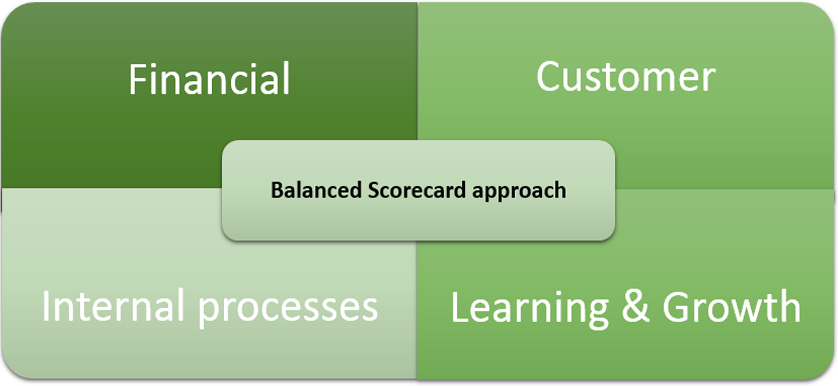
In 1996, Kaplan & Norton suggested that the vision and strategy of a company be more specifically defined from four basic, interconnected perspectives:
Financial Perspective – how to implement a strategy that will maximize profits for equity owners.
Customer Perspective – how to achieve customer satisfaction and loyalty.
Internal business process – how to achieve an effective and efficient business process.
Learning and Growth Perspective – how to gain human capital competitive advantage.
Later, in 2004, Kaplan & Michael E. Nagel proposed a three-part BSC program:
Enterprise Scorecard – synchronized list of results at company level
Board Scorecard – synchronized list of Board results
Executive Scorecard – synchronized list of executors’ scores
Synchronized lists at the company level ensure that top managers, starting from a well-defined company strategy, goals, tasks, benchmarks and initiatives through the four outlined perspectives. This process converts the company’s strategy into operational terms.
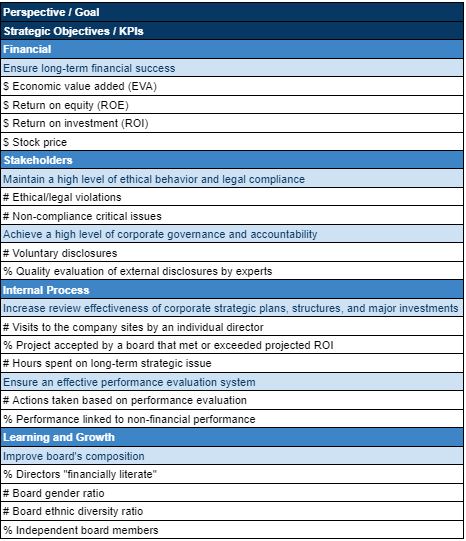
It is necessary to build a synchronized list at the board level. That is, the board of directors should evaluate and approve the corporate strategy map and the corporate level’s harmonized list. According to Kaplan and Nagel, a synchronized list at the board level also has four perspectives:
Financial Perspective – Similar to the company level, the goal is to maximize value for equity owners.
Stakeholder perspective – This is a broader perspective than at the company level because it is now important to respect the interests of all stakeholders.
Perspective on internal business processes – This explains how the board contributes to achieving shareholder goals and relates to performance monitoring, reward systems, etc.
Learning and Growth Perspective – This captures human capital as a source of competitive advantage, related to the specific skills and the knowledge and capabilities of board members.
Application of the BSC to a board’s performance evaluation
According to research published in the Managerial Auditing Journal, studies that have suggested the possibility of using the BSC in evaluating the board performance recognize the financial dimension, the stakeholders’ dimension, the internal processes dimension, and the learning and growth dimension in the BSC.
The framework of the board’s BSC is based on identifying four basic elements in each dimension: the objectives, the performance drivers, the measures, and the targets:
The objectives reflect the board responsibilities;
The performance drivers are actions taken by the board to achieve the objectives. Each performance driver should be linked to specific measures and targets;
The performance measures are used to control the performance drivers and assess whether the board has achieved the goals;
The targets reflect the best practices of the industry.
Using BSC in a board’s performance evaluation can help define strategic contributions of the board; provide a tool to manage the composition and the performance of the board and its committees; clarify the strategic information required by the board, and help monitor the structure and performance of the board and its committees.
The evaluation process: agents and contents
According to the study “Evaluating Boards and Directors”, evaluating board performance may be done by an internal party represented by the chairman of the board. In some cases, it may be appropriate to delegate the evaluation process to a non-executive member, a lead director, or a committee of the board. Also, the evaluation process may be carried out by an external party who has experience in corporate governance and performance evaluation.
The self-evaluation method is a common way to evaluate board performance. Even though this method is characterized by confidentiality, biases can still occur. The close work relationship between chairman or the non-executive member and the board members can affect the objectivity of their point-of-view. The lack of skills and time in conducting performance evaluation can be a major influence on the evaluation results.
Through a nominating committee or an audit committee, a higher degree of objectivity and independence can be achieved; however, the bias risk will remain.
Hiring an external advisor is applicable for the non-availability of the necessary skills for the evaluation process and achieving greater transparency and objectivity. The external counselor may be a professional advisor. Several enterprises use a trusted adviser as the board prefers to deal with people whom they know and trust, but it is better to use a professional advisor that has a proven technical skill in their past experiences and a high degree of independence.
– The responsibilities element aims to evaluate the fulfillment of the board’s responsibilities.
– The operations element aims to assess the board’s relationship with the management.
– The structure element aims to assess the board’s composition.
– The board membership element aims to assess the overall board’s skills and knowledge, experience, competence, ethics, diligence, and independence.
Image source: The KPI Institute
The BSC is an advanced performance management tool that supports organizations to transform vision and strategy into short-term and long-term targets and specific measuring rules. The application of a balanced scorecard in evaluating a board’s performance has been proven through many studies as an effective performance management tool. It also helps a board’s direction to be more aligned at the company and operational level.
Using a BSC in a board’s performance evaluation requires skillful and independent evaluation agents to maximize its potential. To gain the right skills and learn how to implement a balanced scorecard management system in your organization, sign up for The KPI Institute’s Certified Balanced Scorecard Management System Professional course.
The Balanced Scorecard is one of the most important performance management tools used to improve business functions and their outcomes. This tool is used not only at the organizational level but also at the departmental level.
By using departmental scorecards, managers are able to get detailed insights into the performance of their departments. The scorecards can also determine the responsibilities of the employees in terms of achieving strategic objectives.
To implement an effective balanced scorecard for the departmental level, organizations should take into consideration these best practices.
1. Develop the right template.
Employees are often asked to collect data since every manager knows that it is essential in generating qualitative insights. However, the different performance reports could easily lead to different interpretations. A well-designed template leads to a clear, structured reporting and improves communication through standardization.
The template should contain four perspectives that meet the organization’s strategic needs. The most commonly used perspectives are Financial, Customer, Internal Processes, People Learning, and Growth.
Moreover, the template should also display the objectives associated with each perspective and the KPIs associated with each objective. For each KPI, the target and thresholds, the trend, and the previous and current result should also be presented.
2. Choose the right objectives.
When preparing a departmental scorecard, one of the most important steps is to select the right objectives for the different categories, and those objectives should align with the organizational and departmental strategy. Through the cascading process, the organizational objectives and KPIs are translated from the strategic level down to the departmental level.
The departmental scorecard must contain some specific objectives depending on the activities of the operations team. The same objective can be cascaded to more departments, each of them measuring it through different KPIs. Some organizational objectives may not be cascaded to lower levels.
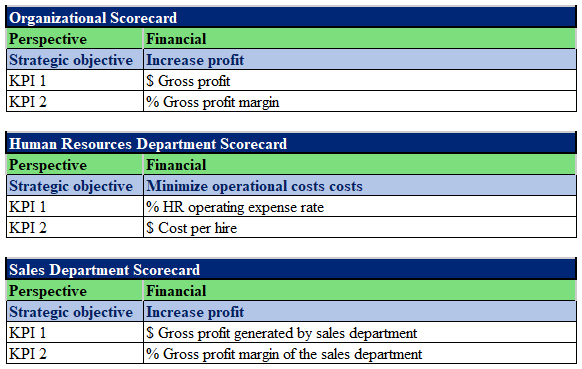
For example, the objective of the Financial perspective is to Increase profit. This organizational objective can not be directly cascaded to the human resources department since the human resources department has no direct influence on the revenue of the organization. However, they could reduce their spending in order to increase organizational profit. Therefore, the objective for the human resources department could be to minimize operational costs. Since the sales department is responsible for profit generation, they can cascade down this organizational objective without any modification.
Figure 1: Objective cascading example
3. Choose the right KPIs to measure the objectives.
As mentioned before, it is recommended not to cascade all objectives and KPIs from the organizational level to the departmental level, but organizations may add specific ones that represent the department. The most important attributes in KPI selection are relevance, clarity, and balance.
In many cases, organizational and departmental scorecards may not be enough to communicate the organizational strategy to all employees. Therefore, individual scorecards should also be created for them.
Data sources for a scorecard
During the scorecard development process, organizations may find it hard to determine the right objectives and KPIs. Objectives and KPIs must be based on relevant data. There are two types of sources of data to consider: primary and secondary.
Feedback from internal stakeholders can be considered as an internal primary data source, while feedback from external stakeholders is an external primary data source. Secondary internal sources could a company’s previous reports and strategy plans, while smartkpis.com and academic articles are external secondary sources.
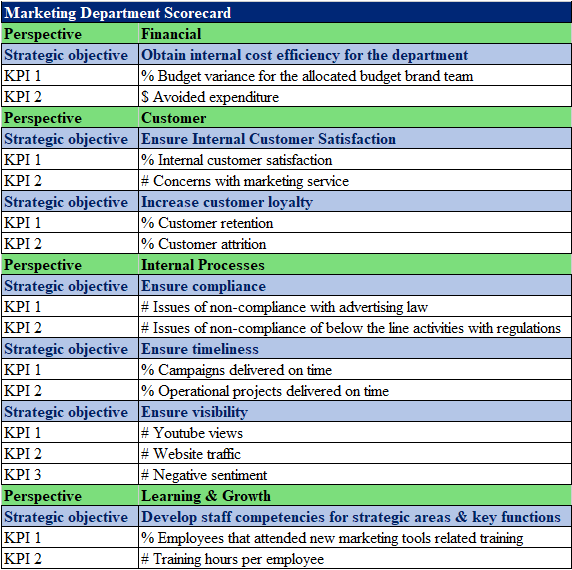
Figure 2: An example of a marketing departmental scorecard
Introduced by Robert Kaplan and David Norton in 1992, the balanced scorecard (BSC) has left an indelible mark on performance measurement. The BSC is a performance measurement framework that goes beyond financial metrics, taking into account the other aspects of a company’s value creation process.
Traditionally, managers would measure performance through the limited lens of financial returns, even in the wake of introducing new strategies that might not be measurable through mere financial metrics. The BSC, on the other hand, measures performance across four perspectives, each one answering a critical question:
Customer (How do customers see us?)
Internal (What must we excel at?)
Learning and Growth (Can we continue to improve and create value?)
The BSC’s holistic and forward-thinking approach is making a notable impact on the tech industry due to its dynamic nature. The development and deployment of new technologies occur at such a rapid pace that traditional performance measurement frameworks can’t catch up. Since the BSC looks at performance from several perspectives, companies that use it are more aware of their current strengths and opportunities for improvement, making it easier for them to adapt to fluctuating circumstances and emerging trends.
Apple’s BSC Indicators
A prime example of a tech company that uses the BSC to its advantage is Apple. A prominent player in the tech industry, Apple wanted to shift focus strictly from financial performance (measured by gross margin, return on equity, and market share) to a more overarching, holistic approach. To accomplish this, the company established a small steering committee that had in-depth, firsthand experience with the deliberations and strategic thinking of the Apple Executive Management Team. This committee then developed a BSC that measured performance according to five indicators that aligned with the four perspectives of the BSC. This approach is outlined in an article written by Norton and Kaplan themselves, from which the following discussion is drawn.
For the customer perspective, Apple used customer satisfaction and market share. For internal processes, the company chose core competencies. For learning and growth, Apple emphasized employee attitudes—specifically, commitment and alignment. Lastly, under the financial perspective, the company focused on shareholder value.
Customer Satisfaction
Customer satisfaction sits among the top of Apple’s priorities, but that wasn’t always the case. Previously, the company had its eye almost exclusively on its technology and products. In the 1980s, Apple’s mission was “to make a contribution to the world by making tools for the mind that advance humankind.” The company’s values have since shifted from technology (i.e., tools) to a seemingly more altruistic, people-centric perspective. This was evident when Apple decided to develop its own customer surveys instead of working with third parties, recognizing the diversity of its customer base.
Market Share
Market share is another essential indicator, especially for a company in the tech industry. This is due to the fact that, by acquiring as much of the market as it can, Apple not only increases its profits but also attracts and retains more software developers.
Core Competencies
Under Apple’s BSC, the company’s employees are expected to possess core competencies, such as creating user-friendly interfaces, powerful software architectures, and effective distribution systems. However, many Apple leaders believe that measuring the impact that these have is a complex task. Over time, the tech company has experimented with quantitative measurements to see if enabling employees in this fashion can nurture their skill sets.
Employee Commitment and Alignment
Apple believes employee commitment and alignment are important. In line with this, they conduct a thorough employee survey for every organizational branch every two years. Random employee surveys are done more frequently. The questionnaires aim to determine how well each employee comprehends the company’s overall strategy and whether they are delivering results that contribute to accomplishing that strategy.
Shareholder Value
Apple views shareholder value as a performance indicator, despite it being a performance result instead of a driver. Doing so enables the company to offset its former reliance on measuring performance via gross margin and sales growth, which did not take into account investments that would bear fruit in the future.
Did Apple make the right choice? It appears so, as the company’s use of the BSC has yielded several net positives throughout the years. It has dominated the market, consistently ranking among the top five smartphone vendors in the world since 2009. The company has also frequently ranked at the top of the American Customer Satisfaction Index, holding the number one spot for two years in a row (2021 and 2022). Moreover, Apple also holds a very high employee satisfaction rating on Glassdoor, with many of its employees praising its culture and values—indicative of the company’s strong employee commitment and alignment. Like many large companies, Apple has also faced its share of challenges. However, its ability to adapt is reflected in its progress, demonstrating the beneficial impact of the BSC.
Another major shift in the business landscape today that’s also reflected in Apple’s recent efforts is sustainability. The need to incorporate sustainability into the BSC can no longer be ignored. Beyond being a responsible choice, it is a strategic move to stay competitive, as today’s consumers increasingly favor brands that align with environmental values.
Although Apple has not publicly disclosed an updated version of its BSC that incorporates sustainability, its recent results—such as achieving carbon neutrality for corporate operations in 2020 and generating 20% lower carbon emissions in 2023 compared to 2022—are evidence of the company’s commitment to sustainable practices.
Harness the Power of the BSC
Whether you’re a consultant or the owner of a small, medium, or large organization, knowing the ins and outs of a BSC and how it can best be used to propel an organizational entity to a higher level of performance is paramount. As such, The KPI Institute offers the Certified Balanced Scorecard Management System Professional, along with resources like templates and webinars, for those looking to deepen their knowledge of the BSC, from design and implementation to managing key performance indicators (KPIs) within the framework and how its components work.
**********
Editor’s Note: This article was originally published on September 10, 2021. It has been updated as of March 28, 2025, with the help of Paolo Orduña, Senior Editor at The KPI Institute.
David Norton and Robert Kaplan introduced the Balanced Scorecard in 1992 to the private sector, as a methodology of measuring a company’s performance beyond its financial outcomes, like profit margins.