The popularity of online shopping platforms has contributed greatly to the global market. A 2021 survey saw Amazon as the biggest online shopping platform in the world, with a market capitalization of nearly USD 1.735 billion, due to the platform’s reliable and easy access on a domestic and international level. On the national level, for example in Indonesia, local e-commerce platforms such as Tokopedia and Shopee are also thriving.
In light of COVID-19, social distancing protocols have been implemented by limiting access to public facilities, including malls and other offline marketplaces, driving people to online shopping. In Indonesia alone, it was found that online shopping habits among Indonesians during the second quarter of 2020 had increased around 18% compared to the previous year. While such a habit is continuously becoming a part of the economy to provide consumers with comfort and convenience, the question is how much of it will affect their living environment and end up as clutter?
Problems with online shopping
Prior study has shown that impulsive buying is among the negative aspects of online shopping. Shoppers may feel addicted to the process of shopping and experience constant cravings but tend to neglect the consequences of it. Several factors that may stimulate underlying this behavior are as follows:
Tailored advertisements
Have you ever noticed that every time you browse the internet, there is always a pop-up advertisement showing an item that speaks to your interests even though you are not specifically searching for it at the moment? Does it make you wonder if the internet is reading your mind? Actually, the interconnectedness within the internet enables algorithms to read your preferences across platforms and predict content that you may be interested in.
For instance, if you just finished looking for a new backpack on Amazon then move to check your Instagram account, you may see backpack advertisements showing on the homepage. This is an intuitive way to help consumers in finding exactly what they need. However, the downside is that it could also induce more cravings as you are exposed to diverse options that may leave you wanting to purchase only one model of the same item.
Seasonal sales and promotions
Discounted prices have become the main attraction of online marketplaces. In the case of Indonesia, it is very common for online shopping platforms to offer big discounts and special promotions on certain dates of the month like holiday sales. You can get a branded product for as much as 75% discount for selected items — a temptation for most consumers. The sale usually starts at midnight, but this does not stop people who still make time to toss their luck and race to get the items they desire with the cheapest deal.
This phenomenon continues to shape a mindset of pseudo-scarcity. Even though the products are always in stock, consumers may have a mindset that big sales will not come twice. This motivates consumers to buy more regardless of whether they actually need it or not, which eventually ends up as clutter.
Fear of missing out
A 2020 survey among Indonesian online shoppers found that 70% of respondents saw reviews made by other customers as very beneficial in helping them choose the best products to buy. This complements the perception that online shoppers rely much on product reviews, especially for products on beauty and cosmetics wherein the market is heavily determined by the customer’s experience and opinion on the internet. The role of social media influencers and celebrities in advertising these products also adds to the public’s curiosity.
This leads some to experience a fear of missing out if they do not participate in the trend despite the possibility of some products not being suitable for them. Hence, some purchases made for the sake of keeping up with a certain trend may end up as clutter. These products may overfill your drawers and expire before you even get a chance to use them.
Online ‘retail therapy’
Online shopping provides the comfort of purchasing items with the convenience of being a click away from having items delivered right to your doorstep. In the wake of the COVID-19 pandemic, this habit is used as a way to cope with the limitation and emotional charges resulting from the obligation to always stay indoors. People filled up their homes with items they bought online until they realized that it was not an effective way to bring pleasure; as a result, these items turned into clutter that overran their living space, regardless of the size of their home.
Aside from accumulating unnecessary items, boxes used to ship items may also end up as clutter. Think about the time when you receive a big package for one small item. Oftentimes, a product can come in a box that is three times bigger than the item you purchased. Due to this, you might find yourself with a house overflowing with boxes that you do not need and add more stress than you originally had.
Managing clutter from online shopping
Excessive purchases resulting from uncontrolled online shopping habits potentially threaten your home with clutter, especially if you do not take immediate action to make a change of habit. While clutter is often considered trivial, it has some serious side effects that some may not realize, such as reducing one’s wellbeing. Here are several ways to combat the clutter problem as a consequence of online shopping:
Stick to a shopping list and a budget
It sounds cliche, but developing a straightforward shopping list and budget is highly effective to keep you on your toes. Having a list you can regularly monitor will help you to avoid overspending while identifying the items that you can actually afford. There are a lot of mobile apps that can offer such functionality; some are even designed specifically for groceries, clothes, electronics, and so on.
Apart from that, decide how much you are going to allocate for your daily, weekly, and monthly spending and commit to it. Prioritize your expense for daily needs over temporary cravings. You can also set a separate bank account for non-essential purchases to help you stay on budget.
Create an interval between purchases
An alternative to holding yourself accountable for your purchase is making a fixed interval from the current purchase to the next one. By applying shopping intervals, you can also get a sense of what is essential to you and what you simply want. You can adapt a 3, 7, 14, or 30-day interval, depending on your needs. You can also utilize a reminder app on your phone to make sure you will not forget the last time you ordered something online.
Consider the availability of space in your house
It is important to analyze the current state of your living space before deciding to make a new purchase. In order to avoid impulsive buying, ask yourself these questions:
1. Where are you going to place it?
2. Do you have adequate space to store it?
3. Do you already have similar items that you can continue to use instead?
4. What would you do with items you already have if you buy a new one?
You might be interested in certain products, but not necessarily need them. If you cannot pinpoint a clear purpose for buying them, it is better to not go for it.
Implement the ‘One In One Out’ rule
The emphasis on this rule is exchanging an old item for a new one. If there is a desire to acquire a new item, a similar item from the house must be discarded. According to Francine Jay, author of The Joy of Less: A Minimalist Guide to Declutter, Organize, and Simplify, this is when the rule has the most impact. Letting go is extremely beneficial when decluttering to prevent you from bringing in more items that might become clutter in your home.
An example would be that for every new purchase of a t-shirt, an old t-shirt must go. You may also want to pay attention to the ratio between related categories of items such as having more shirts than pants. One good option is discarding an old shirt when buying a new pair of pants. In this way, releasing your belongings will also allow you to discover the items that you genuinely cherish.
Recycle or upcycle shipping boxes
Diverse options could be taken to process unused shipping boxes at home. One simple way is to break down or flatten cardboard boxes and put them in the recycle bin to be processed further. Do not forget to remove your personal details, such as your full name, home address, and phone number on the box to avoid others from using your information for unauthorized purposes.
Another alternative would be to reuse these boxes to store your clutter. For example, you can put clothes and books you want to donate or sell in those boxes. In this way, you also get to save money from buying a new container.
Mindful shopping habits are necessary to be developed as a preventive measure from unnecessarily shopping online and adding clutter. Buying items may give you temporary pleasure, but consider its impact on your living space. By raising awareness for yourself and those around you, you can build precautions to avoid clutter from online shopping in your home.
Technology has made it possible to reach out to people, regardless of geographical distances. People today use their smartphones not only to simply work, shop, and play, but also to manage their personal life. This includes the way people conduct their interactions in building romantic and non-romantic relationships.
When the Pew Research Center polled Americans in 2005 about online dating, only 44% believed it was a good way to meet people, and the majority said it was a poor substitute for forming connections in the “real” world. Since then, the way people interact, meet, and show affection has evolved tremendously.In fact, when Pew Research Center conducted a follow-up surveyten years later, the proportion of people who thought internet dating was a decent method to meet others had increased to 59%.
The approach of online dating is similar to that of other social media platforms, but it also gives users the opportunity to meet others who share their interests, dislikes, and qualities. This makes online dating applications distinctiveas these criteria also increase the likelihood that a user will like the person they meet on a date. Due to this, online dating services saw a rising percentage of people who are forming lasting and meaningful relationships online.
Experiences in online dating
Online dating can be a hit-or-miss proposition. Some people have had great success with online dating, resulting in long-term partnerships. Others have tales of befuddlement and frustration.
According to a poll conducted in 2019 by Pew Research Center, three out of 10 Americans have ever used an online dating site or app, with 11% having done so in the previous year. Some claim these platforms have helped them create meaningful relationships.The study saw that 12% of participants have experienced being married or in a committed relationship with someone they met on a dating site or app.
While most online daters think their experience has been favorableoverall, they do point out some of the disadvantages of online dating. Americans who have used a dating site or app in the last year report feeling more frustrated (45%) than hopeful as a result of their previous encounter (28%). Out of those who are active users, 29% think that online dating has made them feel more hopeful, while 35% say it has made them feel pessimistic. Similarly, 32% believe online dating sites or apps have made them feel more confident, while 25% say they have made them feel uneasy.
Advantages of online dating
As with any other method of dating, meeting someone online has both advantages and disadvantages.Finkel et al. (2012), considers three major services that online dating sites offer to understand how online dating varies from traditional offline dating in essential ways. This also considered the circumstances in which online dating produces better romantic consequences than traditional offline dating:
Access: This refers to the users’ exposure and opportunity to identify potential romantic partners whom they would not otherwise meet. The use of an online dating program is convenient, and the effort of searching matches may be done from any location. It provides users with unprecedented levels of access to potential companions, which is especially beneficial for those who might otherwise lack such access.
Communication: Online dating applications allow users to use computer-mediated communication (CMC). This helps users interact and garner an initial sense of compatibility with specific potential partners through the dating site before meeting face-to-face. People are more susceptible to sincerely answer questions regarding their purpose of dating to find relationships that will fully correspond to their preferences.
Matching: Many websites feature an easy-to-use search engine that lets you find matches based on gender, age, hobbies, and aspirations. In an online dating survey, 72% of women said it was extremely essential that the profiles they looked at included information regarding the type of relationship the other party was seeking, compared to around half of males (53%). Women are also more likely to give more significance in finding partners that fit their criteria on religious beliefs (32% vs. 18%), occupation (27% vs. 8%), or height (27% vs. 8%) than men. Other gender disparities are more subtle, such as the relevance of users’ hobbies and interests, their racial or cultural heritage, or political involvement.
Disadvantages of online dating
While there are definite advantages to online dating, there are also some cautions to take. Users should be vigilant in creating relationships with people online as some may have malicious intent. Some of these disadvantagesinclude the following:
Idealization of the image: An idealistic image of your interlocutor with merits that aren’t inherent in them may appear. If the face-to-face meeting is postponed for a long time, it will be much more difficult to match the created image to a real person later. According to a Pew Research Center survey, women who have used a dating site or app are more likely to find it difficult to find individuals they were physically attracted to (36% vs. 21%) or who liked someone they would like to meet in person (36% vs. 21%). Male users, on the other hand, are more likely than female users to claim that finding people who shared their hobbies and interests was at least somewhat challenging (41% vs. 30%).
Harassment. While online dating apps or sites provide users with greater convenience in communicating and expressing themselves with potential matches, this is also their drawback – in terms of social communication morale. Based on a survey by Pew Research Center in 2019 of 4,860 U.S. adults, about 37% of online dating users say someone continued to contact them on a dating site or app after they said they were not interested. Out of those, 35% reported that someone sent them an unsolicited sexually explicit message or image, and 28% reported that the other party called them an abusive term after being rejected. These percentages are even greater among younger females; six out of 10 female users aged 18 to 34 said that someone contacted them after they stated they weren’t interested, and 57% say another user sent them unsolicited sexually explicit messages or photographs. At the same time, 44% of respondents stated they’ve been called offensive names on a dating site or app.
Short-term gratification: Offline encounters appear to be facilitated by location-based structural characteristics of online dating applications (Miles 2017), allowing for a quick fulfillment of users’ requirements (e.g. users seeking sexual encounters or one-night stands are able to find other users within a walking distance). In fact, according to the I-PACE (interaction of person-affect-cognition-execution) model (Brand et al. 2016), short-term gratification on dating apps can cultivate dysfunctional coping styles to deal with unpleasant emotions (e.g. frustration and anger). This also included dysfunctional affective and cognitive responses in relation to dating apps (e.g. craving, urge for mood regulation, and addiction).
Increased self-objectification:As some people use online dating platforms to fulfill their short-term sexual needs, this objectification of other users has become a concern that may also increase self-objectification (Koval et al. 2019). This has been linked to mental health issues such as clinical symptoms of depression and eating disorders in the past. As a result, more research is needed to look into users’ emotional experiences and how prolonged periods of use may affect wellbeing metrics and clinical mental health symptoms through self-objectification.
When it comes to online dating apps and the separation of dating from the rest of social life, there’s a bit of a causality dilemma. It’s likely that dating apps have built barriers between the search for potential spouses and typical work and community routines. However, it’s also plausible that dating apps are thriving at this point in history because people have stopped looking for potential companions while going about their daily lives at work and in their communities.
Throughout the years, many studies have examined the use of the balanced scorecard (BSC) in a board’s performance evaluation. Why is this important and how can this be implemented?
The modern business landscape is characterized by fast-changing trends, an expanding weight from the competition, and risks emerging from new trends. This is why a good corporate governance system is what can help companies achieve high business performance despite uncertainties. Having a control mechanism will help managers carry out business activities that can maximize profits for shareholders. Board members represent an important internal control mechanism.
BSC, designed by Robert Kaplan and David Norton, is primarily made of financial and non-financial benchmarks. The BSC model starts from a defined mission, vision, goals, and strategy of the company and identifies specific goals, tasks, benchmarks, and initiatives from four basic causal relationships: financial perspective, stakeholder perspective, internal business process perspective, and learning-growth perspective.
The BSC component in a board’s performance context
In 1996, Kaplan & Norton suggested that the vision and strategy of a company be more specifically defined from four basic, interconnected perspectives:
Financial Perspective – how to implement a strategy that will maximize profits for equity owners.
Customer Perspective – how to achieve customer satisfaction and loyalty.
Internal business process – how to achieve an effective and efficient business process.
Learning and Growth Perspective – how to gain human capital competitive advantage.
Later, in 2004, Kaplan & Michael E. Nagel proposed a three-part BSC program:
Enterprise Scorecard – synchronized list of results at company level
Board Scorecard – synchronized list of Board results
Executive Scorecard – synchronized list of executors’ scores
Synchronized lists at the company level ensure that top managers, starting from a well-defined company strategy, goals, tasks, benchmarks and initiatives through the four outlined perspectives. This process converts the company’s strategy into operational terms.
It is necessary to build a synchronized list at the board level. That is, the board of directors should evaluate and approve the corporate strategy map and the corporate level’s harmonized list. According to Kaplan and Nagel, a synchronized list at the board level also has four perspectives:
Financial Perspective – Similar to the company level, the goal is to maximize value for equity owners.
Stakeholder perspective – This is a broader perspective than at the company level because it is now important to respect the interests of all stakeholders.
Perspective on internal business processes – This explains how the board contributes to achieving shareholder goals and relates to performance monitoring, reward systems, etc.
Learning and Growth Perspective – This captures human capital as a source of competitive advantage, related to the specific skills and the knowledge and capabilities of board members.
Application of the BSC to a board’s performance evaluation
According to research published in the Managerial Auditing Journal, studies that have suggested the possibility of using the BSC in evaluating the board performance recognize the financial dimension, the stakeholders’ dimension, the internal processes dimension, and the learning and growth dimension in the BSC.
The framework of the board’s BSC is based on identifying four basic elements in each dimension: the objectives, the performance drivers, the measures, and the targets:
The objectives reflect the board responsibilities;
The performance drivers are actions taken by the board to achieve the objectives. Each performance driver should be linked to specific measures and targets;
The performance measures are used to control the performance drivers and assess whether the board has achieved the goals;
The targets reflect the best practices of the industry.
Using BSC in a board’s performance evaluation can help define strategic contributions of the board; provide a tool to manage the composition and the performance of the board and its committees; clarify the strategic information required by the board, and help monitor the structure and performance of the board and its committees.
The evaluation process: agents and contents
According to the study “Evaluating Boards and Directors”, evaluating board performance may be done by an internal party represented by the chairman of the board. In some cases, it may be appropriate to delegate the evaluation process to a non-executive member, a lead director, or a committee of the board. Also, the evaluation process may be carried out by an external party who has experience in corporate governance and performance evaluation.
The self-evaluation method is a common way to evaluate board performance. Even though this method is characterized by confidentiality, biases can still occur. The close work relationship between chairman or the non-executive member and the board members can affect the objectivity of their point-of-view. The lack of skills and time in conducting performance evaluation can be a major influence on the evaluation results.
Through a nominating committee or an audit committee, a higher degree of objectivity and independence can be achieved; however, the bias risk will remain.
Hiring an external advisor is applicable for the non-availability of the necessary skills for the evaluation process and achieving greater transparency and objectivity. The external counselor may be a professional advisor. Several enterprises use a trusted adviser as the board prefers to deal with people whom they know and trust, but it is better to use a professional advisor that has a proven technical skill in their past experiences and a high degree of independence.
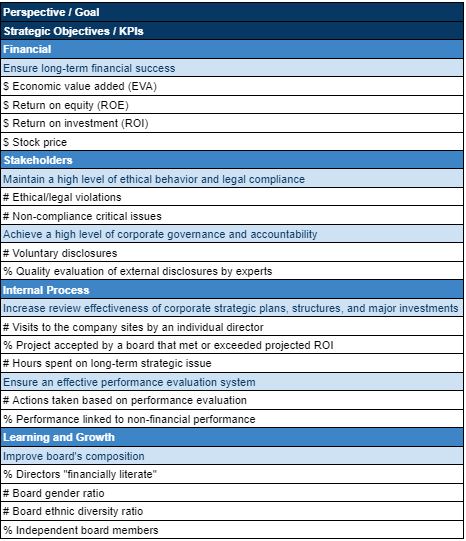
– The responsibilities element aims to evaluate the fulfillment of the board’s responsibilities.
– The operations element aims to assess the board’s relationship with the management.
– The structure element aims to assess the board’s composition.
– The board membership element aims to assess the overall board’s skills and knowledge, experience, competence, ethics, diligence, and independence.
Image source: The KPI Institute
The BSC is an advanced performance management tool that supports organizations to transform vision and strategy into short-term and long-term targets and specific measuring rules. The application of a balanced scorecard in evaluating a board’s performance has been proven through many studies as an effective performance management tool. It also helps a board’s direction to be more aligned at the company and operational level.
Using a BSC in a board’s performance evaluation requires skillful and independent evaluation agents to maximize its potential. To gain the right skills and learn how to implement a balanced scorecard management system in your organization, sign up for The KPI Institute’s Certified Balanced Scorecard Management System Professional course.
The Balanced Scorecard is one of the most important performance management tools used to improve business functions and their outcomes. This tool is used not only at the organizational level but also at the departmental level.
By using departmental scorecards, managers are able to get detailed insights into the performance of their departments. The scorecards can also determine the responsibilities of the employees in terms of achieving strategic objectives.
To implement an effective balanced scorecard for the departmental level, organizations should take into consideration these best practices.
1. Develop the right template.
Employees are often asked to collect data since every manager knows that it is essential in generating qualitative insights. However, the different performance reports could easily lead to different interpretations. A well-designed template leads to a clear, structured reporting and improves communication through standardization.
The template should contain four perspectives that meet the organization’s strategic needs. The most commonly used perspectives are Financial, Customer, Internal Processes, People Learning, and Growth.
Moreover, the template should also display the objectives associated with each perspective and the KPIs associated with each objective. For each KPI, the target and thresholds, the trend, and the previous and current result should also be presented.
2. Choose the right objectives.
When preparing a departmental scorecard, one of the most important steps is to select the right objectives for the different categories, and those objectives should align with the organizational and departmental strategy. Through the cascading process, the organizational objectives and KPIs are translated from the strategic level down to the departmental level.
The departmental scorecard must contain some specific objectives depending on the activities of the operations team. The same objective can be cascaded to more departments, each of them measuring it through different KPIs. Some organizational objectives may not be cascaded to lower levels.
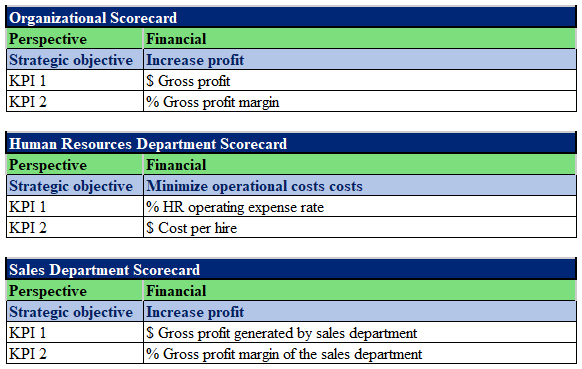
For example, the objective of the Financial perspective is to Increase profit. This organizational objective can not be directly cascaded to the human resources department since the human resources department has no direct influence on the revenue of the organization. However, they could reduce their spending in order to increase organizational profit. Therefore, the objective for the human resources department could be to minimize operational costs. Since the sales department is responsible for profit generation, they can cascade down this organizational objective without any modification.
Figure 1: Objective cascading example
3. Choose the right KPIs to measure the objectives.
As mentioned before, it is recommended not to cascade all objectives and KPIs from the organizational level to the departmental level, but organizations may add specific ones that represent the department. The most important attributes in KPI selection are relevance, clarity, and balance.
In many cases, organizational and departmental scorecards may not be enough to communicate the organizational strategy to all employees. Therefore, individual scorecards should also be created for them.
Data sources for a scorecard
During the scorecard development process, organizations may find it hard to determine the right objectives and KPIs. Objectives and KPIs must be based on relevant data. There are two types of sources of data to consider: primary and secondary.
Feedback from internal stakeholders can be considered as an internal primary data source, while feedback from external stakeholders is an external primary data source. Secondary internal sources could a company’s previous reports and strategy plans, while smartkpis.com and academic articles are external secondary sources.
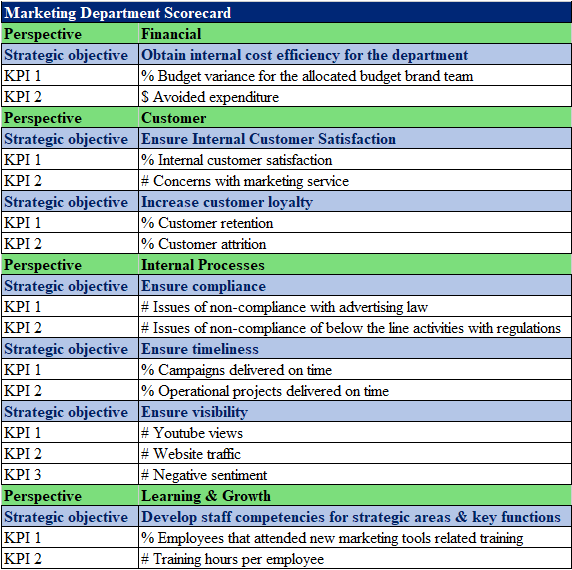
Figure 2: An example of a marketing departmental scorecard
A Balanced Scorecard helps a company innovate and elevate itself to new heights of performance, by assisting its leaders in making key decisions that are in line with the company’s objectives.