Key Performance Indicators (KPIs) are an important tool for businesses, enabling organizations to measure their results and to compare them against pre-set goals. If well designed and implemented, KPIs
Modern practices have provided enough proof to show that performance management has a tendency to alter organizational processes and to shift mentalities. It is of little surprise that archaic business functions, such as the financial one, find themselves in need for refinement.
The question that inevitably comes to mind is: Are the persons in charge aware of the transformation? Are Chief Financial Officers the financial leaders that organizations expect them to be?
The Balanced Scorecard approach to financial performance monitoring has shifted its focus from bottom line spreadsheets to financial strategy. The Chief Financial Officer is compelled, therefore, to reconsider his role within the top management team.
The more a CFO’s role in the company expands, the more value that company draws on the execution of its overall strategy. In the same manner that the Balanced Scorecard focuses on more than its financial perspective, so should the CFO report not only on financial results, but also reveal their end-to-end significance to the entire company.
More explicitly, the Chief Financial Officer of today is expected to use his/her analytical skills to overcome performance driven challenges and to encourage business growth. In the present business environment, the CFO is required to not only record financial data, but also to interpret the numbers for future forecast and decision-making.
In the context of performance management, re-modelling the rigid structure of the financial function is one of the hardest things to do. Communicating financial results to executives in a manner that encompasses the company’s full value chain and operational engagement may be perceived by CFOs as a time consuming demeanor that does not always fit the job description.
Furthermore, CFOs are generally more concerned with regulatory aspects, such as financial compliance, rather than improving performance in an organization. Either way, the increased demand for performance achievement and strategic orientation call for a reassessment of CFO positions within organizations worldwide.
Long story short, CFOs of today must do better than duplicate the role of their controllers. Consequently, an effective way for CFOs to get involved in the strategy formulation and execution processes of an organization is for them to deploy the Balanced Scorecard implementation process.
CFOs – From Financial Controllers to Strategic Leaders
Beyond their purpose of connecting strategic objectives to day–to-day operational activities, Balanced Scorecards provide an in-depth view on financial tracking, as well as non-financial parameters that aid financial forecasting.
A strategically focused CFO ensures that financial indicators track not only performance, but they also reveal trends, raise awareness to risk and highlight business opportunities. Of course, there are the rigid financial metrics such as $ Earnings before interest and taxes (EBIDT), %Return on equity (ROE) and %Net profit margin that are too specific and lagging to create value in the future but, nonetheless, indispensable when evaluating past performances.
Altogether, just as everything evolves with progress, so do performance indicators. Continuously refining financial indicators so that they are aligned with business and market trends, consumer behavior changes and technological advancements, must be the duty of the modern CFO.
Successful CFOs must also pay special attention to calibrate their finance team and spot new talent. By actively taking part in the recruitment process, CFOs provide a valuable insight into the level of financial knowledge a promising candidate possesses. By delivering in-house trainings, a CFO can acquire a better perception of an employee’s competencies, as well as find reasons to rethink competencies required for their future promotions.
Team scorecards can be a useful tool in creating the performance-oriented financial team that modern CFOs need. These performance monitoring tools enable objectives to be achieved by increasing alignment of individual tasks with the overall expectations of the financial team, and the organization, as a whole.
By sponsoring and supporting the implementation of team scorecards, the CFO can add value to the financial department and instill the advantages of balanced reporting on his team.
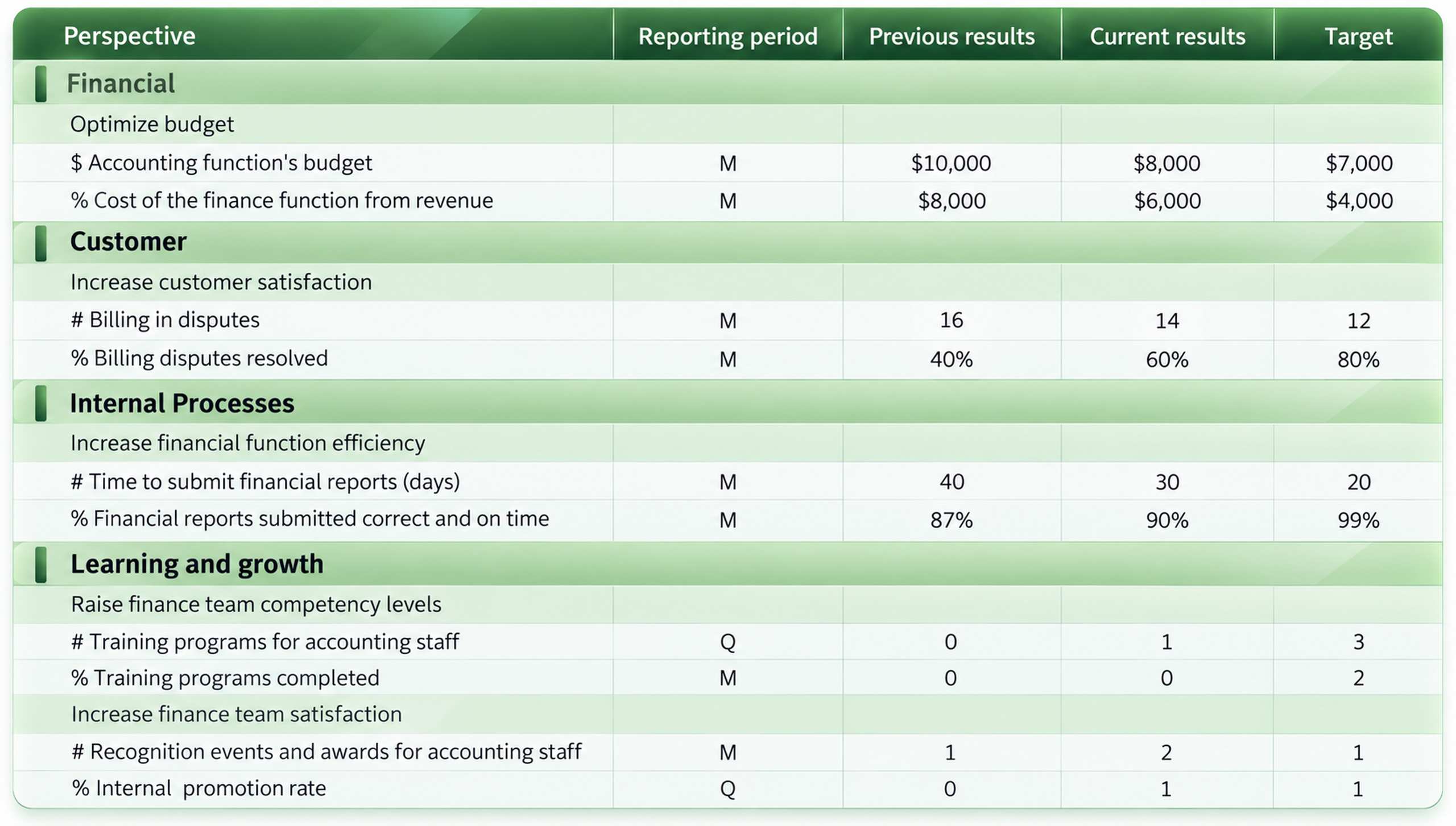
Excel is an outstanding tool for designing a trial template of the financial team Balanced Scorecard. Tests performed over a relevant period of time can provide the CFO with substantial insights on the benefits and challenges the team Balanced Scorecard brings to the financial department. A pilot Balanced Scorecard for the financial team can be easily designed with Microsoft Excel as follows:
Additional strategies for CFOs to smoothly embrace their transition from lead controllers to strategically oriented leaders would be:
Employee empowerment: transferring designated workload to create capacity for high value work;
Identifying value: focus on the key business drivers of the organization when delivering the strategic agenda;
Building knowledge: using all available information resources to collect both financial and non-financial data;
Monitoring performance: selecting the right set of performance indicators to adequately convey the meaning of the organization’s value propositions; encouraging the use of customer oriented indicators, such as # Repeat customers and # Customer satisfaction index can contribute to cohesive strategy delivery and decision making across all levels of the organization;
Upgrading technological infrastructure: business intelligence tools are an investment made for long-term productivity and operational efficiency and, additionally, they guarantee higher returns (ROI) when used to build on performance;
Sharing practice knowledge: use influence to emphasize the importance of a performance oriented culture as well as encourage propensity for financial literacy.
Although the transition from financial controller to strategic leader, might be a challenge for most CFOs, the process of becoming tomorrow’s leader in finance is based on adaptation to market trends. As the main business trend of today is performance management in its entirety, implementing the Balanced Scorecard might just be the way out of the rigid, outdated CFO’s financial role.
A common disappointment among managers in regards to measuring performance is that in practice, in many cases, the key performance indicators (KPIs) monitored do not seem relevant as they are not connected to the strategy.
To better understand how this problem can be addressed, we must first identify its possible causes:
1.The strategy is not translated into clear objectives – Nowadays, most organizations have a strategic plan in place for short and long terms. However, these plans may lack an important characteristic, the ability to clearly transmit what needs to be done and how success looks like.
To provide this clarity, strategic objectives must be concise. For example: Increase stakeholders’ satisfaction, Optimize the delivery process, Reduce recycling costs or Ensure market expansion.
Solution: Developing objectives using the SMART concept in mind is a good practice. Other important information such as timeframe, accountability, KPIs to measure the objective can be mentioned in an Objective Documentation Form.
2.KPI selection is done independently to the strategy – During the selection process, KPIs are not chosen to reflect the achievement of strategic objectives.
Solution: Consider these three questions when measuring performance:
What do I want to achieve?
How will I achieve it?
What are the best ways to measure / reflect the progress in reaching my objectives?
The third question indicates what KPIs are suited for your objectives. In most cases, there is more than one way to measure your goals. For example, given the objective ”Increase customer satisfaction,” the marketing manager may choose to measure % Customers satisfied or # Customer satisfaction index.
The decision to measure one KPI or the other will take into consideration things like budget allocated for the KPI’s activation (# Customer satisfaction index will require a multiple question survey that will be more expensive than measuring the percentage of satisfied customers), time to gather data and so on.
Using other KPI selection criteria can help managers shrink the list of possibilities, but remember that the main criteria is to ensure your KPI is linked to a strategic objective.
3.KPIs are not relevant, as we measure what is easy to measure – This is a very common pitfall that occurs during KPI selection workshops, choosing certain KPIs that we are familiar with, or those ones that are easier to measure.
Solution: To address this issue, keep in mind that the efforts to measure a KPI should not be greater than the benefits generated. However, the key criteria still focus on relevancy.
4.KPIs are not relevant, as we measure what is popular in the industry – In a similar way as mentioned above, managers may be tempted to measure the same KPIs that their competitors use.
Benchmarking is a helpful tool in measuring performance, but it must be used wisely. Comparing one company with another may be irrelevant even if they are in the same market, in the same industry and have a similar size, if they have different strategies.
Solution: Use benchmarking data, if it is available, as a reference point for your activities and make sure the comparisons you are making are relevant.
5.KPIs are not reviewed after every strategic planning cycle – Strategies change all the time, whether it happens in a well-structured way, like annual strategy reviews or informal, when managers responding to market changes start new projects. All the changes happening in the organization may put KPIs further and further from the business activities.
Solution: Reviewing the strategy should take place in an organized way, which ensures KPIs are recalibrated to the new strategic directions and there is consistency between what we measure and what we want to achieve. Strategy review should happen once a year, or even more often for really dynamic business environments or start-up companies and realigning KPIs should be a part of this process.
In time, the organization evolves and so do its KPIs, therefore some of them may be superseded (the entity is mature enough to measure a more complex KPI), for some we may choose to suspend them, as the issue they were monitored has been solved, while others may need to be refreshed (changing the calculation methodology).
The value generated by using KPIs is directly influenced by how relevant the data obtained from the performance measurement process is for business planning and decision-making.
Therefore, addressing the above-presented issues may significantly improve the current performance management framework within the organization. Use the GPA Unit performance measurement audit tool, which is provided for free and can offer you an overview of your current maturity level in your organization, in a specified area.
Never Lose Track of the Big Picture
If you feel that your strategy aligning is not quite up to par with the current practices in the business industries, and you would like to gain a better understanding of how KPIs interact with an organization’s strategy, from its design to its implementation, The KPI Institute offers you a 3-day course, Applied Strategy and Business Performance Improvement with KPIs, which will act as a roadmap to the improvement of your long-term organizational performance.
You will explore the foundation of a successful business strategy and then translate it into actionable objectives. The solution for a higher success rate is to set quantifiable objectives and accordingly, use the right KPIs. The course provides the needed Measurement Framework to properly select the relevant KPIs, to document them and gather data.
Moreover, if after you have finished our course, you believe that this topic is something of interest to you and would like to gain in-depth knowledge and earn a specialization in Strategy and Business Planning, we offer you our Certified Strategy and Business Planning Professional certification course, which will help improve long-term organizational performance, through the use of strategic planning tools.
Participants will explore the framework that provides the foundation of a successful business strategy, focusing on the main components of a strategy and practicing the development of an efficient strategic plan. The course will also provide insights on the fundamental principles and methods for communicating strategy across the organization.
Furthermore, for those interested in other resource types, we offer you a wide array of webinars on strategy & strategic planning, which will serve as video guides to help you never lose sight of the connection between your strategy and KPIs!
Since the early 1990s, Balanced Scorecard practitioners have strived to optimize its successful implementation. It all started on paper, when Kaplan and Norton first delivered the concept in a book, The Balanced Scorecard: Translating strategy into action.