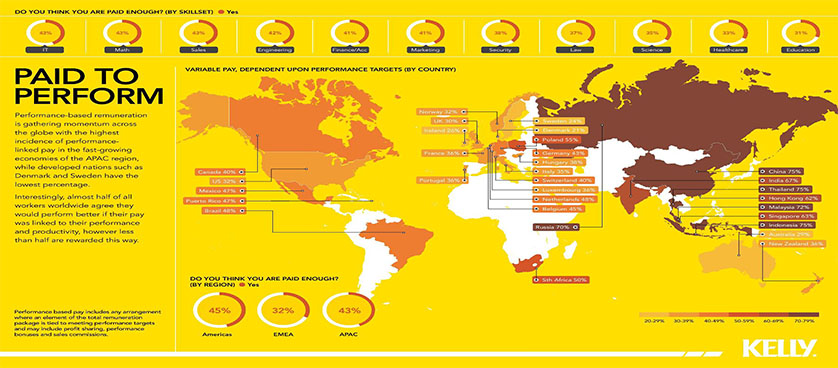
Typically, having employees’ productivity assessed against agreed benchmarks enhances managers monitor if the personnel is meeting the expectations set. As a consequence, the workplace performance influences employees’ payments: increased productivity leads to higher financial benefits, while low productivity attracts reduced levels of the salary.
Key performance indicators (KPIs) are often confused with critical for success factors (CSFs), as these two concepts are tightly connected. Used interchangeably these terms may cause confusion, as in reality they express different things. The main difference between a KPI and a CSF is that performance indicators reflect the level of success, while CSFs point out the cause of success.
“If you cannot measure it, you cannot improve it.” (Lord Kelvin)
The Balanced Scorecard, or BSC, is a strategy performance management tool that helps managers to put in balance four main perspectives (the customer’s perspective, the company’s internal perspective, as well as innovation and improvement). Also, it encourages them to focus on complex cause and effect relationships and on developing a systemic aligned strategy.
Google has a great recruiting culture. And in order to attract their employees, they use more than a good payment and some benefits. Their practices in this matter impact more than just the HR strategy on the short term: it affects the entire organization, on the long term.
Measurement is fundamental if not vital in every organization. Constant use of metrics ensures a good development and guarantees great outcomes. In healthcare, measurements are being performed daily, by healthcare providers and patients altogether. The central point and target of measurements in healthcare is represented by patients.