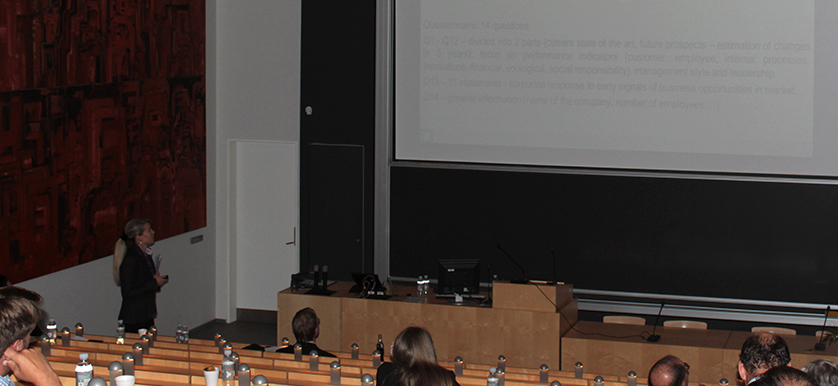
The presentation “Current Trends in Strategic Management and Performance Measurement: Evidence from Japan” was delivered in the second day of the PMA 2014 Conference by Ing. Michaela Blahová, of the Centre of Applied Economic Research of the Faculty of Management and Economics of Tomas Bata University in Zlín, PhD. Parissa Haghirian, Associate Professor at the Faculty of Liberal Arts of Sophia University, Tokyo, and Přemysl Pálka, Academic and Vice-Dean for international relations at the Faculty of Management and Economics of Tomas Bata University in Zlín, Czech Republic.
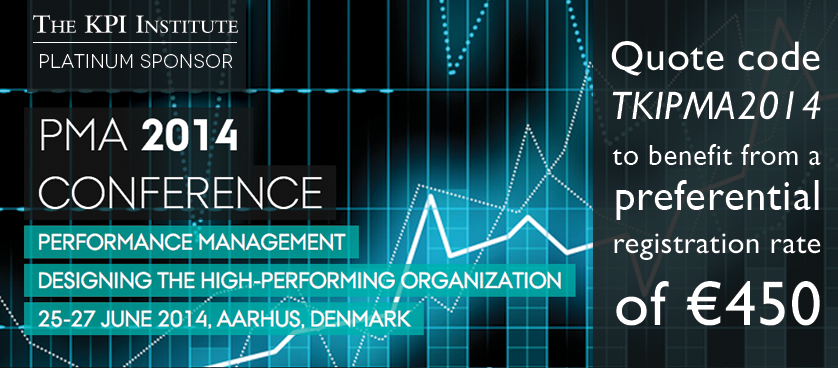
The PMA 2014 Conference offers you the opportunity to explore the latest thinking and research into the design of the high-performing organization. Join the world’s most influential thinkers and inspirational leaders between25 – 27 June, in Aarhus, Denmark!
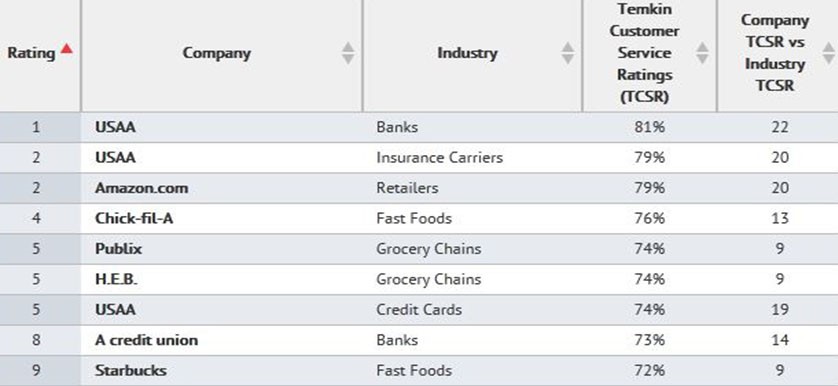
Organisational performance comprises a company’s actual results, as measured against its intended goals. Highly effective companies have a clear focus on leadership, design, people, change management, culture and engagement, so that organizational and individual capabilities contribute to the financial and operational performance, enabling strategy execution. Taking into consideration that almost every organization has profit as a strategic objective, customer satisfaction plays a major part in influencing revenues.
For the report Performance Management in 2013, The KPI Institute conducted 20 semi-structured interviews with practitioners, academics and consultants from 18 countries, who offered rich insights into the state of Performance Management as a discipline.
One of the main editorial rules followed in the development of the content is that a discipline can only evolve through the combined efforts of practitioners, academics and consultants. Gregory Richards, Professor of Performance Management at Telfer School of Management, University of Ottawa, Canada was one of the academics that The KPI Institute has interviewed.
More and more state governments are now introducing Key Performance Indicators (KPIs) to monitor and improve performance across different services offered to citizens, and public transportation is no exception. In Australia, bus drivers resent the pressure of governmental KPIs, especially in regards to running times.