Emotional intelligence in strategic leadership is becoming an important topic in modern management. In the past, leadership was often measured mainly by financial results and decision-making skills. Today, many organizations also look at how leaders manage themselves, connect with their teams, and handle change.
Strategic leaders work in complex environments where they need to align people, resources, and goals. In these situations, technical knowledge alone is not enough. Emotional intelligence helps leaders understand their own emotions, read the emotions of others, and use this awareness to guide better decisions.
For organizations that want to build stronger leadership cultures, understanding the role of emotional intelligence in strategic leadership is becoming increasingly important. This makes emotional intelligence not just a personal trait but a strategic asset: research from the Center for Creative Leadership has found that leaders who show more empathy toward their teams are consistently rated as stronger performers by their own managers.
What Is Emotional Intelligence?
Emotional intelligence is often defined as the ability to recognize, understand, and manage emotions—both in oneself and in others. The concept has become widely used in the fields of psychology, leadership, and organizational behavior, and is now considered an important skill in modern workplaces.
Emotional intelligence is usually described through four main areas. The first is self-awareness, which means understanding one’s own emotions and how they affect behavior. The second is self-management, which is the ability to control emotional reactions, especially in difficult situations.
The third area is social awareness, which involves understanding the emotions and needs of others. The fourth is relationship management, which is the ability to build trust, communicate clearly, and manage conflicts in a healthy way. Together, these four areas form the foundation of emotionally intelligent behavior in the workplace. This four-part structure, often called the Boyatzis-Goleman model, remains one of the most widely applied frameworks for measuring and developing emotional intelligence in professional settings.
Why It Matters for Strategy
Emotional intelligence plays an important role in strategic leadership because strategy is not only about numbers and analysis. It also involves people, relationships, and the ability to guide teams through change. Leaders who understand this dimension can often manage complex situations more effectively.
One area where emotional intelligence supports strategy is decision-making. Strategic leaders often face difficult choices with limited information and high pressure. When they can manage their own stress and stay focused, they may make more balanced decisions instead of reacting emotionally to short-term problems. This connection is supported by recent research: a 2026 study published in Scientific Reports found that emotional-intelligence training measurably improved stress regulation and decision-making performance among professionals in high-pressure roles.
Another important area is leading change. Most strategic initiatives require changes in processes, roles, or culture, and these changes can create resistance among employees. Leaders with strong emotional intelligence are usually better at understanding this resistance, communicating the reasons for change, and building the trust needed to move forward. This is consistent with change management research: Prosci has identified a lack of awareness about why a change is happening as the leading cause of employee resistance, underscoring why clear, empathetic communication from leaders is critical to overcoming it.
How Leaders Can Develop It
Emotional intelligence is not a fixed trait. It is a skill that leaders can build and improve over time through practice and self-reflection. The first step is developing self-awareness. Leaders can do this by asking for feedback from colleagues, keeping a personal journal, or working with a coach who helps them understand their emotional patterns.
The second step is practicing self-management in daily situations. This can include simple habits like pausing before reacting to stressful news, taking time to think before making important decisions, or using techniques such as deep breathing to stay calm during difficult meetings.
The third step is investing in social skills. Leaders can improve their empathy and communication by listening more actively, asking open questions, and paying attention to non-verbal signals during conversations. Regular one-on-one meetings with team members can also help leaders understand different perspectives and build stronger relationships across the organization.
Conclusion
Emotional intelligence is becoming an important skill for strategic leaders in modern organizations. It supports better decision-making, smoother change management, and stronger relationships across teams. Technical knowledge and financial skills remain important, but they are more effective when combined with the ability to understand and manage emotions.
Organizations that invest in developing emotional intelligence at the leadership level are more likely to build cultures where trust, communication, and collaboration support long-term strategic success.
For professionals who want to build the skills needed to lead effectively in complex environments, exploring a certification such as the Certified Strategy and Business Planning Professional program can provide a strong foundation in strategic thinking, leadership, and organizational alignment. These skills are becoming increasingly important in modern strategic leadership environments.
********** Editor’s Note: The article was written by Ms. Sarah Binsaied.
Organizations seldom fail because they don’t have an actual strategy in place – most do have some form of strategy in place.
They fail because the strategy, even if well-conceived and meticulously documented or hap-hazardly strewn together and poorly executed, is rarely acted upon with the required rigor and intent.
After a glossy presentation ends and the strategy is launched, what is truly required is for the responsibility for executing the plan to percolate through various departments and teams.
What most leadership teams fail to appreciate is the delicate nature of strategic alignment: a strategy that seems utterly clear in the boardroom can quickly become contradictory once responsibility is shared with those charged with bringing it to life.
Somewhere in between executive vision and operational reality, the signal degrades. Workflows and priorities shift, messages become unclear, managers become overwhelmed, and ultimately, teams disengage from plans they can no longer grasp.
The outcome doesn’t necessarily lead to explosive, grand failure; actually, it’s insidious organizational drift efforts that everyone is expounding on, but likely not toward the same outcome.
Several recurring patterns are common here. Executive assumptions, communication failures, bottlenecks at the middle-management level, inconsistency, and the ever-present temptation to make constant pivots all chip away at effective execution. For any organization that truly wants to turn strategy into action, recognizing and addressing these patterns is the critical first step.
Executive Assumptions About Understanding Strategy That They Don’t
The most pervasive executive blind spot is equating communication with understanding.
Leaders spend months doting over strategic objectives, perfecting presentation materials, aligning budget priorities, and devising rollout plans.
By the time the strategy is shared internally during a gathering, leaders understand it better than anyone, knowing every single minutiae and detail. However, everyone else only learns about the strategy at that meeting.
Having been immersed in the strategy for months, executives vastly overestimate its clarity to their team members. What seems obvious in the executive suite often seems rather nebulous on the ground floor. Concepts like “customer-centric innovation,” “digital transformation,” or “operational excellence” may ring true during an executive offsite, but become ambiguous when employees have to interpret them in terms of daily tasks and responsibilities.
This misalignment is amplified when the primary strategy communication channel is a top-down, single broadcast. Leadership presents the plan at an all-hands meeting and assumes that the organization is aligned. The reality is that hearing a message doesn’t automatically mean it’s understood or that it can be translated effectively and consistently by teams across the organization.
In fact, employees often nod along to strategic slogans without the faintest idea what those priorities mean for their own day-to-day decisions. The strategy may exist conceptually, but fails operationally.
A similar factor that leads to the communications vacuum is the physical distance between leaders and the everyday work of employees. When leaders are many layers removed from the operational challenges employees face, strategic priorities that appear to make sense at the top of the organization can represent competing pressures or constraints that immediately impact employees’ day-to-day lives.
The outcome is a hidden, often unacknowledged, alignment gap. The leadership team thinks the message has been sent; the employees are trying to operationalize on the basis of various assumptions and local departmental concerns. Over time, this divergence causes the organization to veer off track, subtly (and not so subtly).
The Communication Illusion
Inseparably linked to this point is what experts sometimes call the “communication illusion.” This illusion occurs when the process of transmitting information is mistaken for genuine communication.
In many organizations, communication about strategy feels like a transactional process: emails are sent out, presentations are made, meetings are convened, and documents are distributed. When these actions have been completed, leadership feels a sense of accomplishment and confidence that the organization is now informed.
The problem is that communication in a company, especially when it concerns strategy or planning, requires more than simply delivering information in a clear pattern. That information has to be interpreted properly.
Employees interpret incoming information through their own frame of reference: their day-to-day workloads, anxieties, preconceived notions, prior assumptions about strategy, and personal interpretation of leadership messages. An announcement that appears transparent to leaders can create questions or ambiguities for teams trying to make sense of how a new strategy affects their existing jobs.
The communication illusion is often exacerbated when leaders focus on what’s changing rather than why it matters or how employees should adapt their behaviour. This results in fragmenting information instead of clearly articulating what employees need to do.
Moreover, while it might seem that repeating a strategic message over and over should strengthen it, overexposure to an unchanging message can result in noise fatigue, and the strategic communication is largely ignored because it is not grounded in operational reality.
True strategic communication is not a one-time information download. It requires continuous clarification and dialogue across all levels of the organization so that individuals can have their questions answered and connect the strategy to their immediate reality effectively.
The Middle Management Bottleneck
Middle managers have the unenviable task of ensuring that strategy translates from executive directives to operational execution, and of managing their team members’ day-to-day performance & deadlines.
In theory, middle managers serve as the vital bridge between strategic vision and tactical reality; in practice, they too often become the dreaded bottleneck.
For middle managers, the core problem is overwhelming work.
In periods of organizational change and strategic refocus, they are expected to digest the new priorities while keeping the rest of the organization functioning. In essence, they are on the hook to translate murky directives, reconcile inconsistent messages, patch up wobbly goal patterns, and protect their teams from disruption at a time when the organization is anything but stable. The immediate, pressing deadlines facing their teams become an all-consuming focus, overshadowing the strategic priorities set in more distant leadership circles.
This situation is perpetuated because middle managers, much like other employees, are not always as strategically clear as their leadership teams assume. They receive high-level messages that lack clarity or support, and then are expected to deliver a coherent, motivating message to their teams. When managers are unclear or uncertain, this inconsistency will inevitably permeate their departments and teams, seeping through the cracks of understanding and creating a pool of misinformation that everyone eventually dips their toes into.
Middle managers also become the recipients of much of the frustration and confusion generated by strategic changes. They must absorb employees’ anxieties and criticisms before mediating them to leadership. Without sufficient support from above, middle managers quickly become demotivated and disengaged (a fact that is rarely recognized by many organizations). Middle management may arguably be the most crucial element for strategic execution, yet they often receive the least strategic investment.
The Trouble with Inconsistent Leadership and Changing Goals
Even the best communication strategies break down when leadership behaviours are inconsistent. People don’t just hear what leaders say; they also hear what leaders value over time.
1) Frequent, rapid shifts in leadership priorities undermine trust.
Organizations often create confusion by introducing new initiatives before existing ones are settled or their goals are clearly achieved. One quarter focuses on innovation, the next on efficiency, the next on the customer, then costs are paramount, followed by innovation again. The cycle often continues before the impact of prior change can be truly measured or experienced.
While the leader may see these moves as the ability to respond to a dynamic marketplace, for employees, they simply feel chaotic.
Problems arise because teams are confused about what’s important, always waiting for the next shift, and never really owning a goal. This undermines the sense of strategic urgency, as employees expect the initiative to be replaced at some point.
2) It also undermines accountability.
Leadership can’t be surprised or disappointed when team members don’t stick with or finish objectives that, within a quarter, are no longer considered strategically relevant. The result can be organizations that celebrate the start of initiatives, but rarely finish them.
3) Finally, this causes fatigue.
Employees are tired of adapting to change only to find the rules shifting. They are emotionally disengaging from new directives, believing they will not endure, and will quickly revert to business as usual as soon as possible.
Inconsistency also shows up in smaller gestures. You might encourage collaboration while rewarding individual performance, tell employees it’s okay to fail when introducing innovation, or tell employees you expect long-term thinking but also require immediate results.
Employees notice this in a heartbeat, and when a leader’s actions are not aligned with their message, trust begins to wither. People eventually look to leadership to tell them what they’re interested in through actions rather than words, making a coherent strategy impossible.
Strategic Fatigue Caused by Endless Pivots
While agility is clearly needed to operate in today’s marketplace, it is different than continuous organizational pivoting. Frequent organizational pivoting causes what is termed strategic fatigue, the mental and emotional exhaustion many employees feel due to endless, incessant change.
Strategic fatigue doesn’t normally start immediately. Often, a change effort begins with an air of excitement and optimism as employees are drawn to ambitious new targets. However, over time, as change becomes perpetual, the novelty wears off, and weariness takes hold.
A common cause of strategic fatigue is that organizations launch new transformation initiatives without ensuring old ones are implemented and evaluated thoroughly. Employees are expected to adopt new processes, new priorities, new systems, and new performance expectations, all within very compressed time frames. With time spent re-evaluating old ways of working and integrating new ways, the employees get lost in translation.
Over time, this can push employees to withdraw from new initiatives psychologically. They will begin investing less of themselves in the change effort because their prior experience with continuous change has taught them not to expect results. Productivity can fall, and innovation capacity can decline due to a lack of the mental bandwidth required for rapid, continuous change. In essence, organizations are too tired and too focused on doing to really get any better.
When these constant pivots lead to burnout, some leaders attribute it to general resistance to change, when in reality, employees are willing to change if it is done purposefully and is coherent and sustainable.
The true killer of change isinconsistency.
Sustainable, effective change relies on both adaptability and stability. Without it, organizations may quickly burn out the people tasked with implementing the strategy.
Final Thoughts
As much as we are led to believe, most organizations don’t have difficulty coming up with a strategy and availing themselves of intelligent leadership.
Those aspects are plentiful; however, what is not plentiful is execution and human alignment.
Most executives underestimate how tenuous alignment is, while many overestimate the importance of an intelligent strategy or detailed communication, and underestimate the effect of overwhelming middle management and too-rapid, frequent change.
When all of these factors combine, it creates a state where employees no longer know where the team stands, managers are overburdened, objectives & goals get muddied and lobbed together in a mish-mash fashion, and strategy can disconnect from the organization, without anyone really noticing until it’s too late. The solution, curiously, isn’t more communication, but more intent.
The most successful organizations are those whose clarity makes their strategy meaningful and achievable, consistency prevents it from eroding, and reinforcement sustains the learning necessary to apply it. This requires patience and alignment among people across the entire organization, and without this, even the best-laid strategy can fail unnoticed.
Bridging the gap between strategy and execution requires more than intent—it requires the right frameworks and capabilities. Enroll in the Certified Strategy and Business Planning Professional and Practitioner program by The KPI Institute to learn how to align strategy, planning, and performance for meaningful organizational results.
Modern practices have provided enough proof to show that performance management has a tendency to alter organizational processes and to shift mentalities. It is of little surprise that archaic business functions, such as the financial one, find themselves in need for refinement.
The question that inevitably comes to mind is: Are the persons in charge aware of the transformation? Are Chief Financial Officers the financial leaders that organizations expect them to be?
The Balanced Scorecard approach to financial performance monitoring has shifted its focus from bottom line spreadsheets to financial strategy. The Chief Financial Officer is compelled, therefore, to reconsider his role within the top management team.
The more a CFO’s role in the company expands, the more value that company draws on the execution of its overall strategy. In the same manner that the Balanced Scorecard focuses on more than its financial perspective, so should the CFO report not only on financial results, but also reveal their end-to-end significance to the entire company.
More explicitly, the Chief Financial Officer of today is expected to use his/her analytical skills to overcome performance driven challenges and to encourage business growth. In the present business environment, the CFO is required to not only record financial data, but also to interpret the numbers for future forecast and decision-making.
In the context of performance management, re-modelling the rigid structure of the financial function is one of the hardest things to do. Communicating financial results to executives in a manner that encompasses the company’s full value chain and operational engagement may be perceived by CFOs as a time consuming demeanor that does not always fit the job description.
Furthermore, CFOs are generally more concerned with regulatory aspects, such as financial compliance, rather than improving performance in an organization. Either way, the increased demand for performance achievement and strategic orientation call for a reassessment of CFO positions within organizations worldwide.
Long story short, CFOs of today must do better than duplicate the role of their controllers. Consequently, an effective way for CFOs to get involved in the strategy formulation and execution processes of an organization is for them to deploy the Balanced Scorecard implementation process.
CFOs – From Financial Controllers to Strategic Leaders
Beyond their purpose of connecting strategic objectives to day–to-day operational activities, Balanced Scorecards provide an in-depth view on financial tracking, as well as non-financial parameters that aid financial forecasting.
A strategically focused CFO ensures that financial indicators track not only performance, but they also reveal trends, raise awareness to risk and highlight business opportunities. Of course, there are the rigid financial metrics such as $ Earnings before interest and taxes (EBIDT), %Return on equity (ROE) and %Net profit margin that are too specific and lagging to create value in the future but, nonetheless, indispensable when evaluating past performances.
Altogether, just as everything evolves with progress, so do performance indicators. Continuously refining financial indicators so that they are aligned with business and market trends, consumer behavior changes and technological advancements, must be the duty of the modern CFO.
Successful CFOs must also pay special attention to calibrate their finance team and spot new talent. By actively taking part in the recruitment process, CFOs provide a valuable insight into the level of financial knowledge a promising candidate possesses. By delivering in-house trainings, a CFO can acquire a better perception of an employee’s competencies, as well as find reasons to rethink competencies required for their future promotions.
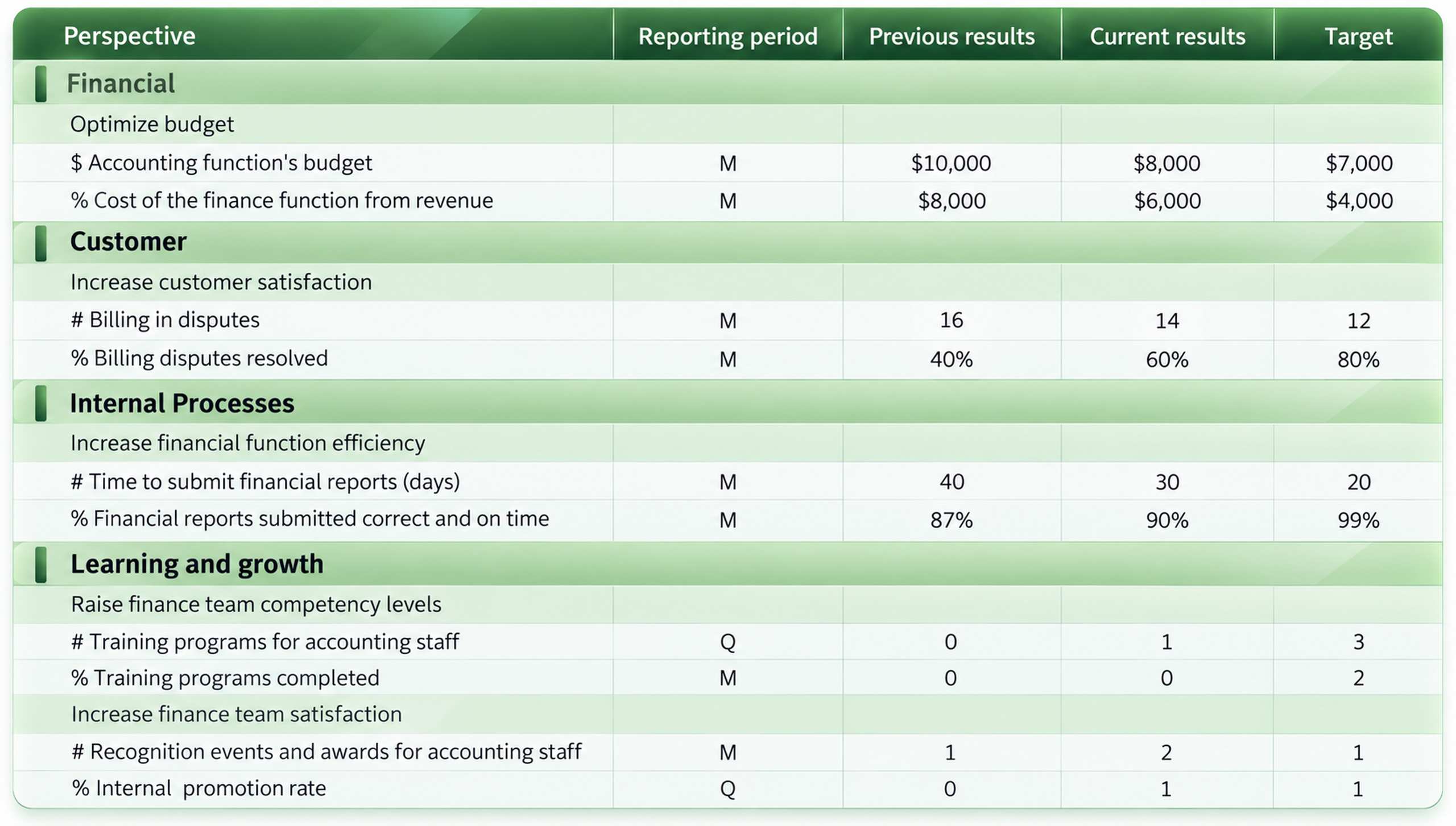
Team scorecards can be a useful tool in creating the performance-oriented financial team that modern CFOs need. These performance monitoring tools enable objectives to be achieved by increasing alignment of individual tasks with the overall expectations of the financial team, and the organization, as a whole.
By sponsoring and supporting the implementation of team scorecards, the CFO can add value to the financial department and instill the advantages of balanced reporting on his team.
Excel is an outstanding tool for designing a trial template of the financial team Balanced Scorecard. Tests performed over a relevant period of time can provide the CFO with substantial insights on the benefits and challenges the team Balanced Scorecard brings to the financial department. A pilot Balanced Scorecard for the financial team can be easily designed with Microsoft Excel as follows:
Additional strategies for CFOs to smoothly embrace their transition from lead controllers to strategically oriented leaders would be:
Employee empowerment: transferring designated workload to create capacity for high value work;
Identifying value: focus on the key business drivers of the organization when delivering the strategic agenda;
Building knowledge: using all available information resources to collect both financial and non-financial data;
Monitoring performance: selecting the right set of performance indicators to adequately convey the meaning of the organization’s value propositions; encouraging the use of customer oriented indicators, such as # Repeat customers and # Customer satisfaction index can contribute to cohesive strategy delivery and decision making across all levels of the organization;
Upgrading technological infrastructure: business intelligence tools are an investment made for long-term productivity and operational efficiency and, additionally, they guarantee higher returns (ROI) when used to build on performance;
Sharing practice knowledge: use influence to emphasize the importance of a performance oriented culture as well as encourage propensity for financial literacy.
Although the transition from financial controller to strategic leader, might be a challenge for most CFOs, the process of becoming tomorrow’s leader in finance is based on adaptation to market trends. As the main business trend of today is performance management in its entirety, implementing the Balanced Scorecard might just be the way out of the rigid, outdated CFO’s financial role.