Consequences of employee turnover on Organizational Performance


Companies make large investments for their employees’ training, development and exert a great desire to retain top-performing employees.
Get the opportunity to grow your influence by giving your products or services prime exposure with Performance Magazine.
If you are interested in advertising with Performance Magazine, leave your address below.

Companies make large investments for their employees’ training, development and exert a great desire to retain top-performing employees.


The Balanced Scorecard provides any organization with a homogeneous view on the execution of strategy. It may take several months to several years for the Balanced Scorecard to reach its full implementation within the organization, but the end of the journey can be marked by impressive results.


Organizational structures have been defined as a pattern by which organizations can divide their activities and tasks, as well as control them, to achieve higher degrees of coordination.


Modern practices have provided enough proof to show that performance management has a tendency to alter organizational processes and to shift mentalities. It is of little surprise that archaic business functions, such as the financial one, find themselves in need for refinement.
The question that inevitably comes to mind is: Are the persons in charge aware of the transformation? Are Chief Financial Officers the financial leaders that organizations expect them to be?
The Balanced Scorecard approach to financial performance monitoring has shifted its focus from bottom line spreadsheets to financial strategy. The Chief Financial Officer is compelled, therefore, to reconsider his role within the top management team.
The more a CFO’s role in the company expands, the more value that company draws on the execution of its overall strategy. In the same manner that the Balanced Scorecard focuses on more than its financial perspective, so should the CFO report not only on financial results, but also reveal their end-to-end significance to the entire company.
More explicitly, the Chief Financial Officer of today is expected to use his/her analytical skills to overcome performance driven challenges and to encourage business growth. In the present business environment, the CFO is required to not only record financial data, but also to interpret the numbers for future forecast and decision-making.
In the context of performance management, re-modelling the rigid structure of the financial function is one of the hardest things to do. Communicating financial results to executives in a manner that encompasses the company’s full value chain and operational engagement may be perceived by CFOs as a time consuming demeanor that does not always fit the job description.
Furthermore, CFOs are generally more concerned with regulatory aspects, such as financial compliance, rather than improving performance in an organization. Either way, the increased demand for performance achievement and strategic orientation call for a reassessment of CFO positions within organizations worldwide.
Long story short, CFOs of today must do better than duplicate the role of their controllers. Consequently, an effective way for CFOs to get involved in the strategy formulation and execution processes of an organization is for them to deploy the Balanced Scorecard implementation process.
Beyond their purpose of connecting strategic objectives to day–to-day operational activities, Balanced Scorecards provide an in-depth view on financial tracking, as well as non-financial parameters that aid financial forecasting.
A strategically focused CFO ensures that financial indicators track not only performance, but they also reveal trends, raise awareness to risk and highlight business opportunities. Of course, there are the rigid financial metrics such as $ Earnings before interest and taxes (EBIDT), %Return on equity (ROE) and %Net profit margin that are too specific and lagging to create value in the future but, nonetheless, indispensable when evaluating past performances.
Altogether, just as everything evolves with progress, so do performance indicators. Continuously refining financial indicators so that they are aligned with business and market trends, consumer behavior changes and technological advancements, must be the duty of the modern CFO.
Performance indicators such as $Liability adjusted cash flow yield (LACFY), $Cash burn, $Cash build, $Net cash position and %Bad debt expense, can stand out as refined indicators which can be both lagging, and leading, in their contribution to management decision making.
Successful CFOs must also pay special attention to calibrate their finance team and spot new talent. By actively taking part in the recruitment process, CFOs provide a valuable insight into the level of financial knowledge a promising candidate possesses. By delivering in-house trainings, a CFO can acquire a better perception of an employee’s competencies, as well as find reasons to rethink competencies required for their future promotions.
Team scorecards can be a useful tool in creating the performance-oriented financial team that modern CFOs need. These performance monitoring tools enable objectives to be achieved by increasing alignment of individual tasks with the overall expectations of the financial team, and the organization, as a whole.
By sponsoring and supporting the implementation of team scorecards, the CFO can add value to the financial department and instill the advantages of balanced reporting on his team.
Excel is an outstanding tool for designing a trial template of the financial team Balanced Scorecard. Tests performed over a relevant period of time can provide the CFO with substantial insights on the benefits and challenges the team Balanced Scorecard brings to the financial department. A pilot Balanced Scorecard for the financial team can be easily designed with Microsoft Excel as follows:
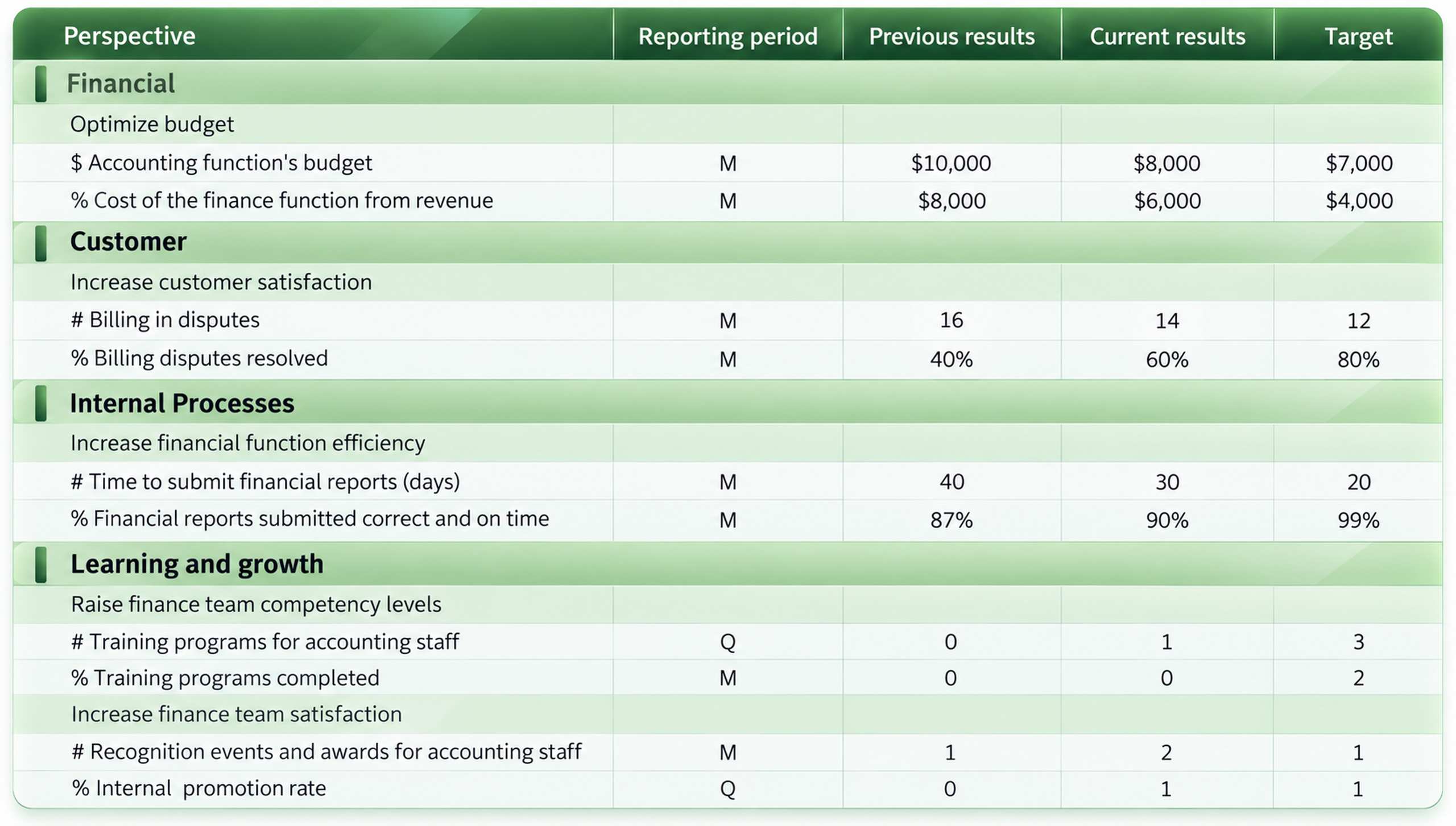
Additional strategies for CFOs to smoothly embrace their transition from lead controllers to strategically oriented leaders would be:
Although the transition from financial controller to strategic leader, might be a challenge for most CFOs, the process of becoming tomorrow’s leader in finance is based on adaptation to market trends. As the main business trend of today is performance management in its entirety, implementing the Balanced Scorecard might just be the way out of the rigid, outdated CFO’s financial role.


In most cases, in small businesses within the service sector, the lack of managerial education of entrepreneurs negatively impacts the quality of the entire managerial process.
This is one of the reasons for employing modern methods of management in small companies from the third sector, in order to obtain qualitative management, even though in some specialty researches, these methods are recommended only for managers of large enterprises or businesses.
Terms of use | Privacy Statement | Cookie Policy | Disclaimer | Online Dispute Resolution (ODR)
Copyright © 2004-2026 The KPI Institute Pty. Ltd. All rights reserved