Expert Interviews Series: Rethinking Performance Management in the Age of AI with Dr. Sarah Binsaied


For years, performance management leaned heavily on financial results and annual reviews to tell organizations how they were doing. That picture is changing fast, and few people are watching the shift as closely as Dr. Sarah Binsaied.
An Assistant Professor at the Institute of Public Administration in Saudi Arabia, Sarah holds a PhD in Nonprofit Marketing from Brunel University of London. Her work sits at the intersection of strategy, marketing, and organizational performance, and she brings an academic’s eye to questions that most executives only have time to answer on instinct: What should organizations actually be measuring? Which tools still hold up under pressure? And what happens when AI starts making judgments that used to belong to people?
In this interview with Performance Magazine, Sarah shares her perspective on where performance management is heading in 2026, why financial KPIs alone no longer tell the full story, and what leaders and researchers should be paying closer attention to as the field evolves.
Trends
What key trends in organizational performance management have you observed emerging so far in 2026?
In 2026, many organizations are moving away from fixed annual strategic plans toward more flexible and adaptive performance management approaches. This includes rolling forecasts, real-time tracking of KPIs, and goals that can be updated as needed. This shift helps organizations respond faster to market changes, new technologies, and evolving stakeholder expectations.
Which of the existing trends, topics, or aspects within performance management have lost their relevance and/or importance, from your point of view?
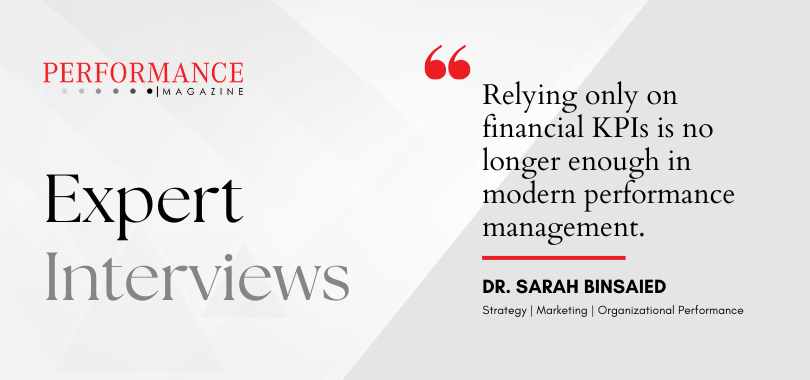
Relying only on financial KPIs is no longer enough in modern performance management. Today, organizations need to look at both financial and non-financial measures, such as employee engagement, customer experience, innovation, and sustainability. Financial results usually reflect what has already happened and may not reveal early risks or future opportunities. By using broader performance indicators, organizations can better understand long-term value and build a more sustainable competitive advantage.
What does the corporate performance management system of the future look like?
The future performance management system will rely more heavily on AI and predictive analytics. It will use real-time data and machine learning to identify possible performance gaps before they happen, and it will combine financial and non-financial indicators in a single dashboard. This will help organizations make faster decisions, adjust their strategy continuously, and move away from traditional annual reviews that risk becoming outdated quickly.
What will be the major challenges in managing performance in the future, and how should organizations prepare for them?
The main challenge will be employee resistance to change, especially when AI is used in performance evaluation. Some employees may feel worried or uncertain about these tools. Organizations can prepare by offering continuous digital training, clearly explaining how AI will be used, and building trust. Employees should understand that AI is meant to support their work and decisions, not replace or threaten them.
How is technology impacting the way organizations conduct strategic planning and manage performance? Any specific technology tools you would like to mention?
Technology is changing the way organizations approach strategic planning. Instead of relying only on fixed annual reviews, organizations can now use real-time data and predictive analytics to make faster, more evidence-based decisions. Tools such as Power BI help teams display KPIs clearly, connect data across departments, and spot performance trends early. This supports more flexible strategic planning and allows organizations to adjust decisions as new information emerges.
How is sustainability impacting the way organizations conduct strategic planning and manage performance? Any specific sustainability aspects you would like to mention?
In Saudi Arabia, sustainability is becoming an important part of strategic planning, especially because of Vision 2030. Organizations are now expected to measure ESG indicators, covering environmental, social, and governance aspects, alongside financial KPIs. This means tracking environmental impact, social contribution, and governance practices. As a result, sustainability is no longer just about meeting requirements; it is becoming a key factor supporting long-term performance and strategic success.
Practice
What should be improved in the use of strategy and performance management tools to make an organization even more resilient to future crises?
Strategy and performance tools should build in risk scenario planning as part of the core strategic framework, not as a separate activity. This means using scenario analysis, stress-testing, and contingency KPIs when building plans. Doing so helps organizations spot possible risks and disruptions earlier, adjusting their strategies before a crisis hits rather than reacting once the problem has already become serious.
While navigating through these challenging times, what would you consider a best practice in performance management?
A good best practice is involving employees in setting goals and KPIs, rather than assigning targets from the top alone. When employees help create the targets, they feel greater ownership and motivation, and the goals become more realistic, especially in uncertain situations. This approach also helps leaders draw on frontline insights, improving both employee engagement and the quality of performance measures.
How does benchmarking support the improvement of performance management and target-setting systems?
Benchmarking helps organizations understand where they stand compared with others in the same industry. Instead of setting targets based only on internal assumptions, they can draw on real examples from high-performing organizations. By comparing results, processes, and practices, organizations can identify performance gaps and areas for improvement. This also helps them set more realistic, informed targets while learning from strategies that have already proven successful.
Research
Which organizations would you recommend observing due to their approach to managing performance and its subsequent results? Why?
I recommend looking at Saudi Aramco, because it combines strong performance management with long-term strategic planning and operational excellence. The company uses structured KPIs across different business units, supported by clear governance and a culture of continuous improvement. This makes Aramco a useful example for understanding how large, complex organizations manage performance effectively and align daily operations with strategic goals.
What aspects of performance management should be explored more through research, given their importance in practice?
More research is needed to understand how employee wellbeing affects long-term organizational performance. Many studies focus on short-term productivity, but it is still unclear how wellbeing programs create lasting results over time. Organizations need stronger evidence on whether these initiatives lead to real performance improvement or only temporary benefits, especially since the impact may differ across industries, workplaces, and organizational cultures.
What are the key competencies of a successful business leader (C-level executive)?
Successful C-level executives need strong emotional intelligence and the ability to lead change in a clear, supportive way. They should understand employees’ feelings during transitions, communicate the vision simply, and build trust across the organization. Emotional intelligence helps leaders manage resistance, motivate people, and create commitment, making change more sustainable rather than dependent solely on top-down decisions or pressure.
What are the key competencies of a strategy and performance manager to succeed nowadays?
Nowadays, a strategy and performance manager needs strong communication skills and the ability to influence people at different levels of the organization. This role is not only about analyzing data but also about explaining it clearly and usefully. When managers can turn complex strategic information into simple messages for executives, middle managers, and frontline employees, they help create alignment, support, and better strategy execution.