According toHolonIQ,the online education market is expected to reach $74 billion by 2025. Meanwhile, Verified Market Research predicts that the global personal development market would reach $51.6 million by 2028. If you are interested in launching your own course, having a marketing model will help you structure and assess your tactics and those of your competitors so you may communicate them to your internal shareholders.
Think of marketing models as a tried and tested checklist. Maybe you are new to the field or have a lot of experience in a very specific domain. Aside from providing a comprehensive view of your goals, models are a great tool to get insights into the marketing strategy of your competitors and gather some best practices. One of the most used marketing models is the AIDA model.
The AIDA model
Developed in 1898 by Elias St. Elmo Lewis, the AIDA model sequences the customer’s journey of awareness, interest, desire, and eventually, action. Due to its nature, it is also called a “response hierarchy model”. This model envisages a world where consumers move through each stage before going to the next one as a classical marketing funnel.
Looking at what your competitors are doing at each stage of the AIDA model is a great way to get insights into your own marketing strategy. But see how this model can be applied to marketing an online course. The idea is that you have a very clear understanding of the market, on who exactly your consumer is, what are their needs and pain points, and what are your unique selling points.
Here are some best practices in terms of marketing online courses using the AIDA model.
Capturing attention. Initially, the assumption is that the consumer is completely ignorant about you. To grab their attention, you would need a marketing outreach strategy. You need to define your brand awareness campaign. So, for an online course, what would that look like?
To illustrate, The School of Life offers personal development courses for individuals under the following categories: self, love, work, and culture. As an outreach strategy, they have an amazing YouTube channel where they post once a week a video with content related to one of these categories. Their content is also built on what people are looking for such as howto articles and best practices lists, as well as searches like “find satisfying work” or “keep a relationship going”. Finally, they use effective content marketing to establish their leadership in the field and attract customers to their website.
Generating interest. At this stage, you want your customers to find out more about the benefits of your product or service. Say that they have already seen your content on a social media platform and they have reached your website. This is a good moment to capture that interest in a subscription list.
As an example, The Gottman Institute offers the Marriage Minute newsletter for sending tools, articles, videos, exercises, and best practices for couples based on their ideology of a “research-based approach to relationships”. It also acts as a great tool for nurturing leads.
Instilling desire. During this stage, you want your customers “to want” your product or service. How to do that for an online course? The Stanford Encyclopedia of Philosophyidentifies six theories of desire which you choose to act on: action-based, pleasure-based, good-based, attention-based, learning-based, and holistic (functionalist and interpretationist).
An example of this would beMindvalley‘s offering of free Masterclasses that are available only for a limited amount of time. Here, they share insights from their courses which, in turn, creates trust. The beauty of this resides in the fact that on the one hand, they nurture the leads with great content (attention-based), while on the other hand, they create some sort of scarcity such as time-limited discount (action-based).
Triggering action. Finally, this is the stage wherein you aim to help consumers convert. This calls for an effective Call to Action (CTA), but how does that work for an online course? You should know exactly what your customer values, and at this point, use them to encourage them to engage with you.
Esther Perel uses this line on her website for her online course as a CTA: “Start your intimacy journey today”. For couples, starting a course is problematic because it requires them to admit that there is a problem. So having a CTA focusing on “starting a journey” taps into fear and addresses it. Moreover, Esther Perel’s short bio also helps the CTA as it reinforces her personal brand to her customers who consider this of high value. Reinforcing her personal brand at this point is a great tactic to encourage action.
Criticism of the model
One of the strongest criticisms of the model is that it does not reflect the actual reality; consumers might not have a linear journey and their decisions are not always rational. Another major drawback of the AIDA model is the lack of focus on the retention and referrals stage.
An alternative to AIDA is TheFlying Wheel, a model developed by HubSpot which focuses its efforts on delighting the customer. Nevertheless, the model is a strong marketing framework that can help you guide your customers along their journey, structure your marketing efforts, and better understand your competitors.
E-learning (recorded) or live online has become a trend, and with the pandemic crisis, the urge to have e-learning courses or live online in all fields has dramatically accelerated. Live online or prerecorded e-learning courses have become an effective means when doing learning courses. With new jobs coming up every day, there is a rise in the need to obtain new skills that the academy will not be able to develop and provide as the pace in the market continues to quicken.
Moreover, live online or prerecorded courses make it possible for everyone to learn new skills, techniques, and tools from any country. Meanwhile, people get to learn new skills other than the ones intended by the course, such as communicating with other people from different cultures with varying perspectives and ideas.
How to design an effective course
The important question to address here is how can we design an effective course whether it is a live or prerecorded one? Currently, this field has become very competitive, and various organizations in different industries are developing their own courses. The answer to this question starts by creating an effective diagnosis of the target market.
Before instructional designers (ID) or content developers rush in by designing courses, they need first to have enough data explaining the current status of the market and the problems their courses will be solving. Companies need to differentiate themselves from competitors when they design similar courses. In other words, why should they choose your course rather than a competitor’s?
Stage 1: Market Diagnosis
The first stage of creating a library of e-learning courses is conducting market research; specifically, a gap analysis to have a better understanding of the gaps in the market and to update the profile of your customers. Moreover, companies should be updating their competitive analysis every now and then to be able to differentiate themselves. Feedback from previous training could be useful and help in designing the right questions for your market research. After gathering and analyzing data, companies will be able to spot the current needs of their target market.
Stage 2: Preparation
During this stage, the ID or content developers should brainstorm the different courses they need to develop. The brainstorming sessions could include different stakeholders across the organization as long as their input is relevant to the sessions. Then, prioritization according to the available resources is crucial at this stage. It goes without saying that the course design should be aligned with the overall business strategy; this is a vital criterion that should be considered during the brainstorming sessions.
Stage 3: Implementation
In the third stage, the ID or content developers start to develop the course chosen during the previous stage. The ID decides on the methodology for developing the course and its learning outcomes and objectives, such as Bloom’s taxonomy for the learning outcomes and ADDIE model for developing the main content of the course. The ID also gets to decide based on the nature of the course and the target market, the type of practical work (such as exercises, discussion questions, case studies, quizzes, exams, etc.) that will be included in the course, as well as the methodology of the questions used. Consequently, it is recommended to have a well-defined and detailed process for this, from the point the course is designed until it reaches the testing phase.
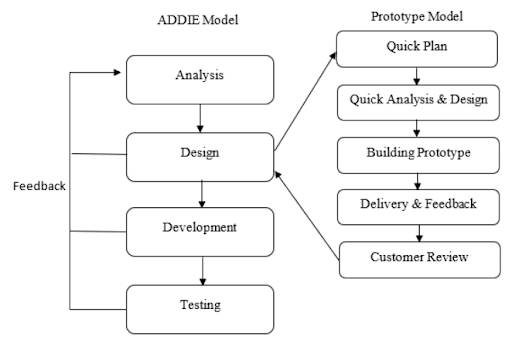
Companies do not have to follow the same exact ID model that is commonly used by other companies such as the ADDIE model. However, they could develop their own model according to the course type they are designing, such as the model suggested in Figure 1 below from the study of Mustafa Saeed and his team (2019).
The model in Figure 1 incorporates a prototype model with the traditional ADDIE model to design e-learning courses for students. It suggests placing the prototype phase after the designing phase or as an extension. It also suggests applying the iterative flow through which one or more of the stages can be repeated during the development process.
The main advantage of this model is that it incorporates the customers’ feedback within the design stage. Despite the fact that this model was developed for e-learning courses, the same concept could be used for prerecorded or live online courses.
Finally, the implementation phase involves choosing the right tools and technologies for delivering the course (whether offline or live online). Needless to say, there are various factors that should be considered in choosing the appropriate tools and technologies (hardware and software). These can include the type of learning platform as well as the security and privacy measures taken to protect the course shared with the participants whether it is done through a pre-recording or live online.
Stage 4: Prototype
In this stage, the ID finalizes the course and is ready to test it. The ID starts this stage by transferring the course knowledge to the trainer, including all the practical work (exercises, case studies, etc.). The ID may include the feedback and the comments of the trainer before testing it. From there, the trainer could create some kind of simulation with a group of people to test the whole content of the course and gather feedback for improvements. This phase is vital because ID and developers will be able to tackle any problems with the content and the different technologies used.
Stage 5: Launching
This is when the course is launched in the market after deciding on the appropriate price of the course, as well as the time and place for conducting it. This stage also includes marketing the course(s) online through channels such as the company’s website and social media. It goes without saying that course competencies, learning objectives, and learning outcomes should be clear for the participants to help them decide whether the course is relevant to their field of expertise/interest or not.
Stage 6: Evaluation
Finally, the company evaluates the effectiveness of its course. This could be done by gathering feedback from the participants by the end of the course to assess the whole learning experience from the moment they sign up for the course until they receive their course certificates. This data will definitely help companies in improving their course and the whole learning experience.
In conclusion, there is no one way that would work for all. Companies get to design their own processes based on certain elements such as the nature of their course, target market, and industry trends. However, this article discusses the common building blocks that are essential for the successful design of a course. Finally, below are a few tips that could help in designing a course effectively:
Keep yourself up-to-date with the current industry and market trends.
Be aware of new tools and techniques for a better e-learning experience.
Decide on the competencies of each course before developing it to match your market needs.
Assess your current instructional model used to identify areas that require improvements or other steps that need to be added to the model.
Involve the input of the relevant stakeholders in the implementation and the prototype phases.
Involve the participants’ expectations within your course. Companies, for example, can allow for discussions with the participants to know more about the course before the pay. This will also allow companies to have more data about the common expectations among different participants for future improvements.
Data-driven decision-making means to put actions based on real metrics and analytics derived from real-world data. In contrast to opinionated, anecdote-driven decision-making, data-driven decision-making is superior since it is based on facts rather than opinions. Numbers and facts represent reality, whereas opinion is highly subjective and susceptible to bias.
Furthermore, with the advent of the internet and technology, we are now bombarded with an abundance of data that is accessible from anywhere. This abundance of data can be an advantage for your organization, but it can also be a threat if you are unable to use it and your competitors are better at it. This article highlights the Sales and Marketing (S&M); area since profitability is the objective of all companies, the main force that drives it is in S&M.
Before going into a data-driven approach, the essential concept of the S&M strategy needs to be discussed. Understanding this concept is important to know what the objective is and ultimately influence the process in a good way. The following are two main components of S&M strategy:
Customer Experience
The customer experience is what your customers want. It is about speed, convenience, consistency, and friendliness. Understanding the consumer extends beyond customer profiling. Because each product or service offered by a business has a unique target demographic, companies must approach the customer experience for each.
A company will be able to organize its involvement with the consumer or potential customer if it has a thorough understanding of the buying cycle: pre-purchase, purchase, and post-purchase. The effort to engage customers nowadays relies heavily on technology and data analytics.
Customer-centric Business
A customer-centric company is a method of conducting business with your customers that provides a positive customer experience – both before and after the sale – to drive repeat orders and customer loyalty. Being customer-centric goes beyond just providing a good service. For that purpose, companies should utilize technologies that can help companies to be more attentive to the customers.
The two components explained above have similarities. They both require an understanding of the customer: the “who”, “what”, “when”, “why”, and “where”. Years ago, companies relied on surveys to obtain information about customers. But now, a myriad of ways to learn about your customers are available.
Start by collecting customers’ feedback. Not only directly (i.e., emails, phone calls) but also indirectly through statistics and analytics. For example, by using web analytics, you can gather information such as customers’ demographics, where they are from, what is their favorite part of the website, what they do before buying your product, and so on. It is only an example of how a data-driven approach can be used to improve customer experience.
Keep in mind that technologies such as data analytics are only enablers, not problem solvers. Its design and implementation must be aligned for both S&M. Marketing should provide Sales with metrics that delve deep into customer data. If the data is of poor quality, the Salesperson cannot convert prospects into buyers effectively. This is where the data-driven approach comes into play. When the S&M processes are in sync, data and analytics perform best. To learn more about data visualization and how it can be utilized to serve your processes better, join The KPI Institute’s Certified Data Visualization Professional Certification.
While the media played a crucial role in information dissemination during the COVID-19 pandemic, the industry wasn’t spared from the effects of the crisis. According to reports, live events were halted, advertisement spending was reduced, and the print media couldn’t distribute its physical materials due to the readers’ concerns about virus transmission.
But for the Emirati state-owned Abu Dhabi Media (ADM), the challenges still paved the way for breakthroughs and opportunities. The ADM rolled out a renovation plan that focuses on digitization. It allowed the media institution to minimize the damages of the crisis and take advantage of emerging opportunities.
Three ADM outlets (Al-Ittihad newspaper, Abu Dhabi TV channel and Abu Dhabi radio station) were established back in 1969, and they were joined by more media platforms and attached to different entities until the ADM–as it exists today–was established in 2007.
Under Law 13 for that year, the company was established as a joint-stock company with 100m AED in capital worth, initially including nine various platforms. Today, the company has at least 22 traditional and online brands to its name.
In February 2020, when the COVID-19 pandemic started to weigh on the country, ADM announced its transition to digital content. While this may seem like a result of the pandemic, the renovation plan has its roots in the company’s 2007 establishing law, which recognizes digital content as an important domain for ADM to pursue. This reflects on digital-first content being one of the value pillars that the company is holding to. Furthermore, the plan was driven by one the organization’s first strategic priority: to maintain financial stability through “efficient finance and resource management and diversified revenue streams.”
Digital transformation has been inevitable for ADM, and the pandemic accelerated it. This is generally true due to the advancement of media technologies and also true in a country that has the highest internet penetration percentage globally. Ninety nine percent of UAE’s population use the internet while only 22% read offline newspapers, according to Northwestern University in Qatar’s Media Use in the Middle East 2019 survey.
Rebranding to digital: ADM introduced rebranding methods to all of its affiliated channels, stations, newspaper and magazines, to recalibrate their orientation towards the digital horizon.
Enhancing digital presence: A part of the rebranding was to remodel all of the affiliated outlet websites to be more dynamic, mainly through taking care of user experience (UX) and user interface (UI).
Boosting digital content: This enhancement allowed expansion in digital-first content. The veteran Al-Ittihad newspaper started offering audio-visual content, including live streams on social media. The women’s Zahrat Al-Khaleeg magazine started introducing interactive content with extra men-engaging conversations. Meanwhile, Maged’s children magazine had its whole parallel virtual universe established. The digital-based platform Muhtawa also released more than 1,000 videos over the following months.
Expanding Video on Demand (VoD): Video content was also available to be watched on demand over the internet. This was offered through the enhanced websites as well as through the bunch of mobile applications that ADM continued to develop. It made sure the applications are available on all mobile operating systems, mainly Android and iOS.
Taking advantage of SVoD: ADM took advantage of audience readiness to pay subscriptions for content through some of its mobile applications (like UFC Arabia). It also widened its partnership with STARZPLAY, one of the most famous SVoD platforms in the GCC, to premiere its original productions.
Extending through OTT technologies: ADM made sure that more of its content is compatible to consume through technologies like Press Reader and Amazon Alexa as well as fostering its presence on Apple TV and Android TV platforms.
Growing library: To meet the accumulating demand due to the increasing audience consumption, ADM added 60 different titles across its platforms.
Meeting the growing interest in news: A considerable portion of the new titles was news and information in nature to help the audience make sense of what is going on in the COVID-induced reality.
Reducing the cost of print: The company turned its magazines Zahrat Al-Khaleeg and Maged to monthly periodicals. This led to reduced costs and more digital offerings and extensive content.
Towering results
The real test for ADM’s plan came in Ramadan in April and May 2020. The Islamic holy month is when media outlets across the MENA region, especially TV channels, get surging consumption. This is a pattern that peaks during the curfewed Ramadan.
For that month, ADM reported a 20% increase in Abu Dhabi TV’s viewership rates across the UAE and 90% across the neighboring Saudi Arabia, compared to Ramadan 2019. The company described the figures as “exceptional” percentages. The recently enhanced OTT channels gathered 7.25m views, with 190,000 new downloads for the channel’s mobile application.
Other published results for the longer period following the plan’s launch included a 500% year on year hike in the number of views for Muhtawa digital platform during the first three quarters of the pandemic year and 1,500% increase in the number of its followers.
Key business lessons
Here are the principles that made ADM’s digital transformation journey possible and could be adopted by businesses in any industry.
An open-look strategy: ADM could have struggled more if it didn’t consider digital transformation in its strategic priorities. Anticipating what the future may hold when formulating a business strategy better prepares companies for any event.
Flexibility: Recalibrating one’s systems towards the digital world required a considerable level of flexibility from ADM. This helps businesses build resilience and capability of working around challenges and taking advantage of opportunities.
Agility: ADM took the courageous leap in the early stage of the pandemic when the whole world was still trying to make sense of the disaster. This quick decision making and implementation saves the business a chain of losses and opens breakthroughs for possible gains.
Courage for pioneership: Both flexibility and agility require courage, but ADM also proved a courage for pioneership as they jumped into unfamiliar territories. They created a parallel virtual universe for a magazine that has lived on paper for decades and betted on SVoD services, which remain rare in the MENA region. This kind of courage is about accepting that hard questions cannot be met with easy answers.
For more lessons on developing new strategies for your business, check out the Strategy and Business Planning Professional Certification course offered by The KPI Institute.
GreenComp identifies a set of sustainability competences to feed into education and training programs to help learners develop knowledge, skills, and attitudes that promote ways to think, plan and act with empathy, responsibility, and care for the planet’s and the public’s health. It also aims towards business growth and development as the niche of sustainability-driven businesses is growing fast.
At a policy level, GreenComp is a policy action derived from the European Green Deal as a catalyst to promote learning on environmental sustainability in the European Union.
GreenComp provides a common ground to learners and guidance to educators, specifying a consensual definition of what sustainability as a competence entails. It was created to support education and training programs, including lifelong learning. Also, it may be used by corporate trainers to translate the sustainability strategy of their companies in training content and programs that may help the employees and other stakeholders to act for sustainability. This will help learners become systemic and critical thinkers, as well as develop agency, and form a knowledge basis required for caring about the planet’s present and future state.
Sustainability competences among employees may enhance innovation and adaptability at an organizational level and may also support the CSR strategy.
Main concepts definition
Sustainability is defined as “prioritising the needs of all life forms and of the planet by ensuring that human activity does not exceed planetary boundaries.”
Asustainability competence empowers learners to embody sustainability values and embrace complex systems to take or request action that restores and maintains ecosystem health and enhances justice, generating visions for sustainable futures.
Learning for environmental sustainability aims to nurture a sustainability mindset from childhood to adulthood with the understanding that humans are part of and depend on nature. Learners are equipped with knowledge, skills, and attitudes that help them become agents of change and contribute individually and collectively to shaping futures within planetary boundaries.
The European Sustainability Competence framework
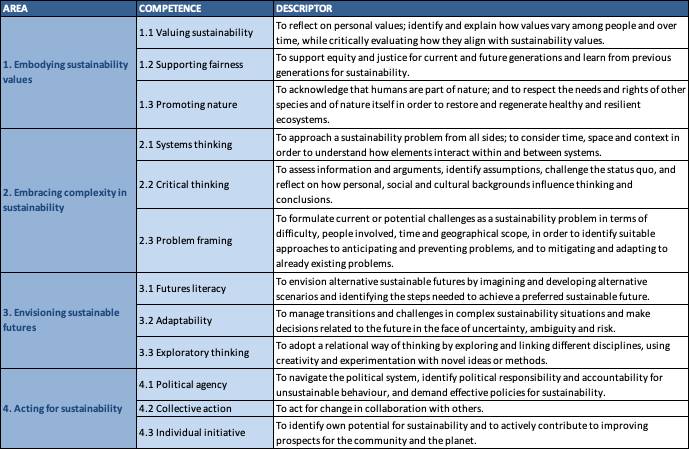
GreenComp consists of four competence ‘areas’ that correspond to the definition of sustainability; each competence area contains three competences. In total, there are 12 sustainability ‘competences’ that, taken together, make up the building blocks of the sustainability competence for all people.
As illustrated in Figure 1 below, the competence areas and competences are numbered for references purposes; this does not imply a sequence of acquisition or hierarchy. All 12 competences are equally important. As such, learners are encouraged to develop all of them.
The four competence areas are intertwined, and sustainability is a competency that encompasses all four. The 12 sustainability competences are also linked and interconnected and should be considered as a whole. While we encourage learners to acquire the 12 competencies, they are not needed to have the highest level of proficiency in all of them, nor do they need to have the same level of proficiency in all of them. Indeed, GreenComp suggests that sustainability as a competency is comprised of 12 components.
Each of the 12 competences is further described in learning outcomes, in terms of Knowledge, Skills, and Attitudes. There are 169 learning outcomes in total.
How businesses can use GreenComp
GreenComp can be used in many ways in the business environment, especially through training programs targeting the employees, as well as mentoring and coaching programs targeting the leadership level. Here are some examples:
Development and execution of CSR strategies. GreenComp may provide a framework for a holistic, integrated approach.
Development and execution of Innovation strategies. GreenComp may set a common working framework for discussions and initiatives where any employee who wants to contribute can do so.
Business development. GreenComp can serve as a compass in finding new business opportunities and new business partners in the niche of sustainability-driven businesses.