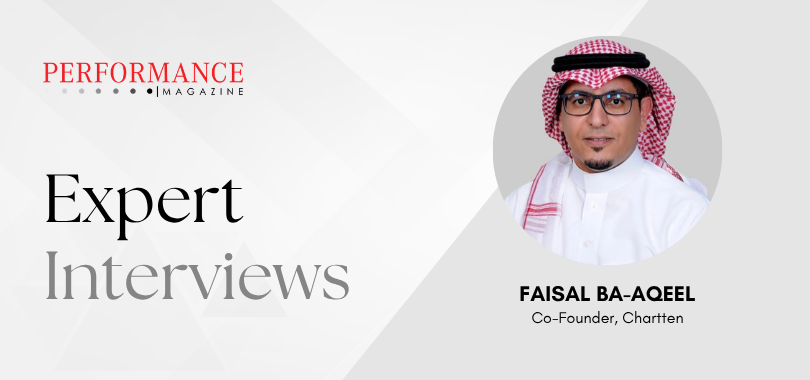
Expert Interviews Series: Scaling Performance in Fast-Moving Organizations with Faisal Ba-Aqeel


High performance rarely happens by chance. Someone has to build the systems, ask the difficult questions, and keep improving them long after the first results appear.
That has been a constant throughout Faisal Ba-Aqeel’s career. As the co-founder of Chartten, an AI-powered business support platform launched in 2025, he is applying more than 21 years of experience across procurement, operations, facilities management, and business transformation to solve a challenge he has repeatedly encountered throughout his career. The platform was born from his belief that while organizations already have access to powerful digital tools, routine operational work continues to consume valuable time because skills, technology adoption, and digital awareness vary across teams. By reducing administrative burdens and simplifying day-to-day business processes, Chartten is designed to help organizations focus on decisions that create real value.
Before co-founding Chartten, Faisal built and scaled procurement, operations, and facility management functions across industries including logistics, food, retail, and technology. Working with organizations such as FedEx, Supreme Foods, Al Romansiah, Delivery Hero, and Careem, he led complex projects in fast-growing environments where disciplined execution, data-driven decision-making, and continuous improvement were essential to delivering results.
What can leaders learn from someone who has built systems across industries, transformed business operations, and now channels those lessons into building an AI platform for modern organizations?
In this interview with Performance Magazine, Faisal reflects on the principles that have guided his career, the thinking behind Chartten, and the mindset required to build organizations that continue to perform as they grow.
Building something from nothing is rarely a straight line. How would you describe the mindset you bring into a role where the structure, the process, even the team, doesn’t exist yet?
A strong foundation comes from understanding the scope of work, knowing the purpose, estimating the required resources (tools, manpower, funds, technology, etc.), involving the right people, aligning stakeholders, consulting and benchmarking the market, and studying the obstacles and risks before execution begins. From there, execution is followed by continuous observation, regular updates to the involved team, and the application of continuous improvement.
You have developed procurement and facility functions from the ground up at more than one company. When you start a function with no existing structure, what do you set up first, and why does that piece come before everything else?
Gathering data (from there, I can see everything that is going on), then analyzing it, helps me make decisions in accordance with company policies and goals. As the widely recognized principle says, “You can’t manage what you can’t measure,” and, as W. Edwards Deming famously said, “In God we trust; all others must bring data.”
At Delivery Hero, you supported the expansion of dark stores, coffee shops, and cloud kitchens at the same time. How did you track performance across formats that differ so much from one another, and what numbers told you a location was on track?
Setting up SLAs (internal and external) based on internal clients’ (colleagues’) project deadlines. Once these boundaries are understood, I compare them with the tools I have, then hire the required manpower (qualified team members) who will lead the work and meet those deadlines on time. Then, I divide the tasks into SMART goals and start measuring them through all possible tools (MS Project, dashboards, and Power BI) to ensure we are on track.
Procurement and facility work often pulls in different directions, one chasing savings, the other chasing speed and reliability. How do you decide which one wins when a decision can’t satisfy both?
Completely agree, as one focuses on saving while the other focuses on spending to ensure business stability. My role is to understand the components and specifications in facilities, including the latest technologies to optimize the work, then secure and align such innovations in-house with a well-drafted contract. After that, I keep evaluating and monitoring performance and results while continuously improving wherever needed.
Your work has touched fresh chicken supply, dark store rollouts, and cloud kitchens, sectors with very different risk profiles. What changes in your approach to performance tracking when the product on the line is perishable versus when it isn’t?
Knowing the nature of the product and its challenges allows us to set up the right and well-agreed terms across all tiers (upstream and downstream). Then, putting in place a proper process (clear communication, real-time data sharing, buffer stock, strong relationships, technology, etc.) allows us to become more resilient from a business perspective. The nature of the product is certainly a challenge, but applying the above makes everything observable and keeps risks to the lowest possible level.
You moved from sales at FedEx into procurement and operations later in your career, a shift many professionals don’t make. What carried over from that early sales experience into how you manage supplier relationships and targets today?
The titles, techniques, and angles seem different, but believe me, sales and procurement are two sides of the same coin: value exchange. Sales taught me commitment, negotiation, contracts, relationships, numbers, and results, all to achieve business value through a win-win approach. Knowing sales absolutely helped me understand how procurement works and how both functions share the same value, allowing me to play my role properly while contributing to business success.
Digital transformation and Power BI tracking came up more than once in your background. Walk us through how a tracker actually gets used day to day. Who looks at it, how often, and what happens when the numbers slip?
Learning to use data and visualization has helped me lead the business, and I built Operations Trackers, Procurement Trackers, and others. I then shared those trackers with the involved parties (internal and external) to align and review them daily, weekly, or monthly (depending on data privacy and relevance), understand business performance, and stay on track to achieve targeted business levels. They also drive real-time decisions, accountability, and corrective actions before small gaps become major problems.
You’ve worked across SAP, Oracle, Microsoft Dynamics 365, and several analytics platforms. When a company already has legacy systems in place, how do you decide what to keep, what to replace, and how fast to move?
I start with a fit-gap analysis by mapping business processes against current ERP capabilities. I keep what supports the core business value and replace or remove what does not align with business needs (while considering costs, of course). The priority is to address the highest-impact areas first, followed by the lower-impact ones. I believe there is no perfect system that fits every business, but systems can be customized according to business needs.
KAIZEN workshops, process organization, automation projects: your background includes a fair share of internal restructuring. What signs tell you a department needs this kind of intervention before the problems become visible at the top?
When small issues interrupt time that should be spent on real priorities, it’s time to use tools such as Muda, Kanban, or Gemba to identify bottlenecks and unnecessary motion, find the root cause, and resolve it before it becomes a bigger issue. The goal is to stay on track with SLAs, policies, and KPIs while applying a continuous improvement methodology.
You’ve delivered projects in three months that other companies might plan for a year. What gets cut from the usual planning process to make that timeline possible, and what risks do you accept in exchange?
I focus on the strategic view, liquidity, and timelines, then accelerate the approval cycle and budget process. This includes combining and eliminating unnecessary steps, such as placing bulk orders for small, repetitive items or supplying new items before common ones, while predicting potential risks by understanding business needs. This approach makes us more resilient and able to closely monitor progress. The accepted risks include extra workload, additional audits, and rework for exceptions outside standard operating procedures (SOPs).
Across FedEx, Supreme Foods, Al Romansiah, Delivery Hero, and Careem, the industries shift but the pattern of building and fixing systems repeats. Looking back at that pattern, what do you think it says about how performance management should work in fast-moving companies versus established ones?
In fast-moving companies like Delivery Hero, performance management is daily: live dashboards, fast feedback, and leaders act as expeditors who fix systems on the go. In established firms like FedEx, Supreme Foods, or Al Romansiah, it is more structured, with quarterly reviews, SOP-driven KPIs, and stability as the priority. The pattern shows that both continuously improve systems, but fast-moving companies prioritize speed over policy, while established companies follow policy to ensure stable outcomes.
Looking at everything you’ve built across these industries, what do you hope the next chapter of your career adds to that story, and what kind of mark do you want to leave on the strategy and performance management space going forward?
To lead in a strategic role, eliminate the operational mistakes I have seen in previous companies as a priority, scale business potential across my network and the companies I have worked for, and drive integration that adds real value to society. The mark I want to leave is creating alignment, empowering people at all levels, sharing knowledge and experience, and driving innovation that integrates with society and creates lasting value.
Tags: artificial intelligence, Business Strategy, business transformation, Chartten, digital transformation, Faisal Ba-Aqeel, Leadership, Operations Management, Performance Management, Procurement performance
Related Posts
 Running Up Debt: The Hidden Cost of Outdated Strategic Decisions in Modern Business
 Expert Interviews Series: Accountability, KPIs, and Execution with Ghazi Hael Alanazi
 Damned If You Do, Damned If You Don’t: Why Middle Managers Are the Real Engine of Strategy Execution
 The KPI Black Market: The Informal Metrics Organizations Actually Trust