Key performance indicators (KPIs) have been the north star guiding business strategy for decades. These criteria measure not only sales and revenue but also customer satisfaction as well as employee engagement.However, as the business landscape continues to evolve at an unprecedented pace, the need for deeper insights and more agile measurement arises. This is where the potential of generative artificial intelligence (GenAI) shines, opening doors to a new era of KPI innovation.
GenAI goes beyond automation to produce entirely novel content. It is a creative catalyst, opening up unprecedented possibilities for KPI innovation. Forget rigid, one-dimensional metrics. Powered by GenAI, KPIs become fluent, adaptive, and poetic, capturing not only the whats but also the whys and what-ifs.
Reimagining KPIs for exponential growth
From static to dynamic: GenAI is capable of integrating dynamic KPIs, meaning they can evolve alongside the company that uses them. KPIs also fit seamlessly into a changing market, with trends and strategies naturally shifting along the way.
Unveiling the unseen: Traditional KPIs often fail to hit the nail on the head by overlooking key, intangible factors that could affect performance. GenAI, however, can delve much deeper. With the help of GenAI, it is possible to determine brand sentiment before a particular campaign is launched, anticipate employee engagement within remote teams, or even predict customer turnover before it happens.
Personalized insights, enhanced action: Data mountains no longer need to be intimidating.GenAI transforms data into personalized narratives, crafting stories tailored to individual stakeholders. Sales teams can access actionable insights, marketing managers can monitor real-time customer sentiment, and CEOs can explore what-if scenarios for strategic foresight. This data-driven storytelling fosters informed decision-making and ignites action across the organization.
A practical guide to unlocking GenAI’s potential for KPI innovation
To effectively utilize GenAI tools like Gemini and ChatGPT for KPI innovation, follow these guidelines:
Define goals and challenges: Clearly articulate objectives, whether uncovering customer sentiment or anticipating market shifts.
Frame specific prompts: Use concise prompts such as “generate potential KPIs for measuring brand sentiment on social media.”
Provide relevant context: Enhance responses by furnishing background information about your industry, business model, and existing KPIs.
Experiment and refine: Iterate prompts, rephrase questions, and provide feedback to improve AI understanding.
Collaborate with experts: Involve human expertise in evaluating and implementing AI-generated insights.
While GenAI’s potential for KPI innovation is undeniable, it thrives on synergy, not substitution. The point is this: human guidance is essential. Act now, invest in your future, and become a master of the new KPI era by enrolling in The KPI Institute’sCertified KPI Professional course.
Today’s organizations drown in information waves. When leveraging data for actionable insights needed to drive strategic decision-making and sound performance measurement, visualization makes that data comprehensible and accessible. Specifically, key performance indicator (KPI) data visualization aims to communicate key performance metrics and trends in a way that is clear, concise, and impactful.
KPI data visualization benefits for organizations
KPI data visualization offers a multitude of benefits for organizations seeking to make data-driven decisions:
Enhanced data understanding: Visualizing KPIs makes it easier and faster to grasp complex data sets, identify patterns, and uncover hidden trends that would otherwise remain obscured in numerical form. KPI visualization provides insights regarding the entity’s current situation and helps a better understanding of the market.
Improved decision-making: Providing a clear and concise overview of key performance metrics, empowers decision-makers as KPI data visualization prioritizes evidence rather than intuition.
Effective communication and collaboration: Visual representations of KPIs facilitate effective communication and collaboration across teams by enabling stakeholders to share insights, align strategies, and achieve desirable goals. Additionally, KPI data visualization fosters accountability by transparently tracking performance against established goals, motivating individuals and teams to take ownership of their results, and promoting a data-driven culture within organizations to encourage data-informed decision-making at all levels.
Popular formats for KPI data visualization
The art of data visualization lies in presenting complex information in an informative and engaging way for all stakeholders. The most popular and effective techniques are as follows:
Charts and graphs: Bar charts and line graphs are effective ways to show trends and comparisons. Bar charts are effective in category comparison within a single measure. The line graph is mostly used to visualize changes in one value relative to another.
Maps and heatmaps: These visual tools are perfect for showcasing geographical data and identifying areas of concentration or dispersion.
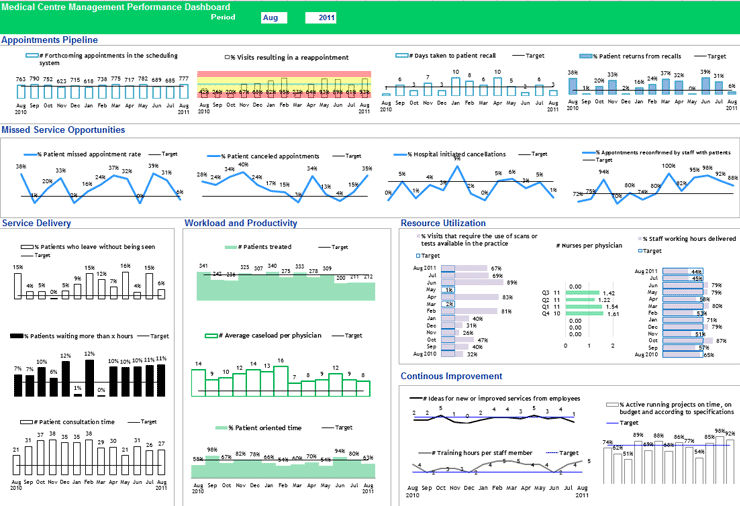
Dashboards: Combining multiple visualizations on a single screen provides a comprehensive overview of KPIs (see Figure 1).
Figure 1. An example of medical center management performance dashboard | Source: The KPI Institute (2023), Medical Practice Dashboard
Major principles for effective KPI data visualization
Clarity and simplicity: Prioritize clarity and simplicity in data visualizations by avoiding cluttered charts and excessive complexity that may obscure insights.
Contextualization: Provide context for visualized KPIs by including relevant information, such as benchmarks, targets, and historical trends.
Visual Hierarchy: Establish a clear visual hierarchy to guide the viewer’s attention towards the most important KPIs and trends.
Storytelling: Utilize data visualizations to tell a compelling story, highlighting key insights and communicating performance trends effectively.
KPI data visualization has emerged as a transformative tool to support organizations in extracting meaningful insights from their vast data repositories. The first move for effective KPI data visualization is to embrace data culture across all organizational levels. The second step is to determine data constraints, such as the type of data, the number of variables, and the type of pattern one is trying to show (comparison, part-to-whole, hierarchy, etc.).
If you want to achieve effective KPI visual representations to support the decision-making process,? sign up for The KPI Institute’s Certified Data Visualization Professional course.
The lifecycle of a Key Performance Indicator (KPI) is a dynamic process involving definition, recalibration, and—sometimes—abandonment. From establishment to practical application and ongoing evolution, KPIs undergo several steps to effectively measure performance, and prioritizing data reliability at every stage is crucial to achieving their intended purpose.
The foundation of reliable data
The first stage of the cycle, KPI selection, may seem simple, but it is a complex process intertwined with various interdependencies and calibrations with the organization’s objectives.
Establishing data reliability should start from this initial step, and involving employees as primary sources for KPI selection is an effective approach. Their valuable knowledge about the data generated from their activities enhances the reliability of the selected KPIs. Additionally, considering data availability and reliability as criteria for the selection further enhances overall data trustworthiness.
KPI documentation plays a pivotal role in ensuring reliability. Adopting a standardized documentation form establishes a solid foundation for rigorous and dependable data collection and reporting. This approach provides clear guidelines for defining KPIs, including unambiguous calculation formulas, ensuring that the collected data accurately reflects the intended purpose of each KPI.
Establishing dependable data collection
During the activation of KPIs, data reliability depends on the meticulous consideration of data sources, robust data-gathering methods, and the establishment of a strong governance structure. It is imperative to utilize trusted and verified data sources that are up-to-date, accurate, and aligned with the KPIs being measured. Accountability for KPI data should be established by clearly designating KPI owners and data custodians. Furthermore, adopting a standardized data collection process that incorporates technology-driven solutions significantly enhances accuracy.
Communicating meaningful insights
The analysis and reporting of KPIs are significant in ensuring the correct organization and communication of data to key stakeholders. Errors in data analysis have the potential to result in misleading insights, which can have negative effects on decision-making. Therefore, correctly identifying relevant KPI content and conveying meaningful insights derived from KPI data to various stakeholder groups within the organization is essential.
Continuous improvement
Finally, data reliability can be enhanced through the process of refreshing KPI documentation. This ongoing effort involves recalibrating KPIs after their initial establishment and customizing them for optimal use.
Attention is given to both the content of the KPIs and the standardization of their format. Standardizing KPI content establishes uniform guidelines and criteria for measurement and reporting, ensuring data reliability and consistency. This step refines the measurement and reporting processes, facilitating accurate and dependable data for decision-making purposes.
Monitoring KPI data reliability: The role of the Data Custodian
The Data Custodian is critical in upholding the reliability of data. They actively participate in the design of performance data collection, receipt and storage, processing, analysis, reporting, dissemination, and even archival or deletion of data. They implement measures to validate and verify the accuracy, consistency, and completeness of the data. This involves conducting regular data audits, resolving discrepancies or anomalies, and implementing data cleansing processes to ensure data integrity.
To evaluate the reliability of KPI data, the Data Custodian can monitor % KPIs with reliable data. This metric measures the number of reported KPIs that contain reliable and trustworthy content out of the total number of KPIs reported, according to smartKPIs.com.
In conclusion, to succeed in a data-driven world, organizations must prioritize data reliability along the KPI lifecycle. By implementing the strategies and practices discussed above, organizations can unlock the true potential of their performance measurement systems and empower stakeholders with reliable insights for better decision-making.
Globally, up to 2.78 million workers die annually from occupational accidents and work-related diseases, while another 347 million suffer from non-fatal occupational accidents, according to the United Nations Global Compact.
Dealing with work-related accidents severely impacts corporate management performance by generating direct and indirect costs and repercussions. Some of these are medical costs, losses due to production downtime, loss of productivity, and low employee morale. A company can also be sanctioned by authorities or suffer from reputation damage, which in turn may result in sales reduction.
Thus, occupational safety and health (OSH) is a priority for businesses. OSH is the practice of protecting the safety and health of employees by identifying workplace hazards and implementing initiatives meant to prevent their occurrence. OSH standards and regulations exist at the international and the national levels, and companies are responsible for adopting them.
To support OSH, the International Labour Organization and the United Nations Global Compact identified business practices to improve workplace safety and health, and one of which encourages companies to “enhance the reporting, recording, and notification of occupational injuries and diseases to improve data collection.” Through the improved recording of workplace mortality and morbidity, companies and authorities can evaluate the performance of internal OSH systems, prioritize OSH initiatives, and enhance corrective actions and prevention efforts.
The performance of such initiatives can be tracked with the help of health and safety key performance indicators (KPIs), such as # Lost Time Injury (LTI), # Lost Time Injury Frequency Rate (LTIFR), % Health and safety (H&S) incident type breakdown, % Health, security, and safety training completed, % Compliance OSH regulations, and % Lost day rate.
The healthcare manufacturing industry is a high-risk industry when it comes to occupational safety and health due to the nature of the products and the operating environment. The OSH problems faced by workers in this industry include exposure to chemical and biological substances, exposure to physical hazards, ergonomic affections, and hazardous processes using heavy machinery.
Medtronic and Johnson & Johnson are renowned corporations in the industry and have established a strong presence in the market. Both companies stated their strong commitment to ensuring the well-being of their employees and have implemented comprehensive OSH systems.
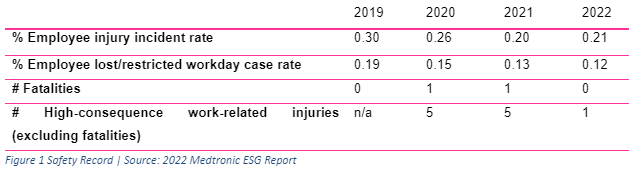
Medtronic, a global leader in medical technology, services, and solutions, strongly focuses on health and safety, implementing enterprise-wide standards to reduce hazards and risks and prevent workplace accidents. Their Environmental, Health, and Safety Performance System monitors the recordable incident rate, employee training, and auditing while providing employees with tools to reduce risks and employ safe behaviors.
As revealed by the KPIs’ results for the last four years, Medtronic’s EHS system achieved notable progress in enhancing workplace safety. Three of the indicators have shown a decreasing trend compared to previous years. Only the % Employee injury incident rate has slightly raised due to an increase in slips, trips, and falls, as stated in the company’s ESG Report.
To address the issue, the company launched a comprehensive awareness campaign across all its sites and took measures to improve outdoor walking surfaces and lighting where deficiencies were detected.
As part of the ongoing initiatives that supported continuous improvement, Medtronic implemented a companywide hazard reporting tool, which allows employees to report potential risks and near-miss incidents. This enables the company to take timely mitigating measures and reduce the likelihood of incidents.Johnson & Johnson, a popular healthcare company that produces a wide range of medical devices, pharmaceuticals, and consumer packaged goods, has implemented thorough safety programs, risk assessments, and training for its employees.
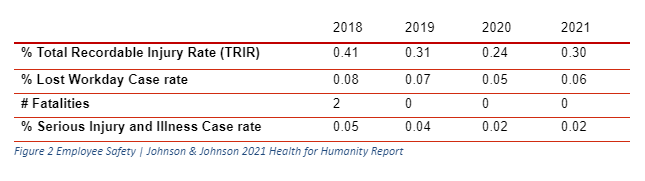
Johnson & Johnson’s OSH system incorporates a global data management system with digital tools, predictive analytics, and visualization tools to track the OSH KPIs, gain deeper insights into their performance, and identify potential risks early.
Using leading indicators facilitates a proactive avoidance of workplace injuries. Examples of leading KPIs the company uses include # Corrective and Preventive Actions (CAPA) resulting from program evaluations, internal audits, and # Near misses.
The company’s recent focus was to prioritize resources and risk mitigation efforts to prevent those incidents that could lead to life-threatening or life-altering outcomes. By following the hierarchy of controls, with an emphasis on eliminating, substituting, or engineering controls rather than relying on administrative controls, the company was able to reduce indicators of fatalities and serious injuries.
Despite this, the other two KPIs showed a slight increase in 2021, contrary to the downward trend seen in previous years.
KPIs drive occupational safety and health performance
There is no one correct formula for employee safety. Starting from the authorities’ standards and recommendations, companies should develop OSH systems tailored to their needs. Business practices focused on employees’ participation in risk identification, periodic audits, OSH training, safe behavior stimulation, and awareness activities could help create a preventive and safety culture.
As shown by the examples of Medtronic and Johnson & Johnson, top-tier companies operating in a high-risk sector, regardless of the chosen initiatives, effective systems enhance the recording and reporting of OSH KPIs.
Monitoring the leading indicators to proactively identify potential risks and implement mitigation measures and lagging indicators to understand the current deficiencies and apply corrective actions can determine the success of an OSH system in creating a safer, healthier, and more efficient workplace.
People have been working from home even before the pandemic, but their number significantly increased when the health crisis led to lockdowns and travel restrictions. Companies were forced to send their employees home to work remotely to comply with social distancing measures and keep the workforce healthy. Statista shows that before the pandemic, only 17% of US employees worked remotely for five days or more weekly. However, the number grew to 44% during the outbreak in 2020.
When the pandemic subsided and governments eased travel restrictions, some companies asked their workforce to return to the office while others offered the hybrid set-up. However, most employees still prefer remote work.
A poll conducted by Pew Research Center with 5,889 workers in America in January 2022 found that 61% of those who work from home said they avoid going to work by choice and 38% claim their office is closed. It represents a shift from October 2020, when 64% of people worked from home because their office was closed and 36% did so voluntarily.
In spite of that, 50% of leaders in information worker roles want to pursue getting employees back to the office full-time next year, based on Microsoft’s Work Trend Index 2022 report. Still, 52% of respondents say they highly consider becoming remote or hybrid in the year ahead and 80% claim that since remote or hybrid work arrangements were implemented, their productivity has increased.
How Remote Workers Can Be More Productive
According to the popular job site Flexjobs, one of the benefits of working from home is it increases “productivity and performance” as employees encounter fewer interruptions, have a quieter work environment, and have increased workplace comfort, resulting in more focused time.
In a research conducted in Latin America, they explored the relationship between remote work, work stress, and work-life during pandemic times. Researchers found out that by having flexible work schedules, the employees’ engagement and productivity levels increased because they could work at their most productive time. Privacy also plays a big role in employees’ efficiency. However, the productivity level is negatively affected when the worker is constantly interrupted by children or adults that need assistance.
A case study published in the Journal of Occupational and Environmental Medicine investigated the impact of family-work conflict, social isolation, distracting environment, job autonomy, and self-leadership on employees’ productiveness, work engagement, and stress experienced when working from home during the pandemic. The authors discovered that excellent self-leadership skills and autonomy positively impact the time assessment in a WFH scenario.
Results from a qualitative study by Danielle Tinneveld of Radboud University also show that productivity tracking facilitates the identification of process bottlenecks. The affected staff gets less anxious and annoyed when these difficulties are resolved, and overall production efficiency improves.
How Employees Can Track Their Productivity at Home
On a remote workday, people have to manage work and non-work-related tasks. To be productive, they have to master the art of time planning. Effective time management involves planning each activity in a time frame, considering priorities such as urgent work tasks and eating breaks. Individuals should fit their activities into 16 hours to get 8 hours of sleep each day to achieve great productivity. By monitoring the duration of their tasks, they can observe which actions can be improved.
To see if their time management strategy is effective, remote workers can use key performance indicators (KPIs). Some KPIs they can consider are:
By monitoring the percentage of tasks performed as planned, individuals can see if they reached their target or not. By knowing the percentage of time spent working, people have insights into the free time left for non-work-related tasks, such as going on a walk, relaxing, cooking, eating, and other housework activities (washing clothes and dishes, drying clothes, cleaning floors).
It’s a different story for employees whose companies have return-to-office schemes. Their organizations should rethink their performance management system to consider the new ways of working that employees gained during the pandemic. Evaluating the relevance of KPIs has become important now more than ever. To better understand KPIs, its nature, characteristics, and implementation, enroll now to The KPI Institute’s Certified KPI Professional and Practitioner course.