Every organization remembers its numbers: revenue, profit margins, cost of customer acquisition, employee utilization, defect rates, NPS scores, or average resolution times.
Pull open any dashboard, and you’ll see hundreds of highly selective data points meticulously tracking almost everything happening within the business. Organizations today are astoundingly adept at capturing data. However, they often can’t answer simpler questions.
Why is this team performing so well when they are tracking only average productivity metrics?
Why are customers loyal to this account manager?
Why did our innovation efforts grind to a halt when our key engineer left, even though the KPIs remained unchanged?
What, beyond hitting deadlines, contributed to that project’s success?
Some of the most crucial assets any organization holds cannot be conveniently pinned on a dashboard. As conversations naturally become centered around measurable outputs, organizations gradually risk developing a kind of “KPI memory loss” – an inability to recall the details that fail to fit within a given metric.
This is not a criticism of KPIs. Not at all, quite the contrary! Businesses must have these metrics to measure performance, diagnose issues, understand thresholds, and make decisions. The issue starts when metrics become less tools for observing the world and increasingly the world itself.
When Metrics Become Memory
Picture a brand-new manager being hired to run a thriving customer service department. They’ve taken over a fantastic dashboard, their average response time has dropped, customer tickets are being resolved faster than ever, and overall productivity is growing each month. From their perspective, they’ve inherited a picture-perfect operation.
Six months down the line, customer churn is on the rise.
But why? What gives?
After interviewing veteran staff members, the manager learns that agents have stopped investing a few extra moments to build rapport with their customers. All the targets were being met; everything looked fantastic on the dashboard, but they had slowly let the human side of it all slide: those little interactions that helped customers feel like they mattered. There was nothing in the dashboard to indicate this.
Nothing in the dashboard was accounting for this. This is one of the greatest strengths (and biggest weaknesses) of performance measurement: KPIs can highlight things we would otherwise never know, yet they also narrow our attention to an unhealthy degree, turning focus into horse blinders.
As much as an organization obsesses over what it can measure, it begins to overlook everything that it cannot. When people start aiming for a metric specifically, that metric eventually fails to reflect what it was intended to reflect.
You’ve almost certainly seen this play out in a large organization:
A sales team prioritizes quick-close deals over long-term customer value because its quarterly target emphasizes sales volume.
A call center has reduced the Average Handle Time (AHT) by ending calls abruptly, leading to more inbound repeat calls from irate customers.
A software team has achieved a high number of resolved tickets while allowing technical debt to fester in the codebase silently.
An HR team fills open positions faster by prioritizing speed-to-hire, but the quality of new hires drops, leading to higher turnover within the first year.
A manufacturing plant reduces production costs by using cheaper materials, only to see warranty claims and customer complaints increase months later.
The metrics look good, but the underlying reality does not. This often has nothing to do with bad motives or intentions, but more with incentives.
Incentives have been at the basis of human behaviour since the dawn of time. Therefore, if success is defined by what appears on a dashboard, people will focus their attention there. Over time, companies develop excellent memories for metrics but an almost complete memory loss for everything else.
What Gets Left Behind?
Try to think of the best colleague you’ve ever had. What was it about them that made them excellent? Were they the emergency adult everyone called to soothe volatile clients before a situation erupted? Maybe they instinctively knew when a project was careening off course. Perhaps they just knew which other departments would be required long before an issue was apparent, or they just knew how to mentor a junior person in the office from scratch.
Knowing all these aspects, we are posed with a series of questions:
How could you quantify these skills?
How could you put a number on them?
How would they feature on a spreadsheet?
It might not be possible. Is it possible? Is it feasible? Now we are left with more questions than we had before we knew about the aforementioned series!
Let’s take a look at a different example.
What about a company trying to build itself on measurable, trackable KPIs and not much else? We have a massive body of work in knowledge management that draws a line between the explicit and the tacit: the former can be written down and shared, the latter can only be understood and absorbed through experience and judgment, in context, through interaction.
There are numerous studies that indicate that organizations that have solely relied on measurable performance-only systems fail to capture value and knowledge, even in areas that are absolutely critical to long-term organizational success.
Interestingly, it’s often the people who do not appear on many charts in any system, or who have nothing visible to put on a spreadsheet, who make the organization successful.
The experienced cardiac nurse may have noticed subtle changes in the patients’ physical condition much earlier than the monitors do.
The savvy machinist may hear an anomaly in the noise from an old tool and just know the machine requires maintenance.
The proficient project manager might have noticed the relationship between two key stakeholder groups deteriorating well before the tangible signs of breakdown were evident.
The well-versed account manager may recognize that a client is quietly disengaging long before declining renewal rates or negative feedback makes it obvious.
These can be moments where organizational failures are averted long before anyone even sees an indicator on a dashboard. These are moments that create and deliver value to an organization every day, yet remain invisible to most of its people and many of its systems.
The Things Dashboards Cannot Remember
The majority of businesses believe their decisions are based on facts. In reality, they generally base their choices on whatever facts happen to be quantifiable. Culture is one of the clearest examples of such behaviour.
Companies commonly try to measure culture through surveys, retention data, absence rates, and employee satisfaction scores. While such information is useful, culture itself is not a figure. It is actually the unwritten principles and practices that establish whether workers report errors early or cover them up. It’s that thing that makes junior employees feel empowered to question those higher up. It’s that je ne sais quoi that leads groups to readily volunteer their expertise rather than guard it or choose to assist their colleagues, even when no one is watching.
Boiling these activities down to a handful of quarterly data points has the threat of mistaking the map for the land. The same is true of reliance on craftsmanship, mentorship, interest, durability, and expert judgment. Organizations seldom lose these features overnight. Rather, they simply fail to mention them because they stop measuring them and ultimately stop noticing them.
As soon as something is missing from the discussion, it tends to be absent from decisions on the whole. That is possibly the major peril of KPI memory loss: organizations do not intentionally cease caring about what is most important; they become so adept at remembering their numbers that they fail to remember everything those numbers can not tell them.
The Hidden Costs of Measuring Everything
Most companies do not wake up one morning deciding to disregard culture, relationships, or craft. It happens more subtly, often barely perceptible to the senses.
A new dashboard gets added.
An additional KPI arrives.
Quarterly reviews become more number-focused.
Charts, scorecards, graphs, and trendlines support decisions.
Conversations turn to the question of what we can measure versus what we ought to be asking.
It appears to be a reasonable transition. At the end of the day, numbers are objective, are they not? They establish commonalities and help control a complicated organization. However, numbers are also a source of our most profound blind spots.
Think of onboarding. Think really well. While it seems prudent for a company to track the number of days before a new employee reaches full productivity, there are typically no measures around building trust with other staff, the organization’s unspoken rules, or the logic behind past decisions. This results, six months and two seasons later, in a productive individual who, by all accounts, repeatedly makes the exact same mistakes the company had already overcome a decade earlier.
The knowledge had existed, scribbled on meeting minutes or stored in the heads of long-serving staff or within an unheard conversation, but it had never reached the recipient in need. This tendency pervades almost every field of work.
An oil and gas operation may monitor equipment uptime and production volumes with remarkable precision, while overlooking the field operator whose practical experience prevents a minor anomaly from escalating into a costly shutdown.
A government agency can report on service delivery targets and policy milestones with detailed dashboards, yet fail to recognize the informal relationships between departments that quietly determine whether complex initiatives succeed or stall.
A real estate firm may measure listings closed and average time on market with ease, while overlooking the seasoned agent whose local knowledge and trusted network resolve problems before they jeopardize a sale.
A hospital may monitor how long patients wait with a stop clock, yet it would struggle to assess the level of trust a pair of experienced nurses builds.
A legal firm could chart the time partners log on individual cases with great precision, while ignoring the unstructured mentoring that cultivates new associates from rookies to confidants.
A manufacturing operation can track its output by the hour, but may miss the insight of the retired engineer who stops a press before it breaks down, preventing a sensor from triggering.
With all of these cases, tangible output may increase; however, the intangible abilities that support that output go largely unnoticed until they can no longer be ignored.
When Efficiency Begins Replacing Craftsmanship
Nowhere may the dichotomy be stronger than in craft. Craft isn’t limited to woodworkers and machinists – there’s an equivalent for every role. A software engineer’s craftsmanship might not be about delivering features as quickly as possible but rather about writing testable and maintainable code. A customer success manager’s craftsmanship might be recalling some tiny, human detail from a conversation with a customer and using it to make them feel deeply seen. These are habits you practice into being, not lessons you teach into being.
Picture two identical table factories.
One rewards everyone for output alone (units per shift). The other one measures output AND craft (the ability of seasoned employees to mentor and teach the younger ones). Thus, the most experienced artisans have time to think of better ways to practice their craft, and they reject pieces they deem inadequate, even if it slows output, while prepping a new generation that comes after. One year in, the output factory is ahead.
Five years later, the craft factory might have developed an entire workforce capable of creating not just more output, but better & smarter output without sacrificing quality or values. Their competitive advantage wasn’t about today’s output; it was about tomorrow’s capabilities, and quarterly KPIs don’t easily capture them.
It grows over years so subtly you usually only realize it’s gone after you notice its absence.
The Things Employees Stop Doing
Not only do metrics influence what employees do, but they also influence what employees quietly stop doing. Take a veteran project manager who routinely spends their Friday afternoons working through colleagues’ complex, messy projects. There is no metric for mentoring, no dashboard tracking generosity, and no quarterly goal to help other departments meet their targets.
Nevertheless, when the company adopts a utilization rate that values nearly all hours spent on billable activity, the manager is never explicitly asked to halt his mentoring, only that “we’d love for you to be 100% utilization and work your shift’s duration on billable projects”. Over time, the manager has trouble justifying mentoring anyone.
Then, in an instant, poof, it’s gone!
The company gets 3% points of utilization and a loss of something far harder to repair. Moreover, those who, at this point, would be tempted to say “it’s just an individual matter” should remember that a company is made up of hundreds to thousands of living, breathing individuals. It’s not so much that one person stops functioning; entire departments stop sharing knowledge, because collaboration time could be allocated to departmental goals. Managers stop coaching team members because getting stuff out the door right now takes precedence over people’s development and future growth. Employees hesitate to try innovative projects because failed attempts have consequences for their personal evaluations. These things are not deliberate managerial decisions; these are inevitable responses to organizational cues and the incentives we keep mentioning.
Peter Drucker observed well: “What gets measured gets managed.” Yet what is not measured will be ignored, seldom discussed, forgotten, and will surface as unforeseen consequences later on.
When Good KPIs Produce Bad Decisions
The KPIs themselves may not be wrong; they’re just limited. A good metric can become a bad one when it shifts from a guidepost to the destination itself. Organizations of all shapes and sizes have had the same experience.
Software Development
For many years, developers were measured by the lines of code they wrote. On the surface, the logic seemed fine – the more code written, the more productive the developer. Unfortunately, developers were incentivized to write more code, not better code – ye’ ol’ quantity-over-quality shenanigan. Conversely, modern software engineering holds that good solutions often involve writing less code.
Healthcare
Patient throughput in the emergency room is routinely monitored for a range of reasons, not least to reduce wait times and improve access to care.
This metric is clearly important, but clinicians are aware that meaningful conversations, nuanced observations, and shared decision-making cannot always be neatly slotted into pre-set time boxes. Hospitals that focus solely on speed do so at the risk of missing key aspects of care.
Aviation
Even in this highly quantitative field, there is an understanding that not every important thing can be represented by a number.
Commercial airlines meticulously monitor thousands of variables, from fuel efficiency to maintenance schedules. Nevertheless, they spend a considerable amount of time and resources on developing Crew Resource Management (CRM), an approach focused on building communication skills, mutual trust, leadership, and a safe psychological environment within the cockpit. These aspects are not ignored because they are hard to measure. They are carefully nurtured because, as history shows, they save lives.
Automotive
Perhaps one of the most widely known examples in the business world comes from Toyota, the Japanese automaker. The Toyota Production System (TPS) is well known for its metrics and continuous improvement methodology. Concurrently, it also strongly emphasizes people development, encourages employees to halt the line if they detect quality issues, and views improvement as a collective learning process rather than a numbers game. In essence, the numbers do matter, but so do the conversations that occur around them, and that can be easy to miss.
Companies struggling with KPI memory loss tend to assume that if a metric is not displayed on the dashboard, it cannot be strategically important. The healthiest companies take the opposite approach. They understand that the dashboard offers only a partial picture of the organization’s health.
Some of its most vital components – trustworthiness, judgment, craftsmanship, curiosity, mentorship, and shared experience – remain alive, regardless of whether they are measured. The real problem is not whether to rely on numbers or intuition, but rather the failure to remember that one can never replace the other.
What High-Performing Organizations Choose Not to Measure
That raises an interesting question: if some of the organization’s greatest capabilities are elusive to measure, what do the best organizations in the world do?
They can’t just abandon performance measures, right? RIGHT?
Right, they don’t. In many cases, high performers recognize that measurement has its limits.
Take a look at Pixar. For years, the animation studio has turned out films that win hearts and minds and create core childhood memories for parents and children alike. Of course, Pixar monitors budgets, schedules, and production milestones. Yet some of the real magic happens because the company is willing to make room for what can’t be quantified by a KPI: candid dialogue.
One of the most widely discussed Pixar traditions is the Braintrust, a circle of seasoned directors and writers who regularly gather to roast works in progress.
No scores, no charts, no dashboards, no key performance indicators. What matters is genuine feedback, a psychological safety net, and a willingness to push ideas (not people) to their breaking point. The organization creates room for judgment.
Now let’s go back to Toyota for a second.
Not everything gets translated into a number. The famous Toyota Production System may be well known for its metrics and focus on continuous improvement, but one of the company’s enduring guiding principles is respect for people.
Its workers feel empowered to halt a production line when they spot a flaw not because a performance measure mandates it, but because their judgment is trusted and valued.
This doesn’t mean that Toyota avoids measuring. It has more to do with the fact that it appreciates that its greatest assets reside alongside its measurements, not within them. That theme will appear time and time again across top-tier companies.
Experienced executives don’t just ask, “What should we measure?” ❌
They ask, “What do we need to keep talking about even if we can’t measure it perfectly?” ✅
Beyond Dashboards: Remembering the “Why“
One theme that echoes throughout the literature on organizational memory is that organizations are pretty good at recording what happened. They’re a whole lot worse at remembering why it happened.
Minutes of meetings show what was decided, project plans show when the decision was made, dashboards show what the result was; however, even with all that, the reasoning behind the decision (the trade-offs it required, the alternatives it rejected, the hunches it relied on) often remains elusive.
Think about walking into a company where the same customer policy has been in effect for a decade. Everyone adheres to it, but nobody knows why. Its memory has been lost among dusty desks and cramped file cabinets. A manager suggests tweaking it, as it seems stale and no longer aligns with the organization’s current state. Their peer protests that “it’s always been done this way,” yet none of them can tap the original logic behind it all. It’s not just that information is missing. The entire context for the origin of the information is missing.
This is the plight of most KPIs as well.
We recall that our customer satisfaction score dropped four points, and not that our recent reorganization had frayed our client relationships months prior.
We recall that productivity grew by 12%, and not that our employees started shunning one another to get there.
We recall that costs declined, but not which abilities those reductions simultaneously hobbled.
We recall that revenue exceeded its target, and not that a handful of unsustainably large discounts drove it.
We recall that safety incidents declined, and not that workers had become increasingly reluctant to report near misses.
Numbers capture results or the end product. Stories capture context or the journey to said end product. The best companies value both.
Building Organizations That Remember More Than Numbers
None of that is to say that companies shouldn’t measure less. Often, they should probably measure better. A balanced performance system understands that metrics are evidence, not adjudication.
When your engagement metric drops, it should start a conversation, not conclude it.
When your productivity metric improves, you should question your leaders: “What did you change? What may have suffered as a consequence?”
In the same way, when there’s an unexpectedly great result, don’t just look at it on a celebratory dashboard and gloat to everyone near & dear. Dig into it: What did we do differently to get here? Was it more collaboration? Did a senior, intuitive employee make a gut call at just the right moment? Did the team have enough faith in each other to say, “Hey, this isn’t working?”
Some companies consciously strive to keep institutional memory alive through mentoring, after-action reviews, storytelling, communities of practice, intergroup collaboration, and discussions focused on reflecting on the past. These are more than just tools for transferring knowledge. They are tools for transferring judgment because, as the adage goes, judgment doesn’t live in the data alone. It lives from person to person, conversation by conversation.
Final Thoughts
Performance management has revolutionized modern management. Organizations would have a hard time understanding performance, gauging results and failures, allocating resources, or identifying potential risks without KPIs. The use of metrics remains the strongest lever available to leaders. However, every tool has its limitations.
A map shows us the path around a city; it’s not the city itself. Likewise, a dashboard illustrates organizational performance; it’s not organizational performance itself. Organizational performance is much more than just mere engagement numbers; leadership is much more than productivity metrics; organizational innovation is much more than just the number of ideas spewed forth by lateral thinkers; organizational customer loyalty is much more than Net Promoter Scores, and our organization’s memory is much richer than any data we collect in reports and dashboards.
The single largest risk may be that we measure too much, rather than recognizing that there are more ways than measurement alone can provide. Organizations do not become exceptional by quantifying everything; they become exceptional by discerning what must be quantified and what must be conversational, observant, coached, and trusted.
Numbers tell us what happened; people explain to us why the numbers happened.
*********
Looking to strengthen your expertise in KPI design and performance measurement? Gain practical knowledge, proven methodologies, and globally recognized certification through The KPI Institute’s Online Certified KPI Professional.
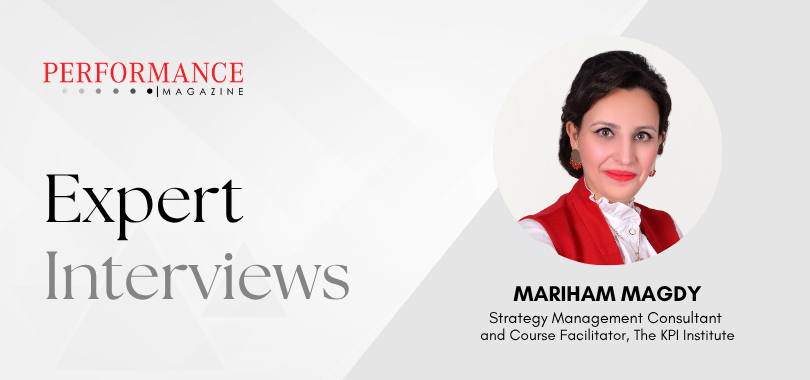
In high-stakes industries like oil and gas, human resources (HR) is more than an administrative function; it’s the engine of operational stability. With over 18 years of corporate experience, Mariham Magdy has built a career navigating the high-pressure demands of this field. As a facilitator for The KPI Institute, she leads the Certified Employee Performance Management Professional, empowering practitioners to bridge the gap between individual output and departmental goals.
A versatile expert, Magdy also delivers the other certifications: Certified KPI Professional, Certified Strategy and Business Planning Professional, Certified Balanced Scorecard Management System Professional, Certified Agile Strategy and Execution Professional, and Certified Strategy and Performance Maturity Assessment Professional. Moreover, she is an award-winning researcher, receiving the Best ROI Article 2018 award from the ROI Institute for her contributions to the field.
In this feature, Magdy shares her approaches to professional development. She explores how leaders thrive in fast-paced environments by treating individual strengths as milestones in a larger narrative. By moving beyond one-size-fits-all briefings, Magdy provides a roadmap for integrating employee well-being into performance discussions to ensure that measurable results never come at the cost of the individual.
Can you describe your current role and how your daily responsibilities relate to HR strategy and performance management? I’m deeply involved in a wide range of HR functions. I’m a strategic HR leader in end-to-end recruitment, ROI-driven talent initiatives, and organization design. By integrating sophisticated selection tools like Competency Based Interview (CBI) and the Myers-Briggs Type Indicator (MBTI), I align human capital with business objectives. My expertise spans HR governance, total rewards, and leadership development (GLA 360), ensuring operational compliance and a sustainable competitive advantage for global clients.
Have you worked in fast-paced or high-pressure environments? If so, can you describe your experience? If not, how do you think employee growth should be included in performance discussions without losing focus on operational results?
Yes, I do have extensive experience thriving in demanding settings, particularly within the oil and gas industry, which is known for its dynamic and high-pressure nature. I have over 18 years of corporate experience, starting from building HR departments from scratch to managing all HR functions.
My experience spans from handling HR operations in the oil and gas sector, including offshore personnel coordination. This has required me to respond swiftly and effectively to unexpected challenges, ensuring both operational continuity and support for the team. Furthermore, leading strategic management and planning initiatives has allowed me to align HR practices with business needs in rapidly changing environments, while implementing performance systems and KPIs that have ensured organizational goals are met even under pressure.
Moreover, delivering training to various management levels in fast-paced sectors has allowed me to maintain quality and engagement, even when timelines are tight.
With your experience in HR, consulting, and training, how do you see the connection between individual development and organizational goals?
In today’s dynamic business environment, organizations are constantly seeking ways to align their strategic objectives with the evolving needs and aspirations of their workforce.
I see the connection between individual development and organizational goals as a catalyst for sustainable growth and innovation for both the organization and the individual. When people see clear pathways for advancement and understand how their growth aligns with broader company goals, they are more likely to innovate and go the extra mile.
Our role then as organizations and learning and development (L&D) professionals is to integrate personal development plans with organizational KPIs. Thus, leaders can transform their teams into engines of achievement and resilience.
When setting performance expectations, what approaches help clarify goals while reflecting each employee’s strengths?
Imagine a team meeting at the start of a new quarter. Instead of delivering a one-size-fits-all briefing, the manager gathers everyone and begins with a question: “What does success look like for each of you, and how can your unique talents help us get there?”
As each team member shares their perspective, the manager listens intently, making note of individual strengths and weaving them directly into the team’s targets. By breaking down overarching objectives into personalized, strength-based tasks, everyone feels seen and valued. Over time, these goals become more than mere metrics; they transform into milestones in an ongoing story where each person’s specific abilities move the team forward.
I always love to apply Steve Jobs’ philosophy with my team: “We don’t hire smart people to tell them what to do, we hire smart people to tell us what to do.”
How do you identify the competencies that matter most for employees in different functions, such as training, consulting, or corporate HR?
Identifying the right competencies for employees in diverse functions like training, consulting, and corporate HR starts with understanding both the unique demands of each role and the broader goals of the organization.
The key is to combine data-driven methods—such as analyzing top performers and collecting feedback from stakeholders—with an appreciation for the evolving landscape of each function. We also have to review job requirements, stay attuned to industry trends, and invite input from employees themselves to ensure that competency frameworks remain relevant and empowering across all areas.
How do you align employee behaviors with performance criteria while keeping assessments flexible and practical?
Leaders should start by clearly articulating what successful behaviors look like in the context of specific roles and team objectives. These criteria should be transparent and directly linked to the company’s values and goals, ensuring that everyone understands how their work and behaviors contribute to the big picture.
To keep assessments practical, organizations can incorporate regular check-ins, peer feedback, and self-reflection opportunities. This creates a dynamic feedback loop where employees are empowered to adjust their approach and see how their behaviors drive results. Flexibility then comes from recognizing that excellence may manifest differently across individuals and situations. As such, performance criteria should allow room for creativity and personal strength.
Based on your experience, what role do informal feedback and day-to-day interactions play in helping employees reach their performance goals?
Let’s imagine a typical scenario that we witness: a busy office where, between project deadlines and team meetings, small conversations happen in the hallway or over coffee. These everyday moments of feedback, often spontaneous and genuine, create a culture where improvement feels natural and supportive rather than intimidating. When employees know their efforts are recognized in real time, they’re more likely to adjust behaviors, reinforce positive habits, and stay motivated.
Informal feedback acts as a compass, keeping everyone on course toward their performance goals, one conversation at a time.
How do you balance structured evaluation processes with opportunities for personal growth for employees?
Structured evaluations, such as annual reviews, goal setting, and competency frameworks, provide clarity and consistency in measuring performance. However, these formal processes must be complemented by avenues for personal growth that acknowledge each employee’s unique talents and aspirations. This could be by encouraging employees to pursue stretch assignments or by allowing space for mentorship, skill-building workshops, and self-directed projects that foster creativity and initiative.
I believe that managers can use performance check-ins to discuss both progress on specific targets and areas where the employee wishes to grow. This dual focus helps employees feel valued for their achievements and empowered to shape their own professional journeys.
When planning development initiatives, what factors guide your choices about which skills or behaviors to focus on?
I prioritize skills and behaviors that not only address current performance gaps but also anticipate future challenges, such as technological changes or shifting client expectations. Gathering input from employees and managers helps ensure that our focus areas are relevant and impactful. This creates opportunities for growth that are meaningful and aligned with our business objectives.
How do you measure progress in employee development beyond standard metrics?
I look for signs such as increased initiative, adaptability to new challenges, and a willingness to take on stretch assignments. Qualitative feedback from peers and managers, examples of creative problem-solving, and evidence of willingness to mentor others are strong indicators of development.
Additionally, I consider how employees pursue self-directed learning, seek feedback, and contribute to a positive team culture. These factors help paint a fuller picture of professional growth that metrics alone cannot capture.
From your perspective, what trends in performance management are influencing HR practices in Egypt and the wider region today?
In Egypt and the wider region, performance management is increasingly shifting toward continuous feedback and development-focused conversations rather than relying solely on annual reviews. There is also a growing emphasis on leveraging technology platforms to streamline performance tracking and data-driven decision-making, which makes the process more transparent and accessible for both employees and managers.
Additionally, there is a trend toward integrating employee well-being and engagement metrics into performance discussions, reflecting a more holistic approach to talent management. As companies are increasingly recognizing the importance of aligning individual and team objectives with organizational strategy, they are focusing on building a culture of continuous learning and adaptability to remain competitive in a rapidly evolving market.
How do you manage the balance between meeting immediate targets and developing longer-term skills in your teams?
I encourage team members to identify learning opportunities within their current projects, so that skill-building becomes part of daily work rather than a separate activity. I also support both the achievement of business objectives and the cultivation of future capabilities within the team
When employees have high autonomy, what practical steps help maintain accountability and alignment with performance expectations?
When employees have high autonomy, it’s important to establish clear goals and regularly communicate expectations to ensure accountability and alignment. Setting measurable criteria, along with frequent check-ins or progress reviews, helps maintain focus and provides opportunities for feedback.
Additionally, fostering a culture of transparency—where team members openly share updates and challenges—encourages mutual responsibility and ensures everyone remains aligned with performance standards.
From your experience, how should feedback be structured to support learning and measurable performance outcomes?
By including well-being and engagement measures, organizations can promote continuous learning, adaptability, and a culture of shared responsibility. Effective feedback in high-autonomy teams should be clear, timely, and actionable, focusing on specific behaviors and measurable outcomes while fostering open dialogue and a growth-oriented mindset.
What strategies work best for keeping motivation and engagement when teams face heavy workloads or tight deadlines?
When teams encounter heavy workloads or tight deadlines, maintaining motivation and engagement hinges on several key strategies. It begins with the clear communication of priorities, which helps individuals focus on the most critical tasks and reduces overwhelm. To sustain this focus over time, breaking large projects into manageable milestones and celebrating small wins can sustain momentum and reinforce progress.
Additionally, regular check-ins support sustaining the efforts in order to acknowledge effort, offer support, address challenges, and create a supportive environment that values both results and well-being.
Throughout your career, which leadership practices have had the greatest impact on employee performance in demanding work settings?
We can summarize leadership practices that have the greatest impact on employee performance in three simple steps: setting clear expectations, communicating priorities effectively, and fostering an environment of open dialogue.
Additionally, recognizing and celebrating incremental achievements sustains engagement and reinforces progress even during high-pressure periods. Promoting transparency around workload and inviting team input also empowers employees to co-create solutions, building trust and a sense of shared responsibility.
**********
Inspired by Mariham Magdy’s perspective on aligning employee growth with organizational performance?
Organizations seldom fail because they don’t have an actual strategy in place – most do have some form of strategy in place.
They fail because the strategy, even if well-conceived and meticulously documented or hap-hazardly strewn together and poorly executed, is rarely acted upon with the required rigor and intent.
After a glossy presentation ends and the strategy is launched, what is truly required is for the responsibility for executing the plan to percolate through various departments and teams.
What most leadership teams fail to appreciate is the delicate nature of strategic alignment: a strategy that seems utterly clear in the boardroom can quickly become contradictory once responsibility is shared with those charged with bringing it to life.
Somewhere in between executive vision and operational reality, the signal degrades. Workflows and priorities shift, messages become unclear, managers become overwhelmed, and ultimately, teams disengage from plans they can no longer grasp.
The outcome doesn’t necessarily lead to explosive, grand failure; actually, it’s insidious organizational drift efforts that everyone is expounding on, but likely not toward the same outcome.
Several recurring patterns are common here. Executive assumptions, communication failures, bottlenecks at the middle-management level, inconsistency, and the ever-present temptation to make constant pivots all chip away at effective execution. For any organization that truly wants to turn strategy into action, recognizing and addressing these patterns is the critical first step.
Executive Assumptions About Understanding Strategy That They Don’t
The most pervasive executive blind spot is equating communication with understanding.
Leaders spend months doting over strategic objectives, perfecting presentation materials, aligning budget priorities, and devising rollout plans.
By the time the strategy is shared internally during a gathering, leaders understand it better than anyone, knowing every single minutiae and detail. However, everyone else only learns about the strategy at that meeting.
Having been immersed in the strategy for months, executives vastly overestimate its clarity to their team members. What seems obvious in the executive suite often seems rather nebulous on the ground floor. Concepts like “customer-centric innovation,” “digital transformation,” or “operational excellence” may ring true during an executive offsite, but become ambiguous when employees have to interpret them in terms of daily tasks and responsibilities.
This misalignment is amplified when the primary strategy communication channel is a top-down, single broadcast. Leadership presents the plan at an all-hands meeting and assumes that the organization is aligned. The reality is that hearing a message doesn’t automatically mean it’s understood or that it can be translated effectively and consistently by teams across the organization.
In fact, employees often nod along to strategic slogans without the faintest idea what those priorities mean for their own day-to-day decisions. The strategy may exist conceptually, but fails operationally.
A similar factor that leads to the communications vacuum is the physical distance between leaders and the everyday work of employees. When leaders are many layers removed from the operational challenges employees face, strategic priorities that appear to make sense at the top of the organization can represent competing pressures or constraints that immediately impact employees’ day-to-day lives.
The outcome is a hidden, often unacknowledged, alignment gap. The leadership team thinks the message has been sent; the employees are trying to operationalize on the basis of various assumptions and local departmental concerns. Over time, this divergence causes the organization to veer off track, subtly (and not so subtly).
The Communication Illusion
Inseparably linked to this point is what experts sometimes call the “communication illusion.” This illusion occurs when the process of transmitting information is mistaken for genuine communication.
In many organizations, communication about strategy feels like a transactional process: emails are sent out, presentations are made, meetings are convened, and documents are distributed. When these actions have been completed, leadership feels a sense of accomplishment and confidence that the organization is now informed.
The problem is that communication in a company, especially when it concerns strategy or planning, requires more than simply delivering information in a clear pattern. That information has to be interpreted properly.
Employees interpret incoming information through their own frame of reference: their day-to-day workloads, anxieties, preconceived notions, prior assumptions about strategy, and personal interpretation of leadership messages. An announcement that appears transparent to leaders can create questions or ambiguities for teams trying to make sense of how a new strategy affects their existing jobs.
The communication illusion is often exacerbated when leaders focus on what’s changing rather than why it matters or how employees should adapt their behaviour. This results in fragmenting information instead of clearly articulating what employees need to do.
Moreover, while it might seem that repeating a strategic message over and over should strengthen it, overexposure to an unchanging message can result in noise fatigue, and the strategic communication is largely ignored because it is not grounded in operational reality.
True strategic communication is not a one-time information download. It requires continuous clarification and dialogue across all levels of the organization so that individuals can have their questions answered and connect the strategy to their immediate reality effectively.
The Middle Management Bottleneck
Middle managers have the unenviable task of ensuring that strategy translates from executive directives to operational execution, and of managing their team members’ day-to-day performance & deadlines.
In theory, middle managers serve as the vital bridge between strategic vision and tactical reality; in practice, they too often become the dreaded bottleneck.
For middle managers, the core problem is overwhelming work.
In periods of organizational change and strategic refocus, they are expected to digest the new priorities while keeping the rest of the organization functioning. In essence, they are on the hook to translate murky directives, reconcile inconsistent messages, patch up wobbly goal patterns, and protect their teams from disruption at a time when the organization is anything but stable. The immediate, pressing deadlines facing their teams become an all-consuming focus, overshadowing the strategic priorities set in more distant leadership circles.
This situation is perpetuated because middle managers, much like other employees, are not always as strategically clear as their leadership teams assume. They receive high-level messages that lack clarity or support, and then are expected to deliver a coherent, motivating message to their teams. When managers are unclear or uncertain, this inconsistency will inevitably permeate their departments and teams, seeping through the cracks of understanding and creating a pool of misinformation that everyone eventually dips their toes into.
Middle managers also become the recipients of much of the frustration and confusion generated by strategic changes. They must absorb employees’ anxieties and criticisms before mediating them to leadership. Without sufficient support from above, middle managers quickly become demotivated and disengaged (a fact that is rarely recognized by many organizations). Middle management may arguably be the most crucial element for strategic execution, yet they often receive the least strategic investment.
The Trouble with Inconsistent Leadership and Changing Goals
Even the best communication strategies break down when leadership behaviours are inconsistent. People don’t just hear what leaders say; they also hear what leaders value over time.
1) Frequent, rapid shifts in leadership priorities undermine trust.
Organizations often create confusion by introducing new initiatives before existing ones are settled or their goals are clearly achieved. One quarter focuses on innovation, the next on efficiency, the next on the customer, then costs are paramount, followed by innovation again. The cycle often continues before the impact of prior change can be truly measured or experienced.
While the leader may see these moves as the ability to respond to a dynamic marketplace, for employees, they simply feel chaotic.
Problems arise because teams are confused about what’s important, always waiting for the next shift, and never really owning a goal. This undermines the sense of strategic urgency, as employees expect the initiative to be replaced at some point.
2) It also undermines accountability.
Leadership can’t be surprised or disappointed when team members don’t stick with or finish objectives that, within a quarter, are no longer considered strategically relevant. The result can be organizations that celebrate the start of initiatives, but rarely finish them.
3) Finally, this causes fatigue.
Employees are tired of adapting to change only to find the rules shifting. They are emotionally disengaging from new directives, believing they will not endure, and will quickly revert to business as usual as soon as possible.
Inconsistency also shows up in smaller gestures. You might encourage collaboration while rewarding individual performance, tell employees it’s okay to fail when introducing innovation, or tell employees you expect long-term thinking but also require immediate results.
Employees notice this in a heartbeat, and when a leader’s actions are not aligned with their message, trust begins to wither. People eventually look to leadership to tell them what they’re interested in through actions rather than words, making a coherent strategy impossible.
Strategic Fatigue Caused by Endless Pivots
While agility is clearly needed to operate in today’s marketplace, it is different than continuous organizational pivoting. Frequent organizational pivoting causes what is termed strategic fatigue, the mental and emotional exhaustion many employees feel due to endless, incessant change.
Strategic fatigue doesn’t normally start immediately. Often, a change effort begins with an air of excitement and optimism as employees are drawn to ambitious new targets. However, over time, as change becomes perpetual, the novelty wears off, and weariness takes hold.
A common cause of strategic fatigue is that organizations launch new transformation initiatives without ensuring old ones are implemented and evaluated thoroughly. Employees are expected to adopt new processes, new priorities, new systems, and new performance expectations, all within very compressed time frames. With time spent re-evaluating old ways of working and integrating new ways, the employees get lost in translation.
Over time, this can push employees to withdraw from new initiatives psychologically. They will begin investing less of themselves in the change effort because their prior experience with continuous change has taught them not to expect results. Productivity can fall, and innovation capacity can decline due to a lack of the mental bandwidth required for rapid, continuous change. In essence, organizations are too tired and too focused on doing to really get any better.
When these constant pivots lead to burnout, some leaders attribute it to general resistance to change, when in reality, employees are willing to change if it is done purposefully and is coherent and sustainable.
The true killer of change isinconsistency.
Sustainable, effective change relies on both adaptability and stability. Without it, organizations may quickly burn out the people tasked with implementing the strategy.
Final Thoughts
As much as we are led to believe, most organizations don’t have difficulty coming up with a strategy and availing themselves of intelligent leadership.
Those aspects are plentiful; however, what is not plentiful is execution and human alignment.
Most executives underestimate how tenuous alignment is, while many overestimate the importance of an intelligent strategy or detailed communication, and underestimate the effect of overwhelming middle management and too-rapid, frequent change.
When all of these factors combine, it creates a state where employees no longer know where the team stands, managers are overburdened, objectives & goals get muddied and lobbed together in a mish-mash fashion, and strategy can disconnect from the organization, without anyone really noticing until it’s too late. The solution, curiously, isn’t more communication, but more intent.
The most successful organizations are those whose clarity makes their strategy meaningful and achievable, consistency prevents it from eroding, and reinforcement sustains the learning necessary to apply it. This requires patience and alignment among people across the entire organization, and without this, even the best-laid strategy can fail unnoticed.
Bridging the gap between strategy and execution requires more than intent—it requires the right frameworks and capabilities. Enroll in the Certified Strategy and Business Planning Professional and Practitioner program by The KPI Institute to learn how to align strategy, planning, and performance for meaningful organizational results.