Strategy is the set of choices an organization makes about where it wants to go, what it will prioritize, how it will compete, and how it will allocate resources to reach its objectives.
The concept has several established interpretations. Michael Porter describes strategy through competitive positioning and a deliberately different set of activities. Henry Mintzberg presents strategy through five perspectives: plan, ploy, pattern, position, and perspective. The CSBP framework from The KPI Institute also treats strategy as part of a wider performance cycle that connects purpose, objectives, strategic choices, organizational structure, management systems, execution, review, and recalibration.
In practice, strategy answers a deceptively simple question:
What choices must the organization make to achieve the future it wants?
Those choices become meaningful when they influence objectives, resource allocation, initiatives, operating priorities, and performance measures.
This guide explains:
what strategy means
how strategy differs from strategic planning and strategic management
the main types of strategy
the strategic planning process
the tools used for strategic analysis
how strategy moves from corporate objectives to departmental action
What Is Strategy?
Strategy is a coherent set of choices about an organization’s direction, priorities, competitive position, and use of resources.
There is no single definition accepted across the entire strategy literature. A 2024 review of strategic planning research found substantial variation in how strategic planning is defined, particularly in how far the process extends into implementation.
One of the most influential definitions comes from Michael Porter. In his classic article “What Is Strategy?”, Porter distinguishes strategy from operational effectiveness and describes strategy in terms of choosing a distinct position and a different set of activities.
Henry Mintzberg takes a broader view. His 5 Ps of Strategy describe strategy as:
Plan: an intended course of action.
Ploy: a deliberate maneuver in relation to competitors.
Pattern: consistency in decisions and actions over time.
Position: the organization’s place in its external environment.
Perspective: the organization’s way of seeing the world and acting within it.
The CSBP slides use the Mintzberg 5P model to place strategy across past, present, and future perspectives.
A useful working definition for performance management is therefore:
Strategy is the set of choices that determines the organization’s direction, priorities, competitive position, and allocation of resources in pursuit of its objectives.
What Is Strategic Planning?
Strategic planning is the structured process through which an organization analyzes its current situation, defines its desired direction, makes strategic choices, establishes objectives, and determines the initiatives and resources required to move toward those objectives.
The distinction matters.
Strategy describes the choices.
Strategic planning describes the process used to formulate and organize those choices.
Strategic management covers the broader management of strategy, including formulation, implementation, monitoring, learning, and adjustment.
The distinction also appears in recent research. A 2024 study describes strategic planning as process-oriented, while strategy concerns the fundamental choices made to achieve organizational objectives.
The Cambridge Business English Dictionary defines strategic planning as a process in which executives decide what they want to achieve and determine the actions and resources required to do so.
Strategy vs. strategic planning vs. strategic management
Concept
Main question
Typical output
Strategy
What choices will we make?
Strategic choices and direction
Strategic planning
How will we formulate and organize those choices?
Strategic plan
Strategic management
How will we manage strategy over time?
Strategy formulation, execution, monitoring, and review
Strategic planning therefore should not be reduced to producing a document. The research literature treats it as a process, and recent work continues to examine how planning connects with implementation, risk, uncertainty, and organizational performance.
Why Does Strategy Matter?
Strategy provides a basis for making choices about priorities, resources, objectives, and action.
Without strategic choices, organizations can accumulate projects and activities without a clear connection to their intended direction.
The CSBP framework places strategy inside a broader performance cycle:
Define meaning through mission and values.
Define success through vision and strategic objectives.
Define strategy.
Define the execution structure.
Define the management system.
Execute, review, and recalibrate the strategy.
This creates a connection between strategy and performance management.
A strategy can therefore influence:
Which markets an organization serves
Which customers or stakeholders receive priority
Which products or services receive investment
Which capabilities need development
Which initiatives receive funding
Which risks require attention
Which objectives departments receive
Which KPIs are used to monitor progress
Which activities are treated as business as usual
Which new projects require dedicated resources
The OECD’s 2024 work on strategic planning also highlights the importance of translating long-term vision into priorities and connecting planning with implementation.
What Are the Main Types of Strategy?
Strategy operates at several organizational levels. The CSBP framework illustrates a hierarchy that runs from the corporate level through regional, business-unit, functional, team, and employee levels.
1. Corporate Strategy
Corporate strategy concerns the organization as a whole.
It addresses questions such as:
Which businesses or markets should the organization participate in?
Where should resources and investment go?
Should the organization grow, maintain its current position, or reduce its scope?
Which businesses or activities belong within the corporate portfolio?
Corporate strategy becomes particularly important when an organization operates across multiple businesses, markets, or geographical areas.
2. Competitive or Business Strategy
Competitive strategy concerns how a business competes within a particular market.
Porter’s work places competitive positioning at the center of strategy. The CSBP framework presents several competitive strategy options, including:
Low-cost, low-price strategy
Differentiation
Customer service and relationship strategy
Networking-effect strategies
Porter’s Five Forces can also help organizations examine the competitive environment through:
Existing competitors
New entrants
Bargaining power of buyers
Bargaining power of suppliers
Substitute products or services
The central issue is strategic choice. An organization needs to understand the basis on which it intends to compete and whether its activities support that position.
3. Functional Strategy
Functional strategy translates higher-level strategic choices into priorities for functions such as:
Marketing
Finance
Human resources
Operations
Information technology
Procurement
Research and development
A functional strategy should connect departmental priorities to corporate or business-unit objectives.
The CSBP framework treats this connection as a cascading process. Corporate objectives can be transferred to departments as the same objective when a department owns or directly contributes to it, or as supporting objectives when the department contributes indirectly.
4. Growth Strategy
Growth strategy addresses how an organization intends to expand.
The CSBP slides identify several approaches:
Intensive growth
The organization seeks greater market share within its current geographical market.
Integrative growth
The organization expands across the value chain through approaches such as:
Backward integration
Forward integration
Horizontal integration
Diversification
The organization expands into related or unrelated areas beyond its existing sector.
Internationalization
The organization expands across geographical borders through mechanisms such as alliances, joint ventures, franchising, licensing, mergers and acquisitions, or other international models.
Growth is therefore a strategic choice rather than a single formula.
What Is the Strategic Planning Process?
A strategic planning process usually moves from understanding the organization and its environment to making strategic choices, setting objectives, allocating resources, and executing the resulting initiatives.
The exact sequence varies by organization. The CSBP framework provides a useful integrated structure.
Step 1: Define the organization’s identity
Strategy starts with the organization’s underlying purpose and identity.
This includes:
Mission
Values
Corporate capabilities
Desired impact
Vision
The CSBP material distinguishes mission from impact. The impact describes the change the organization wants to create, while the mission describes how it intends to create that change.
Corporate capabilities also matter because strategy depends on what the organization can actually do. The course defines capabilities as the collective skills, abilities, and expertise of an organization.
Step 2: Conduct an Internal Environment Analysis
An internal environment analysis examines what the organization currently has and how effectively it operates.
The CSBP framework examines:
Processes
Procedures
Resources
Functional and structural perspectives
The analysis asks several practical questions:
What resources do we have?
How well do our processes work?
Which capabilities support our strategy?
Where are the gaps between what exists and what the strategy requires?
The resource analysis covers:
Financial resources
Human resources
Information resources
Material resources
Knowledge and expertise
The purpose is to establish a realistic picture of organizational capacity. The CSBP framework describes the internal scan as a way to anchor strategic planning in the current reality and identify gaps between existing and required capabilities.
Step 3: Analyze the External Environment
Organizations operate within environments they cannot fully control.
The CSBP framework separates the external environment into:
Macro-environment: broad forces outside the organization’s direct control
Micro-environment: actors and forces involved in transactions with the organization
Several tools can support this analysis.
PESTEL analysis
PESTEL examines six categories:
Political
Economic
Social
Technological
Environmental
Legal
The CSBP process moves through four stages:
Identify relevant factors.
Identify possible changes.
Examine relationships among factors.
Assess whether each factor could represent an opportunity or threat.
A 2026 academic review of PESTEL notes that the framework remains widely used across strategic and policy research, while also warning against treating it as a simple checklist. Environmental analysis has limits. It cannot predict the future or remove uncertainty on its own.
That distinction matters. A long list of external factors is not a strategy.
Porter’s Five Forces
Five Forces examines the competitive structure of an industry through:
Competitive rivalry
Threat of new entrants
Buyer power
Supplier power
Threat of substitutes
It helps answer a different question from PESTEL.
PESTEL asks: What is changing in the wider environment?
Five Forces asks: What competitive pressures affect the industry’s economics?
The two analyses can therefore complement each other.
Step 4: Use SWOT Analysis Carefully
SWOT organizes strategic factors into four categories:
Internal
External
Strengths
Opportunities
Weaknesses
Threats
The CSBP framework distinguishes internal strengths and weaknesses from external opportunities and threats.
SWOT becomes more useful when the analysis leads to strategic questions:
Which strengths can support strategic objectives?
Which weaknesses could restrict execution?
Which opportunities deserve strategic attention?
Which threats require a response?
Which strategic objectives should be added because of the analysis?
The CSBP framework makes an important distinction here: SWOT does not create the strategy by itself. Its output is additional strategic objectives that can feed into the strategy tree.
Recent research also continues to examine limitations in conventional SWOT, including subjectivity and difficulty in prioritizing factors.
Step 5: Use Scenario Planning for Uncertainty
Scenario planning considers several plausible ways the external environment could develop.
The CSBP framework distinguishes scenarios from SWOT in an important way:
SWOT examines individual threats and opportunities. Scenario planning considers combinations of threats and opportunities that could produce different future conditions.
A scenario planning process can ask:
What major uncertainties could affect the organization?
What combinations of factors could produce different future conditions?
How would each scenario affect strategic KPIs?
Which indicators should management monitor during execution?
Recent research describes scenario planning as a process that develops alternative stories about the future and uses them to challenge current assumptions and develop more robust strategies.
Step 6: Define the Vision
A vision describes the organization’s desired future state.
The CSBP framework defines vision as the organization’s desirable future and describes it as a qualitative statement that defines success.
A useful vision should answer:
What will the organization become?
The vision then gives strategic planning a future reference point.
The CSBP material uses a longer-term horizon for vision and then translates it into objectives at shorter time horizons.
Step 7: Translate the Vision Into Strategic Objectives
A vision is difficult to manage unless it can be translated into specific outcomes.
Operational objectives: Annual targets and actions that contribute to the strategic objective.
This translation creates a bridge between strategic intent and performance measurement.
Step 8: Build a Strategy Tree
A strategy tree shows the cause-and-effect relationships among strategic objectives.
The CSBP framework uses a simple question:
To achieve this objective, what do we need?
Each strategic objective should lead logically to the objectives beneath it. The framework asks whether the lower-level objectives are necessary and sufficient to reach the higher-level objective.
A strategy tree can therefore look like:
Vision
↓
Long-term objective
↓
Strategic objective A Strategic objective B Strategic objective C
↓
Supporting strategic objectives
↓
Operational objectives
↓
KPIs and targets
This structure gives performance managers a way to test whether the strategy has a coherent logic.
Step 9: Choose Strategic Initiatives
Objectives describe what the organization needs to achieve.
Strategic initiatives describe what the organization will undertake to achieve those objectives.
The CSBP framework connects strategic objectives with corporate initiatives, programs, projects, and organizational structures.
At departmental level, the process includes identifying a portfolio of projects that supports the corporate competitive and growth choices. Each initiative should have its risks, resources, and schedule considered.
This distinction is useful:
Strategy element
Question
Vision
Where do we want to be?
Strategic objective
What result must we achieve?
KPI
How will we measure it?
Target
What level of performance do we require?
Initiative
What major undertaking will contribute to it?
Project
What specific temporary effort will deliver it?
Business as usual
What ongoing activities will support it?
Step 10: Cascade Strategy Across the Organization
Corporate strategy has limited practical effect if it stays at the corporate level.
The CSBP framework cascades strategic objectives through organizational levels, from corporate objectives to departments and employees.
At department level, organizations can:
Communicate corporate objectives.
Cascade relevant objectives.
Establish supporting departmental objectives.
Identify projects and initiatives.
Estimate resources and schedules.
Identify risks.
Coordinate with other departments.
Align departmental strategies with corporate strategy.
This also addresses one of the recurring problems in strategic management: a disconnect between organizational priorities and functional activity.
Strategy Execution: From Objectives to Action
Strategy execution is the point at which strategic choices become organizational activity.
The CSBP framework separates departmental work into two broad categories:
Business as usual
These are ongoing activities that can become part of an employee’s or department’s normal responsibilities.
New projects
These are new undertakings that require dedicated teams, budgets, planning, or other resources.
New strategic projects can then move into more detailed project planning. The CSBP slides reference project charters, work breakdown structures, Gantt charts, resource plans, budgets, and portfolio monitoring.
Strategy execution therefore requires more than a strategic plan. It requires a management system that connects objectives, initiatives, resources, responsibilities, measures, and review.
What Are the Most Common Strategy Frameworks?
Several frameworks are frequently used during strategic planning.
Framework
Main purpose
PESTEL
Examine the macro-environment
Porter’s Five Forces
Examine industry competition
SWOT
Organize internal and external strategic factors
Scenario planning
Explore plausible future conditions
Strategy tree
Show relationships among strategic objectives
SMART objectives
Specify measurable strategic outcomes
Business model analysis
Examine how the organization creates and captures economic returns
Strategy map
Connect objectives through cause-and-effect relationships
No single framework answers every strategic question.
The appropriate tool depends on the decision being made.
Recent strategic planning research also supports a broader view of the planning process rather than treating individual frameworks as complete strategy methodologies.
What Makes a Strategic Objective Different From a Goal?
A goal can express a broad desired outcome.
A strategic objective is more precise.
The CSBP framework describes an objective as a brief but explicit statement of what the organization intends to achieve as a result of implementing its strategy. It then links the objective to a KPI, target, timeframe, and owner.
For example:
Broad goal: Improve customer satisfaction.
Strategic objective: Increase customer satisfaction from 60% to 85% by the end of 2027.
KPI: Customer satisfaction rate.
Target: 85%.
Timeframe: End of 2027.
Owner: Marketing Director.
The additional specificity makes the objective easier to monitor.
Strategy and Performance Management
Strategy and performance management are closely connected because strategic choices determine what the organization intends to achieve, while performance management provides mechanisms for measuring progress toward those outcomes.
The connection can be represented as:
The CSBP deck explicitly places strategy inside the performance cycle and connects strategy with vision, objectives, initiatives, organizational structure, management systems, execution, review, and recalibration.
The OECD’s recent work similarly stresses the connection between long-term vision, priorities, implementation, and review within strategic planning systems.
Common Strategy Mistakes
1. Treating strategy as a document
A strategic plan can document strategy, but the document itself is not the strategy.
Strategy requires choices that influence organizational decisions.
2. Confusing operational improvement with strategy
Improving efficiency can be important. It does not automatically constitute a strategic choice.
Porter’s distinction between operational effectiveness and strategy remains useful here.
3. Treating SWOT as the strategy
SWOT can identify factors that deserve strategic attention. The CSBP framework specifically states that SWOT alone cannot create the strategy.
4. Creating objectives without a strategic logic
A collection of objectives does not automatically form a strategy.
The strategy tree addresses this issue by asking whether objectives are necessary and sufficient to support higher-level objectives.
5. Setting corporate objectives without cascading them
Departmental and individual priorities can drift away from corporate priorities when objectives remain at the top of the organization.
The CSBP planning model therefore includes objective cascading and interdepartmental alignment.
6. Ignoring resources
A strategy that requires capabilities or resources the organization does not possess needs further analysis.
The CSBP internal environment framework treats resources as both strategic inputs and potential constraints.
7. Assuming the external environment will remain stable
Strategic planning needs mechanisms for monitoring external change.
The CSBP framework recommends ongoing environmental scanning and an early-warning system that tracks emerging events and trends.
Strategy Example
Consider a fictional regional professional education organization.
Its vision is to become a leading provider of professional education across Southeast Asia.
Its strategic planning process could look like this:
1. Internal analysis
The organization identifies strong subject-matter expertise but limited regional distribution capacity.
2. External analysis
PESTEL identifies regulatory and technological changes affecting professional education. Five Forces identifies competitive pressure from universities, specialist training providers, and digital platforms.
3. Strategic choice
Management chooses regional expansion through digital delivery and selected local partnerships.
4. Strategic objectives
Increase Southeast Asian revenue.
Expand the number of markets served.
Increase digital course enrollment.
Develop regional delivery capabilities.
5. Strategic initiatives
Launch localized digital programs.
Establish regional partnerships.
Build a multilingual content portfolio.
Develop a regional marketing and distribution program.
6. Departmental cascade
Marketing, publishing, technology, finance, and learning teams establish supporting objectives and projects.
7. Performance measurement
KPIs track indicators such as:
Regional revenue
Digital enrollment
Market penetration
Course completion
Customer acquisition cost
Partner contribution
Revenue by market
The example shows the basic logic of strategy:
Where are we now? → Where do we want to go? → What choices will take us there? → What must the organization achieve? → What must each function do? → How will we measure progress?
Frequently Asked Questions About Strategy
What is strategy in simple terms?
Strategy is a set of choices about where an organization wants to go, how it intends to compete or operate, what it will prioritize, and how it will use its resources to achieve its objectives.
What is strategic planning?
Strategic planning is the process of analyzing the organization’s situation, defining its direction, making strategic choices, setting objectives, and planning the initiatives and resources required to pursue them.
What is the difference between strategy and strategic planning?
Strategy concerns the choices an organization makes. Strategic planning is the structured process used to formulate and organize those choices.
What are the main types of strategy?
Common categories include corporate strategy, competitive or business strategy, functional strategy, and growth strategy.
What are the main steps in strategic planning?
A typical process includes defining organizational identity, analyzing the internal and external environment, defining the vision, choosing strategic directions, establishing strategic objectives, selecting initiatives, cascading objectives, allocating resources, executing the strategy, and reviewing performance.
The exact process varies by organization.
What is a strategic objective?
A strategic objective is a specific statement of an outcome the organization intends to achieve through its strategy. It can be linked to a KPI, target, timeframe, and responsible owner.
What is a strategy tree?
A strategy tree is a visual representation of cause-and-effect relationships among strategic objectives. It shows how lower-level objectives contribute to higher-level objectives.
What is SWOT analysis used for?
SWOT organizes internal strengths and weaknesses and external opportunities and threats. It can generate additional strategic objectives and strategic questions, but it should not be treated as a complete strategy methodology.
What is PESTEL analysis?
PESTEL is an environmental analysis framework that examines Political, Economic, Social, Technological, Environmental, and Legal factors.
How does strategy connect to KPIs?
Strategy establishes the outcomes the organization wants to achieve. Strategic objectives translate those outcomes into specific results, while KPIs measure progress toward those results.
How often should strategy be reviewed?
There is no universal review interval. Organizations need a review rhythm that fits their environment, planning cycle, strategic horizon, and rate of change. The CSBP framework includes execution, review, and recalibration as part of the performance cycle.
All About Choices
Strategy is ultimately about choices.
A strong strategic planning process connects those choices to organizational identity, environmental analysis, competitive and growth decisions, strategic objectives, initiatives, resources, and performance measurement.
The core sequence can be summarized as:
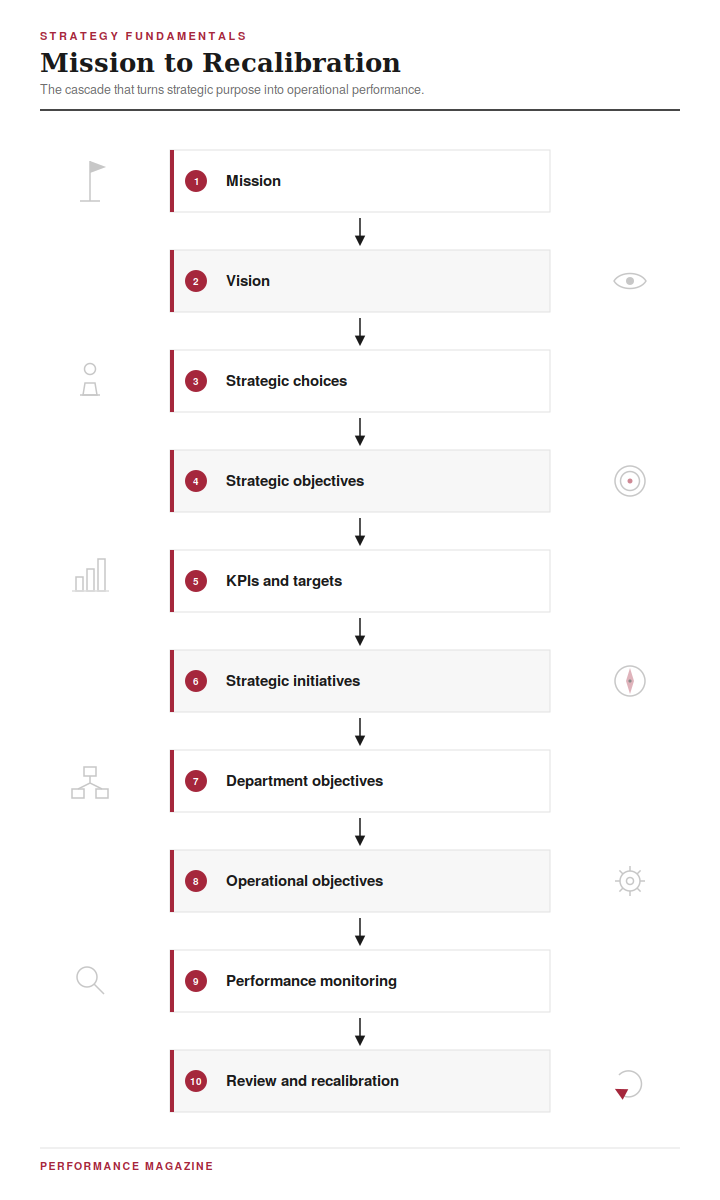
Define the organization → analyze the environment → define the future → make strategic choices → establish objectives → build the strategy tree → select initiatives → cascade strategy → execute → measure → review and recalibrate.
Strategic planning gives this sequence structure. Strategic management keeps it connected to organizational decisions and performance over time.
*********
Editor’s Note: This article draws on concepts, frameworks, and references covered in The KPI Institute’s Certified Strategy and Business Planning Professional (C-SBP) course.Learn more about the Certified Strategy and Business Planning Professional course
Many companies end up in a failure state because people believe it is due to poorly formulated strategies, when in fact many already possess decent-to-good strategies, yet fail to move the needle beyond the predispositions, processes, and priorities that served their past incarnation.
For example, a company may shift its strategic focus, but its KPIs reward old behaviour; its leaders declare transformation, but its middle managers still receive rewards based on old targets; it adopts new technologies while utilizing processes established for non-existent markets.
These contradictions slowly and imperceptibly build up over time, forming a phenomenon known as strategy debt.
In many ways, it is the equivalent of technical debt in software: the price organizations pay for the impact of previous, now-obsolete strategic decisions, inherited assumptions, legacy priorities, and previously resolved choices that continue to exert influence on their present state.
However, unlike the clearly identifiable problems in operations, strategy debt can lie hidden for many years. It may even happen that a business might encounter strange misgivings when implementing its new strategy because the old one simply never left the room.
As markets evolve and accelerate, strategy debt has emerged as one of the most significant and unrecognized hurdles to progress and execution. While businesses are unlikely to fall at a single catastrophic misstep, many suffer over time as their ability to adapt declines, even while they continue to optimize for the realities of the past.
Think of it like a car that slowly accrues one too many fittings & components that grind against each other. Just one won’t cause a crash; one hundred, however, start to become a significant livelihood problem. This is eerily similar for businesses, too!
This reality can be unsettlingly mundane: the staff are so accustomed to the competing priorities, overlapping processes, interminable alignment meetings, and initiatives no one seems to question anymore that it feels completely normal within the business.
The business still moves; it just moves slowly, weighed down by sluggish decision-making and languid initiatives, to the point where its very livelihood is endangered.
This introduces decision debt.
Every strategic decision is associated with assumptions made when it was initiated. As markets speed up, this timeframe shortens and assumptions quickly become obsolete, continuing to impact new realities in unintended ways unless reconsidered.
This results not in immediate collapse but incremental strategic dragging, and by the time the organization recognizes the issue, the debt has already compounded tenfold.
How Organizations Build Strategy Debt Over Time
Organizations do not normally set out to build strategy debt; quite the opposite, in many cases. Companies often attempt to foster stability and predictability by adhering to established procedures and objectives.
Traditional business strategy was once based on stable conditions. 5-year plans, annual forecasts, hierarchical structures, and fixed performance systems seemed logical in periods when market shifts were predictable and gradual.
Now, the business environment is drastically different.
Consumer behaviour changes rapidly, technologies can reshape entire industries overnight, competitive advantages erode at unprecedented speed, pivots can introduce completely new competitors where there were few before, yet many businesses still operate under strategies built for a more gradual, incremental landscape.
This marks the first noticeable layer of strategy debt: outdated assumptions and conditions become permanently embedded in an organization’s structure.
A KPI implemented three years prior, for instance, might still dictate behaviour today, despite significant shifts in the company’s business model. Similarly, a customer profile crafted earlier in development may continue to inform research, product iteration, sales, and marketing efforts, even though it no longer reflects the ideal target audience.
These inherited strategic choices gradually become ingrained in an organization’s DNA, amplifying decision debt.
Decision debt is the accumulation of past choices whose context is no longer relevant. The decisions themselves may have been sound at the time, but the organizational process for evaluating or challenging them has not evolved, leaving them in place beyond their useful lifecycle.
This can explain why some organizations appear highly dynamic and engaged yet produce minimal tangible progress. They are not failing to execute the strategy; however, the strategy they are executing may be obsolete.
The irony is that, more often than not, a company’s success makes it particularly susceptible to strategy debt. When a strategy is proven to be effective, companies naturally build systems around it: processes are optimized and standardized, key metrics are deeply ingrained, silos are segmented as expected, and entire departments are built to replicate success.
The more successful a company has been historically, the harder it is to challenge its underlying assumptions, particularly when it tries to transform. The barrier is not just implementing a new strategy; it is dismantling the influence of the old one, which is a far more difficult challenge.
The Silent Costs of Strategy Debt
One of the biggest misconceptions about strategy debt is that it’s limited to long-term, strategic discussions.
In reality, it can quickly become an operational problem: employees feel overwhelmed by competing priorities; managers can’t translate strategic intent into concrete actions; departments are unknowingly at cross-purposes while pursuing the same goals.
The organization is busy, but progress is slow, and strategy debt creates friction across the business.
1) One common symptom is initiative overload.
Companies accumulate more and more projects, frameworks, priorities, and transformation programs without retiring old ones. In other words, new strategic directions are piled on top of existing ones instead of replacing them. Employees are forced to build tomorrow’s company while also keeping yesterday’s business alive.
The result is a chronic strategic gridlock that functions in an unbalanced state.
2) A second symptom is decision paralysis.
When assumptions are no longer retired, organizations find themselves constantly complicating decision-making.
Employees spend a great deal of time seeking consensus on strategy because each department operates on a different strategic foundation. Sales might focus on revenue growth, product teams on retention, operations on efficiency, and leadership on innovation. Nothing here is wrong per se, at face value.
However, we now run into the problem that the organization has never explicitly identified which goals are most important in today’s environment and which are not.
As a result, we sit in a state of simulated agreement.
Middle managers feel this pressure the most. They are caught between dynamic leadership expectations and immobile operational systems tied to outdated strategies, and it’s often their job to deliver organizational change while maintaining expectations built on old strategies. The cumulative result is employee burnout.
Now, to be clear, this doesn’t happen because employees don’t want to change, but because they’re trying to balance many competing strategic identities.
3) A third symptom is quite an insidious problem: reinvention work.
We find ourselves rebuilding old processes, decisions, initiatives, methodologies, techniques, and systems because the original intent isn’t well-documented. Employees leave, institutional memory fades, procedures become bogged down in a muck of paperwork, and the organization is forced to play archeologist to recall why this system exists in the first place.
A surprisingly significant part of operational inefficiency comes from this.
Meetings take longer; action plans now sprawl over several months instead of weeks; decision-making requires more scrutiny; teams avoid risky actions because the underlying strategy is unclear.
Now the organization loses another critical factor: decision velocity, and in today’s markets, slow adaptation is more dangerous than an imperfect decision. A flawed decision can be recovered with agility; an organization slowed by accumulated strategy debt can’t.
Warning Signs Of An Organization Optimized For Yesterday’s Market
Strategy debt usually doesn’t reveal itself through dramatic pronouncements; instead, it’s a subtle process that becomes normal over time.
A) A clear indicator is repeated strategic discussions that don’t result in definitive decisions.
Leadership meetings are consistently stuck with the same questions and topics each quarter. Discussions don’t lead to clarity; they just keep going because the organization is stuck between its past assumptions and current realities.
B) “Zombie projects” are another warning sign.
These are projects that aren’t truly abandoned, nor are they properly completed; what’s more, they seldom truly become formally canceled. They linger in organizational consciousness and continue to drain time and resources because no one wants to be the one to finally pull the plug finally.
Companies with heavy strategy debt almost invariably suffer from an abundance of such projects.
C) Strategic language bloat becomes commonplace.
As strategy becomes less concrete, words like “digital transformation“, “customer-centricity,” and “innovation acceleration” become ubiquitous while being progressively less aligned with real work.
The more vague the actual strategy becomes, the more words people use to fake alignment. Employees are usually aware of this long before management.
D) A heavy reliance on historical best practices is yet another indicator.
The organization insists on evaluating new business opportunities against the conditions that applied in the past. Leaders still measure new opportunities against the same customer profiles and old assumptions that were effective in the past.
Rather than adapting its strategy to the market, the organization unconsciously tries to fit the market into its strategy. This is often where growth grinds to a halt.
E) Cultural implications also apply to strategy debt.
Risk-averse cultures often persist despite the organization’s claims to foster innovation. Employees become hesitant to challenge old processes because they are directly linked to historical success. “It’s always been done this way” becomes more than a bad habit. It becomes an instinct for self-preservation.
This can happen within companies that still claim to be agile and adaptive. The organization outwardly embodies the concept of change but structurally resembles stagnation.
F) A truly dangerous portent is when the strategy planning process itself becomes a performance.
Employees attend workshops without any real expectation of meaningful change. Strategy is observed as a ritual rather than enacted as a plan.
At that stage, strategy debt is no longer just a drain on execution. It is an erosion of trust, and once employees no longer believe that strategic change is possible, the organization’s ability to adapt will collapse from within.
How Organizations Can Cut Down Strategy Debt Before It Strangles Growth
This doesn’t mean organizations should stop thinking about the long term.
The company still needs direction, priorities, planning, and strategic intent. However, modern strategy demands an approach different from the rigid strategic planning models most organizations have inherited from a bygone era. The best-run organizations treat strategy as an iterative concept rather than a perpetual one.
Instead of presuming the original strategy will hold true in the long term, they establish mechanisms to continually reassess assumptions and update priorities as the business environment evolves. In other words, they actively manage down strategy debt.
One method is to conduct regular “strategy debt audits“.
I) The purpose is to examine all the major strategic decisions taken in the previous twelve to twenty-four months and pose one seemingly obvious question: “If I were taking this decision today, would I still do so?“
Few organizations take time to re-examine old decisions, unless an immediate crisis necessitates their review. This is a mistake that many managers simply glide over.
II) Another essential aspect is the segregation of actual strategy and inherited inertia.
Companies must identify which activities, reports, KPIs, and operational models continue to support current objectives, rather than those that persist because no one ever bothered to examine them. This, however, demands knowledgeable & charismatic leadership.
Letting go of past objectives can be difficult because organizations tend to imbue past strategies with emotional significance (especially if they were once effective). It makes sense – organizations are made of people, and people are emotional beings first and foremost who look to latch onto security reasons before speculative efforts.
However, failing to replace outdated systems generally incurs higher future costs.
III) Organizations should also normalize “kill lists” for strategies.
Just as businesses create roadmaps for launching new ventures, they should create specific lists of priorities that they will actively stop pursuing. Strategic subtraction can be as important as strategic addition.
IV) Preserving context is another crucial improvement.
Most organizations simply don’t document decisions sufficiently. They record outputs, not insights. Their successors end up inheriting conclusions without understanding how they were reached.
Understanding why a decision was made can often be more important than understanding what the decision was. After all, circumstances will eventually change, and organizations must retain the ability to challenge past logic rather than mindlessly follow past decisions.
V) Finally, organizations must embrace adaptive strategy execution.
The most resilient businesses today are not those that perfectly predicted the distant future. They are those who can adjust rapidly without causing organizational confusion. This means creating operational and mental flexibility.
Modern strategy is less about rigidly defined plans and more about building organizations that learn constantly. After all, the biggest strategic risk in today’s environment is not making the wrong decision; it is optimizing for decisions that have long since become ineffective.
Final Thoughts
The biggest danger of strategy debt is that it is usually not created by error.
The majority of strategy debt originates from perfectly logical, even effective and successful, decisions made in the past. That is what makes them dangerous. Companies tend to become emotionally attached to the strategies that made them succeed.
However, business markets change far more quickly than organizational inertia. In time, past strengths will inevitably turn into present weaknesses.
The most adaptive companies will not be those that were the most foresightful; they will be the companies most willing to challenge outdated assumptions and priorities, and to re-evaluate decisions when they no longer serve the purpose.
This requires a shift in the company culture. It involves a transition away from a fixed, immutable conception of strategy towards a more fluid, iterative learning process. It requires acknowledging that every strategy decision has a life span. Some expire rapidly; others last much longer. None should be permanently exempted from reassessment. After all, strategy debt compounds silently.
Initially, this appears as minor operational disruptions, shifting priorities, or a decline in velocity. Ultimately, it can evolve into a more pervasive issue, one in which the company can no longer adapt as quickly as its environment demands.
In today’s environment, the ability to adapt is not just a strategy; it is strategy itself.
Bridging the gap between strategy and execution requires more than intent—it requires the right frameworks and capabilities. Enroll in the Certified Strategy and Business Planning Professional and Practitioner program by The KPI Institute to learn how to align strategy, planning, and performance for meaningful organizational results.
Most organizations love the idea that strategy happens at the top: executives develop it, and employees on the ground execute it. Things somewhere in the middle just work. We wave our hands, and like magic, processes fall into place.
Well, that’s not exactly true. Somewhere in the middle is exactly where most strategies succeed or fail.
Across all industries and studies, one pattern rears its head again and again: well-designed strategy rarely translates into actual output. It isn’t so much that the vision is wrong, per se; it is simply a matter of losing it along the way, of it being diluted or misunderstood.
That gap between intent and output lies where middle managers work. Enabling or neglecting them often dictates whether change will take hold or fade under its own weight.
In this article, we delve into this critical role by drawing on diverse views on change management, strategy execution, and leadership behaviours. Each section looks at this issue from a different angle; all reflect the same truth: middle managers aren’t merely intermediaries-they are the mechanism by which strategy takes shape in organizations.
The Strategic Translation Layer: How Middle Managers Turn Vision into Action
While an organization’s strategy defines what it wishes to achieve, it is middle managers who help transform that vision into something understandable and executable.
They occupy a unique position in organizations: positioned above are executives focused on strategy and priority-setting; below them, employees face the challenges of day-to-day operations. It is this dual orientation that grants them the detail executives often lack: context.
They are attuned to what leadership wants and what employees can realistically achieve.
Their ability to both translate strategy into executable plans and adjust plans to the realities of the work lies in their interpretation and adaptation of information from above and below. It is quite akin to alchemical transformation.
Studies and research consistently cite the translation role as critical. Employees’ understanding and belief in strategy correlates with performance gains, whether measured by revenue, engagement, job satisfaction, or customer experience. However, almost every time, without fail, understanding tends to stem not from the top but from above.
The irony is that strategy often never reaches the middle clearly. Managers often say they are not entirely confident in communicating strategy because they don’t fully understand it themselves. This deficit can ripple outward; the entire organization becomes unclear when the middle is unclear.
In sum, strategy fails not at the design stage, but at the translation stage, and this translation layer usually resides with middle managers.
From Resistance to Alignment: How Change Spreads Organically Inside Organizations
Despite having a strategy at the top, people will rarely fall in line spontaneously. Change within organizations is not a rational, top-down endeavor; rather, it is inherently social and emotional.
Initially, there is likely a division among middle managers. Some champion the new strategy, others defend established procedures. Each response is a common feature of this stage. However, with time, a subtle change occurs.
Initially reluctant middle managers may come to realize that even deeply cherished practices and systems will not persist in their current form without adaptation; innovation may actually be the means of preservation. As this occurs at the individual level, influence begins to be driven by credibility rather than by authority alone.
When a well-respected middle manager adopts a new perspective, it serves as an influential model, drawing followers and shaping the organization’s discourse around the strategy. The transformation begins to gain organic momentum, spreading not through directives, but through personal relationships and evolving consensus.
Eventually, the organization may realize that innovation and tradition are not necessarily antithetical and that alignment can provide the foundation for bridging them.
Organizational change is an emergent phenomenon rather than an announced decision. It evolves in the middle layers of leadership. As a result, organizational change rarely occurs rapidly; however, it is usually the long, slow process within middle management that results in the enduring transformation of an organization’s overall culture.
Why Strategy Fails: The Under-Discussed Problem of Alignment
Executives tend to view strategy execution as a technical problem – a matter of disciplined execution. In reality, it is almost always an alignment issue.
A) Vast studies have consistently shown that many of a strategy’s failed initiatives were not based on flawed ideas but on an inability to ensure consistent implementation. The literature frequently reports strategy implementation failure rates ranging from 50% to 90%, although these estimates are debated and vary across pieces of research.
This metric doesn’t reflect intellect or diligence; it reflects a breakdown in alignment and clarity.
Often, leaders see the strategy as transparent, while employees, and particularly middle managers, experience it as ambiguous or fragmented. This disconnect, a wide chasm between top-level confidence and the reality below, renders the strategy powerless. Instead of directing action, it becomes abstract material in presentation slides.
B) Another factor leading to failure is prioritization: where strategy is unclear, every initiative appears vital. Where all initiatives are vital, no single effort receives the attention it deserves.
It is middle managers who, day in and day out, must navigate this contradiction; they are the individuals making real-time choices about where effort and resources will be directed. They don’t merely execute strategy, but adapt and interpret it.
Indeed, alignment matters far more than planning. No strategy, however ingenious, can survive long-term failure to align the organization. Strategy fails not because of popular opposition, but because of differential experience with it across different parts of an organization.
The Reality of the Middle Manager’s Role: Pressure, Ambiguity, and Overload
It’s a lot more comfortable to use words like “bridge” to describe middle managers than to be comfortable with what this feels like.
Middle managers operate in two directions at once:
They are recipients of directives on strategy, mandates for transformation, and performance targets.
They are also simultaneously dealing with team members’ issues, capacity constraints, execution realities, and their own team’s morale.
That combination creates a structural tension that is difficult to resolve.
A primary factor in this challenge is role ambiguity. How much autonomy middle managers actually possess often becomes unclear.
Are they strictly implementation-focused, or is the implementation adaptable to the reality of the work? How accountable should middle managers be for things beyond their direct control?
Lack of clarity about how much discretion they have inevitably leads to overload. Without clear boundaries, it becomes impossible for middle managers to distinguish between urgent and important, leading to more reactive rather than strategic prioritization of activities.
The capability gap is another widely overlooked issue. Moving from operational leader to translator of strategy requires a fundamentally different skill set. This mental shift is rarely formally part of a middle manager’s promotion and development plan. Middle managers are frequently promoted based on their ability to execute and are expected to become capable strategic communicators and leaders of change immediately.
The result is the expected: stress, fatigue, strain, burnout, and disengagement.
It does not just affect individual middle managers. Lower productivity, scattered priorities, increased staff turnover, and a weaker alignment between middle management and the overall strategy are all byproducts of middle manager overload within an organization.
In other words, the pressure on the middle layer is a systemic challenge, not just for individual managers.
Making Strategy Work: Enabling Middle Managers
Given the importance of the middle manager layer, the question arises: why do organizations underinvest in it?
In most cases, the answer is a combination of inertia and an overemphasis on strategy design, with a laissez-faire approach to execution, assuming it will happen automatically.
However, nothing could be further from the truth.
The most effective method to improve strategy execution isn’t more strategy – it’s stronger enablement for those who translate it into reality.
1) The first crucial step is clarity of role and expectations.
Managers need to understand precisely what will be asked of them, which decisions they own, which must be escalated, and what successful execution looks like in practical terms.
Uncertainty and ambiguity lead to either constant over-escalation or boundary overstepping.
2) Second, capabilities must be developed.
Strategic execution requires much more than the ability to complete tasks. It relies on strong coaching and change management skills, so investment in development in these areas cannot remain just a nice-to-have option if consistent execution is the objective. It is mandatory, if one cares for the success of their business, that is.
3) Third, leadership alignment is critical.
If, on the one hand, middle managers are viewed as merely messengers, they cannot provide valuable feedback to those who designed the strategy, and their engagement in the process will be low.
If, on the other hand, they are valued for the insights they can provide on the ground, they will provide valuable input to the strategic planning process.
4) Fourth, the organization needs feedback loops that work in both directions.
Managers need to effectively communicate execution challenges upwards, while leadership needs to clearly articulate the strategic rationale downwards.
Without an effective two-way feedback structure, a series of distortions emerges, leading each successive level to hear a modified version of the intended strategy.
5) Finally, rewards are important.
Organizations signal to their employees what is valued by reinforcing both operational execution and transformation. Recognition for change leadership rather than just task completion ensures that the challenging work of strategy implementation is integrated into everyday performance.
With these conditions, middle managers transform from overburdened intermediaries into powerful drivers of organizational direction.
Final Thoughts
When reviewing the research and evidence, one theme consistently emerges: the middle management layer is not an auxiliary level in the organization but rather the engine through which strategy actually takes effect.
Middle managers take high-level direction and transform it into tangible actions, process ambiguity into decisions, resist resistance, and disseminate understanding throughout the organization through relationships rather than purely by authority.
Strategy becomes stuck when this layer is not supported. When enabled properly and with a clear understanding, strategy advances with great celerity.
Most successful organizations prioritize investing in the enablement of their middle managers-the people who bring their strategy to life every day-rather than focusing solely on better strategic design.
This is because, in the final analysis, at the end of it all, strategy failure does not occur in the boardroom but in the middle.
Bridging the gap between strategy and execution requires more than intent—it requires the right frameworks and capabilities. Enroll in the Certified Strategy and Business Planning Professional and Practitioner program by The KPI Institute to learn how to align strategy, planning, and performance for meaningful organizational results.
Organizations seldom fail because they don’t have an actual strategy in place – most do have some form of strategy in place.
They fail because the strategy, even if well-conceived and meticulously documented or hap-hazardly strewn together and poorly executed, is rarely acted upon with the required rigor and intent.
After a glossy presentation ends and the strategy is launched, what is truly required is for the responsibility for executing the plan to percolate through various departments and teams.
What most leadership teams fail to appreciate is the delicate nature of strategic alignment: a strategy that seems utterly clear in the boardroom can quickly become contradictory once responsibility is shared with those charged with bringing it to life.
Somewhere in between executive vision and operational reality, the signal degrades. Workflows and priorities shift, messages become unclear, managers become overwhelmed, and ultimately, teams disengage from plans they can no longer grasp.
The outcome doesn’t necessarily lead to explosive, grand failure; actually, it’s insidious organizational drift efforts that everyone is expounding on, but likely not toward the same outcome.
Several recurring patterns are common here. Executive assumptions, communication failures, bottlenecks at the middle-management level, inconsistency, and the ever-present temptation to make constant pivots all chip away at effective execution. For any organization that truly wants to turn strategy into action, recognizing and addressing these patterns is the critical first step.
Executive Assumptions About Understanding Strategy That They Don’t
The most pervasive executive blind spot is equating communication with understanding.
Leaders spend months doting over strategic objectives, perfecting presentation materials, aligning budget priorities, and devising rollout plans.
By the time the strategy is shared internally during a gathering, leaders understand it better than anyone, knowing every single minutiae and detail. However, everyone else only learns about the strategy at that meeting.
Having been immersed in the strategy for months, executives vastly overestimate its clarity to their team members. What seems obvious in the executive suite often seems rather nebulous on the ground floor. Concepts like “customer-centric innovation,” “digital transformation,” or “operational excellence” may ring true during an executive offsite, but become ambiguous when employees have to interpret them in terms of daily tasks and responsibilities.
This misalignment is amplified when the primary strategy communication channel is a top-down, single broadcast. Leadership presents the plan at an all-hands meeting and assumes that the organization is aligned. The reality is that hearing a message doesn’t automatically mean it’s understood or that it can be translated effectively and consistently by teams across the organization.
In fact, employees often nod along to strategic slogans without the faintest idea what those priorities mean for their own day-to-day decisions. The strategy may exist conceptually, but fails operationally.
A similar factor that leads to the communications vacuum is the physical distance between leaders and the everyday work of employees. When leaders are many layers removed from the operational challenges employees face, strategic priorities that appear to make sense at the top of the organization can represent competing pressures or constraints that immediately impact employees’ day-to-day lives.
The outcome is a hidden, often unacknowledged, alignment gap. The leadership team thinks the message has been sent; the employees are trying to operationalize on the basis of various assumptions and local departmental concerns. Over time, this divergence causes the organization to veer off track, subtly (and not so subtly).
The Communication Illusion
Inseparably linked to this point is what experts sometimes call the “communication illusion.” This illusion occurs when the process of transmitting information is mistaken for genuine communication.
In many organizations, communication about strategy feels like a transactional process: emails are sent out, presentations are made, meetings are convened, and documents are distributed. When these actions have been completed, leadership feels a sense of accomplishment and confidence that the organization is now informed.
The problem is that communication in a company, especially when it concerns strategy or planning, requires more than simply delivering information in a clear pattern. That information has to be interpreted properly.
Employees interpret incoming information through their own frame of reference: their day-to-day workloads, anxieties, preconceived notions, prior assumptions about strategy, and personal interpretation of leadership messages. An announcement that appears transparent to leaders can create questions or ambiguities for teams trying to make sense of how a new strategy affects their existing jobs.
The communication illusion is often exacerbated when leaders focus on what’s changing rather than why it matters or how employees should adapt their behaviour. This results in fragmenting information instead of clearly articulating what employees need to do.
Moreover, while it might seem that repeating a strategic message over and over should strengthen it, overexposure to an unchanging message can result in noise fatigue, and the strategic communication is largely ignored because it is not grounded in operational reality.
True strategic communication is not a one-time information download. It requires continuous clarification and dialogue across all levels of the organization so that individuals can have their questions answered and connect the strategy to their immediate reality effectively.
The Middle Management Bottleneck
Middle managers have the unenviable task of ensuring that strategy translates from executive directives to operational execution, and of managing their team members’ day-to-day performance & deadlines.
In theory, middle managers serve as the vital bridge between strategic vision and tactical reality; in practice, they too often become the dreaded bottleneck.
For middle managers, the core problem is overwhelming work.
In periods of organizational change and strategic refocus, they are expected to digest the new priorities while keeping the rest of the organization functioning. In essence, they are on the hook to translate murky directives, reconcile inconsistent messages, patch up wobbly goal patterns, and protect their teams from disruption at a time when the organization is anything but stable. The immediate, pressing deadlines facing their teams become an all-consuming focus, overshadowing the strategic priorities set in more distant leadership circles.
This situation is perpetuated because middle managers, much like other employees, are not always as strategically clear as their leadership teams assume. They receive high-level messages that lack clarity or support, and then are expected to deliver a coherent, motivating message to their teams. When managers are unclear or uncertain, this inconsistency will inevitably permeate their departments and teams, seeping through the cracks of understanding and creating a pool of misinformation that everyone eventually dips their toes into.
Middle managers also become the recipients of much of the frustration and confusion generated by strategic changes. They must absorb employees’ anxieties and criticisms before mediating them to leadership. Without sufficient support from above, middle managers quickly become demotivated and disengaged (a fact that is rarely recognized by many organizations). Middle management may arguably be the most crucial element for strategic execution, yet they often receive the least strategic investment.
The Trouble with Inconsistent Leadership and Changing Goals
Even the best communication strategies break down when leadership behaviours are inconsistent. People don’t just hear what leaders say; they also hear what leaders value over time.
1) Frequent, rapid shifts in leadership priorities undermine trust.
Organizations often create confusion by introducing new initiatives before existing ones are settled or their goals are clearly achieved. One quarter focuses on innovation, the next on efficiency, the next on the customer, then costs are paramount, followed by innovation again. The cycle often continues before the impact of prior change can be truly measured or experienced.
While the leader may see these moves as the ability to respond to a dynamic marketplace, for employees, they simply feel chaotic.
Problems arise because teams are confused about what’s important, always waiting for the next shift, and never really owning a goal. This undermines the sense of strategic urgency, as employees expect the initiative to be replaced at some point.
2) It also undermines accountability.
Leadership can’t be surprised or disappointed when team members don’t stick with or finish objectives that, within a quarter, are no longer considered strategically relevant. The result can be organizations that celebrate the start of initiatives, but rarely finish them.
3) Finally, this causes fatigue.
Employees are tired of adapting to change only to find the rules shifting. They are emotionally disengaging from new directives, believing they will not endure, and will quickly revert to business as usual as soon as possible.
Inconsistency also shows up in smaller gestures. You might encourage collaboration while rewarding individual performance, tell employees it’s okay to fail when introducing innovation, or tell employees you expect long-term thinking but also require immediate results.
Employees notice this in a heartbeat, and when a leader’s actions are not aligned with their message, trust begins to wither. People eventually look to leadership to tell them what they’re interested in through actions rather than words, making a coherent strategy impossible.
Strategic Fatigue Caused by Endless Pivots
While agility is clearly needed to operate in today’s marketplace, it is different than continuous organizational pivoting. Frequent organizational pivoting causes what is termed strategic fatigue, the mental and emotional exhaustion many employees feel due to endless, incessant change.
Strategic fatigue doesn’t normally start immediately. Often, a change effort begins with an air of excitement and optimism as employees are drawn to ambitious new targets. However, over time, as change becomes perpetual, the novelty wears off, and weariness takes hold.
A common cause of strategic fatigue is that organizations launch new transformation initiatives without ensuring old ones are implemented and evaluated thoroughly. Employees are expected to adopt new processes, new priorities, new systems, and new performance expectations, all within very compressed time frames. With time spent re-evaluating old ways of working and integrating new ways, the employees get lost in translation.
Over time, this can push employees to withdraw from new initiatives psychologically. They will begin investing less of themselves in the change effort because their prior experience with continuous change has taught them not to expect results. Productivity can fall, and innovation capacity can decline due to a lack of the mental bandwidth required for rapid, continuous change. In essence, organizations are too tired and too focused on doing to really get any better.
When these constant pivots lead to burnout, some leaders attribute it to general resistance to change, when in reality, employees are willing to change if it is done purposefully and is coherent and sustainable.
The true killer of change isinconsistency.
Sustainable, effective change relies on both adaptability and stability. Without it, organizations may quickly burn out the people tasked with implementing the strategy.
Final Thoughts
As much as we are led to believe, most organizations don’t have difficulty coming up with a strategy and availing themselves of intelligent leadership.
Those aspects are plentiful; however, what is not plentiful is execution and human alignment.
Most executives underestimate how tenuous alignment is, while many overestimate the importance of an intelligent strategy or detailed communication, and underestimate the effect of overwhelming middle management and too-rapid, frequent change.
When all of these factors combine, it creates a state where employees no longer know where the team stands, managers are overburdened, objectives & goals get muddied and lobbed together in a mish-mash fashion, and strategy can disconnect from the organization, without anyone really noticing until it’s too late. The solution, curiously, isn’t more communication, but more intent.
The most successful organizations are those whose clarity makes their strategy meaningful and achievable, consistency prevents it from eroding, and reinforcement sustains the learning necessary to apply it. This requires patience and alignment among people across the entire organization, and without this, even the best-laid strategy can fail unnoticed.
Bridging the gap between strategy and execution requires more than intent—it requires the right frameworks and capabilities. Enroll in the Certified Strategy and Business Planning Professional and Practitioner program by The KPI Institute to learn how to align strategy, planning, and performance for meaningful organizational results.
Many organizations believe that employees who disengage lack motivation or discipline. However, most of the time, people disengage for less obvious reasons, such as a lack of clarity.
When people are not fully aware of what matters, why it matters, how urgent it is, or how success is defined, a gradual shift in performance begins. Teams keep working, meetings keep happening, deadlines are being met, and dashboards are being updated, but truly productive momentum is fading.
The organization, while busy on the outside, is subtly becoming misaligned beneath the surface.
This disconnect rarely happens because employees lose interest. More often, it occurs when strategy gets fuzzy, or performance systems overwhelm rather than guide. In these instances, humans intuitively start to optimize for predictability rather than for impact.
The net result is an organization that is busy but lacks momentum.
Recognizing the psychological and operational impacts of vague objectives is critical for organizations striving to link strategy with execution. When goals lack clarity, the highest-performing teams will inevitably lose focus, ownership, and engagement over the longer term.
Why Employee Engagement Fades When Goals Feel Vague
Employees are more likely to remain engaged when they have a clear understanding of the purpose and meaning that their efforts will ultimately generate. When organizational objectives feel distant, intangible, inscrutable, or disconnected from daily actions, a sense of purpose dwindles.
Most organizations have their strategy documented in broad strokes. Common strategy descriptions are “become more innovative”, “focus on the customer”, “lead the transformation”, or “drive greater growth”. While appealing at the leadership level, these aspirations provide little direct guidance for employees.
This begins to create psychological dissonance between effort and outcome.
People naturally seek validation of their efforts and will readily respond to goals that provide evidence of what they are working towards. When individuals don’t have that direct visibility and connection to business outcomes, work becomes functional rather than purposeful.
Emotional investment then begins to decline with celerity.
Employees start to emphasize the accomplishment of immediate, tactical tasks over those that lead to meaningful organizational outcomes because the former offer clearer feedback and more predictable results.
Abstract goals also create divergent interpretations across the organization. Different parts of the organization define success using their own unique frame of reference rather than by overarching organizational goals.
Fragmentation ultimately weakens alignment as it expands throughout departments and teams.
This impact is exacerbated in larger, geographically diverse, or hybrid organizations.
Engagement doesn’t come from being assigned work; it comes from a clear understanding of what it represents.
The Psychological Impact of Unclear Priorities
In addition to reducing operational efficiency, undefined priorities induce psychological stress.
When individuals face competing demands, constantly shifting expectations, or inconsistent direction, they live with perpetual uncertainty about where to direct their efforts.
Humans crave clarity and predictability. When organizational priorities are murky, employees enter a continuous evaluation cycle, questioning their own decisions and seeking clarification from managers.
Stress levels increase
Employees may grow fearful that they are focusing on the wrong tasks or failing to meet expectations.
Cognitive efficiency decreases
Employees divert their attention to several perceived urgencies instead of focusing on tasks that generate strategic value.
This inevitably drives reactive, rather than strategic, decision-making.
Organizations rarely appreciate the compounding impact that this situation has on employee performance.
Conflicts arise, priorities must be constantly re-negotiated, and employees often give up trying to anticipate future work and simply manage the current uncertainty.
Overloading the Employee’s Mind with KPIs
Performance measurement is crucial for establishing and maintaining alignment across an organization; however, organizations often undermine performance when they measure too much.
As businesses become increasingly data-driven, organizations tend to develop more sophisticated KPI-based measurement systems and dashboards. Ironically, when overused, they can cause cognitive overload.
You can only keep a couple of metrics truly in focus. The moment you start asking people to juggle fifty metrics, attention becomes diffused.
This causes three distinct problems:
1. Paralysis
People cannot decide which metrics truly matter and either spread their effort thinly across all of them or focus only on the easiest metrics to influence.
2. Reduced Strategic Focus
Instead of focusing on organizational outcomes, individuals and teams focus on individual metrics.
You end up rewarding people for managing dashboards instead of solving problems.
3. Increased Mental Fatigue
People are forced to keep switching tasks, and the cost of switching accumulates.
The result is that the measurement system itself becomes demotivating.
The most effective organizations succeed because they know that using too many metrics creates more complexity and less clarity.
How Ambiguity Produces “Safe” Instead of Effective Work
An unclear environment can often lead employees to produce “safe” work.
“Safe” work implies completing tasks in a way that minimizes individual risk or visibility.
Ambiguous organizations tend to foster environments where risk-taking is discouraged.
The organization starts to become performance-oriented toward easily defensible activities.
The culture of innovation, as a result, becomes greatly hindered.
Employees are encouraged to maintain the status quo even if it isn’t delivering true organizational value.
By reducing the psychological costs of taking action, organizations increase motivation to do meaningful work.
The Distinction Between Compliance and Commitment
Compliance: employees work to do what they are told.
Commitment: employees work to achieve desired results in ways they believe add value.
These may appear similar on the surface, but what happens underneath is fundamentally different.
Compliant employees focus on doing enough to satisfy expectations.
Committed employees proactively solve problems, collaborate effectively, and adapt more willingly to change.
The gap between compliance and commitment is fundamentally a problem of unclear purpose, low trust, and lack of meaning.
Companies driven by commitment outperform those that rely solely on compliance.
Final Thoughts
The most fundamental reason companies fail isn’t that their people don’t work hard enough; it is that the work they do does not add sufficient value because they cannot clearly see the point.
Unclear priorities, complex systems, and undefined success measures dilute people’s focus, create psychological stress, and diminish initiative.
Strategic alignment is a psychological discipline as much as a tactical or operational one.
Without clear alignment, people can put in a lot of effort without ever having a significant impact because the connection between their work and intended results is too weak.