What Is Strategy? Definition, Types, Process, and Examples



Strategy is the set of choices an organization makes about where it wants to go, what it will prioritize, how it will compete, and how it will allocate resources to reach its objectives.
The concept has several established interpretations. Michael Porter describes strategy through competitive positioning and a deliberately different set of activities. Henry Mintzberg presents strategy through five perspectives: plan, ploy, pattern, position, and perspective. The CSBP framework from The KPI Institute also treats strategy as part of a wider performance cycle that connects purpose, objectives, strategic choices, organizational structure, management systems, execution, review, and recalibration.
In practice, strategy answers a deceptively simple question:
What choices must the organization make to achieve the future it wants?
Those choices become meaningful when they influence objectives, resource allocation, initiatives, operating priorities, and performance measures.
This guide explains:
- what strategy means
- how strategy differs from strategic planning and strategic management
- the main types of strategy
- the strategic planning process
- the tools used for strategic analysis
- how strategy moves from corporate objectives to departmental action
What Is Strategy?
Strategy is a coherent set of choices about an organization’s direction, priorities, competitive position, and use of resources.
There is no single definition accepted across the entire strategy literature. A 2024 review of strategic planning research found substantial variation in how strategic planning is defined, particularly in how far the process extends into implementation.
One of the most influential definitions comes from Michael Porter. In his classic article “What Is Strategy?”, Porter distinguishes strategy from operational effectiveness and describes strategy in terms of choosing a distinct position and a different set of activities.
Henry Mintzberg takes a broader view. His 5 Ps of Strategy describe strategy as:
- Plan: an intended course of action.
- Ploy: a deliberate maneuver in relation to competitors.
- Pattern: consistency in decisions and actions over time.
- Position: the organization’s place in its external environment.
- Perspective: the organization’s way of seeing the world and acting within it.
The CSBP slides use the Mintzberg 5P model to place strategy across past, present, and future perspectives.
A useful working definition for performance management is therefore:
Strategy is the set of choices that determines the organization’s direction, priorities, competitive position, and allocation of resources in pursuit of its objectives.
What Is Strategic Planning?
Strategic planning is the structured process through which an organization analyzes its current situation, defines its desired direction, makes strategic choices, establishes objectives, and determines the initiatives and resources required to move toward those objectives.
The distinction matters.
Strategy describes the choices.
Strategic planning describes the process used to formulate and organize those choices.
Strategic management covers the broader management of strategy, including formulation, implementation, monitoring, learning, and adjustment.
The distinction also appears in recent research. A 2024 study describes strategic planning as process-oriented, while strategy concerns the fundamental choices made to achieve organizational objectives.
The Cambridge Business English Dictionary defines strategic planning as a process in which executives decide what they want to achieve and determine the actions and resources required to do so.
Strategy vs. strategic planning vs. strategic management
| Concept | Main question | Typical output |
| Strategy | What choices will we make? | Strategic choices and direction |
| Strategic planning | How will we formulate and organize those choices? | Strategic plan |
| Strategic management | How will we manage strategy over time? | Strategy formulation, execution, monitoring, and review |
| Strategy execution | How will we put the strategy into practice? | Initiatives, projects, operating priorities, measures |
Strategic planning therefore should not be reduced to producing a document. The research literature treats it as a process, and recent work continues to examine how planning connects with implementation, risk, uncertainty, and organizational performance.
Why Does Strategy Matter?
Strategy provides a basis for making choices about priorities, resources, objectives, and action.
Without strategic choices, organizations can accumulate projects and activities without a clear connection to their intended direction.
The CSBP framework places strategy inside a broader performance cycle:
- Define meaning through mission and values.
- Define success through vision and strategic objectives.
- Define strategy.
- Define the execution structure.
- Define the management system.
- Execute, review, and recalibrate the strategy.
This creates a connection between strategy and performance management.
A strategy can therefore influence:
- Which markets an organization serves
- Which customers or stakeholders receive priority
- Which products or services receive investment
- Which capabilities need development
- Which initiatives receive funding
- Which risks require attention
- Which objectives departments receive
- Which KPIs are used to monitor progress
- Which activities are treated as business as usual
- Which new projects require dedicated resources
The OECD’s 2024 work on strategic planning also highlights the importance of translating long-term vision into priorities and connecting planning with implementation.
What Are the Main Types of Strategy?
Strategy operates at several organizational levels. The CSBP framework illustrates a hierarchy that runs from the corporate level through regional, business-unit, functional, team, and employee levels.
1. Corporate Strategy
Corporate strategy concerns the organization as a whole.
It addresses questions such as:
- Which businesses or markets should the organization participate in?
- Where should resources and investment go?
- Should the organization grow, maintain its current position, or reduce its scope?
- Which businesses or activities belong within the corporate portfolio?
Corporate strategy becomes particularly important when an organization operates across multiple businesses, markets, or geographical areas.
2. Competitive or Business Strategy
Competitive strategy concerns how a business competes within a particular market.
Porter’s work places competitive positioning at the center of strategy. The CSBP framework presents several competitive strategy options, including:
- Low-cost, low-price strategy
- Differentiation
- Customer service and relationship strategy
- Networking-effect strategies
Porter’s Five Forces can also help organizations examine the competitive environment through:
- Existing competitors
- New entrants
- Bargaining power of buyers
- Bargaining power of suppliers
- Substitute products or services
The central issue is strategic choice. An organization needs to understand the basis on which it intends to compete and whether its activities support that position.
3. Functional Strategy
Functional strategy translates higher-level strategic choices into priorities for functions such as:
- Marketing
- Finance
- Human resources
- Operations
- Information technology
- Procurement
- Research and development
A functional strategy should connect departmental priorities to corporate or business-unit objectives.
The CSBP framework treats this connection as a cascading process. Corporate objectives can be transferred to departments as the same objective when a department owns or directly contributes to it, or as supporting objectives when the department contributes indirectly.
4. Growth Strategy
Growth strategy addresses how an organization intends to expand.
The CSBP slides identify several approaches:
Intensive growth
The organization seeks greater market share within its current geographical market.
Integrative growth
The organization expands across the value chain through approaches such as:
- Backward integration
- Forward integration
- Horizontal integration
Diversification
The organization expands into related or unrelated areas beyond its existing sector.
Internationalization
The organization expands across geographical borders through mechanisms such as alliances, joint ventures, franchising, licensing, mergers and acquisitions, or other international models.
Growth is therefore a strategic choice rather than a single formula.
What Is the Strategic Planning Process?
A strategic planning process usually moves from understanding the organization and its environment to making strategic choices, setting objectives, allocating resources, and executing the resulting initiatives.
The exact sequence varies by organization. The CSBP framework provides a useful integrated structure.
Step 1: Define the organization’s identity
Strategy starts with the organization’s underlying purpose and identity.
This includes:
- Mission
- Values
- Corporate capabilities
- Desired impact
- Vision
The CSBP material distinguishes mission from impact. The impact describes the change the organization wants to create, while the mission describes how it intends to create that change.
Corporate capabilities also matter because strategy depends on what the organization can actually do. The course defines capabilities as the collective skills, abilities, and expertise of an organization.
Step 2: Conduct an Internal Environment Analysis
An internal environment analysis examines what the organization currently has and how effectively it operates.
The CSBP framework examines:
- Processes
- Procedures
- Resources
- Functional and structural perspectives
The analysis asks several practical questions:
What resources do we have?
How well do our processes work?
Which capabilities support our strategy?
Where are the gaps between what exists and what the strategy requires?
The resource analysis covers:
- Financial resources
- Human resources
- Information resources
- Material resources
- Knowledge and expertise
The purpose is to establish a realistic picture of organizational capacity. The CSBP framework describes the internal scan as a way to anchor strategic planning in the current reality and identify gaps between existing and required capabilities.
Step 3: Analyze the External Environment
Organizations operate within environments they cannot fully control.
The CSBP framework separates the external environment into:
- Macro-environment: broad forces outside the organization’s direct control
- Micro-environment: actors and forces involved in transactions with the organization
Several tools can support this analysis.
PESTEL analysis
PESTEL examines six categories:
- Political
- Economic
- Social
- Technological
- Environmental
- Legal
The CSBP process moves through four stages:
- Identify relevant factors.
- Identify possible changes.
- Examine relationships among factors.
- Assess whether each factor could represent an opportunity or threat.
A 2026 academic review of PESTEL notes that the framework remains widely used across strategic and policy research, while also warning against treating it as a simple checklist. Environmental analysis has limits. It cannot predict the future or remove uncertainty on its own.
That distinction matters. A long list of external factors is not a strategy.
Porter’s Five Forces
Five Forces examines the competitive structure of an industry through:
- Competitive rivalry
- Threat of new entrants
- Buyer power
- Supplier power
- Threat of substitutes
It helps answer a different question from PESTEL.
PESTEL asks: What is changing in the wider environment?
Five Forces asks: What competitive pressures affect the industry’s economics?
The two analyses can therefore complement each other.
Step 4: Use SWOT Analysis Carefully
SWOT organizes strategic factors into four categories:
| Internal | External |
| Strengths | Opportunities |
| Weaknesses | Threats |
The CSBP framework distinguishes internal strengths and weaknesses from external opportunities and threats.
SWOT becomes more useful when the analysis leads to strategic questions:
- Which strengths can support strategic objectives?
- Which weaknesses could restrict execution?
- Which opportunities deserve strategic attention?
- Which threats require a response?
- Which strategic objectives should be added because of the analysis?
The CSBP framework makes an important distinction here: SWOT does not create the strategy by itself. Its output is additional strategic objectives that can feed into the strategy tree.
Recent research also continues to examine limitations in conventional SWOT, including subjectivity and difficulty in prioritizing factors.
Step 5: Use Scenario Planning for Uncertainty
Scenario planning considers several plausible ways the external environment could develop.
The CSBP framework distinguishes scenarios from SWOT in an important way:
SWOT examines individual threats and opportunities. Scenario planning considers combinations of threats and opportunities that could produce different future conditions.
A scenario planning process can ask:
- What major uncertainties could affect the organization?
- What combinations of factors could produce different future conditions?
- How would each scenario affect strategic KPIs?
- Which indicators should management monitor during execution?
Recent research describes scenario planning as a process that develops alternative stories about the future and uses them to challenge current assumptions and develop more robust strategies.
Step 6: Define the Vision
A vision describes the organization’s desired future state.
The CSBP framework defines vision as the organization’s desirable future and describes it as a qualitative statement that defines success.
A useful vision should answer:
What will the organization become?
The vision then gives strategic planning a future reference point.
The CSBP material uses a longer-term horizon for vision and then translates it into objectives at shorter time horizons.
Step 7: Translate the Vision Into Strategic Objectives
A vision is difficult to manage unless it can be translated into specific outcomes.
The CSBP framework uses a sequence:
Vision → long-term objectives → strategic objectives → operational objectives → KPIs and targets.
For example:
Vision: Become a leading regional provider of digital learning.
↓
Long-term objective: Establish a strong regional market position.
↓
Strategic objective: Increase regional market share.
↓
KPI: Regional market share (%)
↓
Target: 20% by 2030
↓
Operational objectives: Annual targets and actions that contribute to the strategic objective.
This translation creates a bridge between strategic intent and performance measurement.
Step 8: Build a Strategy Tree
A strategy tree shows the cause-and-effect relationships among strategic objectives.
The CSBP framework uses a simple question:
To achieve this objective, what do we need?
Each strategic objective should lead logically to the objectives beneath it. The framework asks whether the lower-level objectives are necessary and sufficient to reach the higher-level objective.
A strategy tree can therefore look like:
Vision
↓
Long-term objective
↓
Strategic objective A
Strategic objective B
Strategic objective C
↓
Supporting strategic objectives
↓
Operational objectives
↓
KPIs and targets
This structure gives performance managers a way to test whether the strategy has a coherent logic.
Step 9: Choose Strategic Initiatives
Objectives describe what the organization needs to achieve.
Strategic initiatives describe what the organization will undertake to achieve those objectives.
The CSBP framework connects strategic objectives with corporate initiatives, programs, projects, and organizational structures.
At departmental level, the process includes identifying a portfolio of projects that supports the corporate competitive and growth choices. Each initiative should have its risks, resources, and schedule considered.
This distinction is useful:
| Strategy element | Question |
| Vision | Where do we want to be? |
| Strategic objective | What result must we achieve? |
| KPI | How will we measure it? |
| Target | What level of performance do we require? |
| Initiative | What major undertaking will contribute to it? |
| Project | What specific temporary effort will deliver it? |
| Business as usual | What ongoing activities will support it? |
Step 10: Cascade Strategy Across the Organization
Corporate strategy has limited practical effect if it stays at the corporate level.
The CSBP framework cascades strategic objectives through organizational levels, from corporate objectives to departments and employees.
At department level, organizations can:
- Communicate corporate objectives.
- Cascade relevant objectives.
- Establish supporting departmental objectives.
- Identify projects and initiatives.
- Estimate resources and schedules.
- Identify risks.
- Coordinate with other departments.
- Align departmental strategies with corporate strategy.
This also addresses one of the recurring problems in strategic management: a disconnect between organizational priorities and functional activity.
Strategy Execution: From Objectives to Action
Strategy execution is the point at which strategic choices become organizational activity.
The CSBP framework separates departmental work into two broad categories:
Business as usual
These are ongoing activities that can become part of an employee’s or department’s normal responsibilities.
New projects
These are new undertakings that require dedicated teams, budgets, planning, or other resources.
New strategic projects can then move into more detailed project planning. The CSBP slides reference project charters, work breakdown structures, Gantt charts, resource plans, budgets, and portfolio monitoring.
Strategy execution therefore requires more than a strategic plan. It requires a management system that connects objectives, initiatives, resources, responsibilities, measures, and review.
What Are the Most Common Strategy Frameworks?
Several frameworks are frequently used during strategic planning.
| Framework | Main purpose |
| PESTEL | Examine the macro-environment |
| Porter’s Five Forces | Examine industry competition |
| SWOT | Organize internal and external strategic factors |
| Scenario planning | Explore plausible future conditions |
| Strategy tree | Show relationships among strategic objectives |
| SMART objectives | Specify measurable strategic outcomes |
| Business model analysis | Examine how the organization creates and captures economic returns |
| Strategy map | Connect objectives through cause-and-effect relationships |
No single framework answers every strategic question.
The appropriate tool depends on the decision being made.
Recent strategic planning research also supports a broader view of the planning process rather than treating individual frameworks as complete strategy methodologies.
What Makes a Strategic Objective Different From a Goal?
A goal can express a broad desired outcome.
A strategic objective is more precise.
The CSBP framework describes an objective as a brief but explicit statement of what the organization intends to achieve as a result of implementing its strategy. It then links the objective to a KPI, target, timeframe, and owner.
For example:
Broad goal:
Improve customer satisfaction.
Strategic objective:
Increase customer satisfaction from 60% to 85% by the end of 2027.
KPI:
Customer satisfaction rate.
Target:
85%.
Timeframe:
End of 2027.
Owner:
Marketing Director.
The additional specificity makes the objective easier to monitor.
Strategy and Performance Management
Strategy and performance management are closely connected because strategic choices determine what the organization intends to achieve, while performance management provides mechanisms for measuring progress toward those outcomes.
The connection can be represented as:
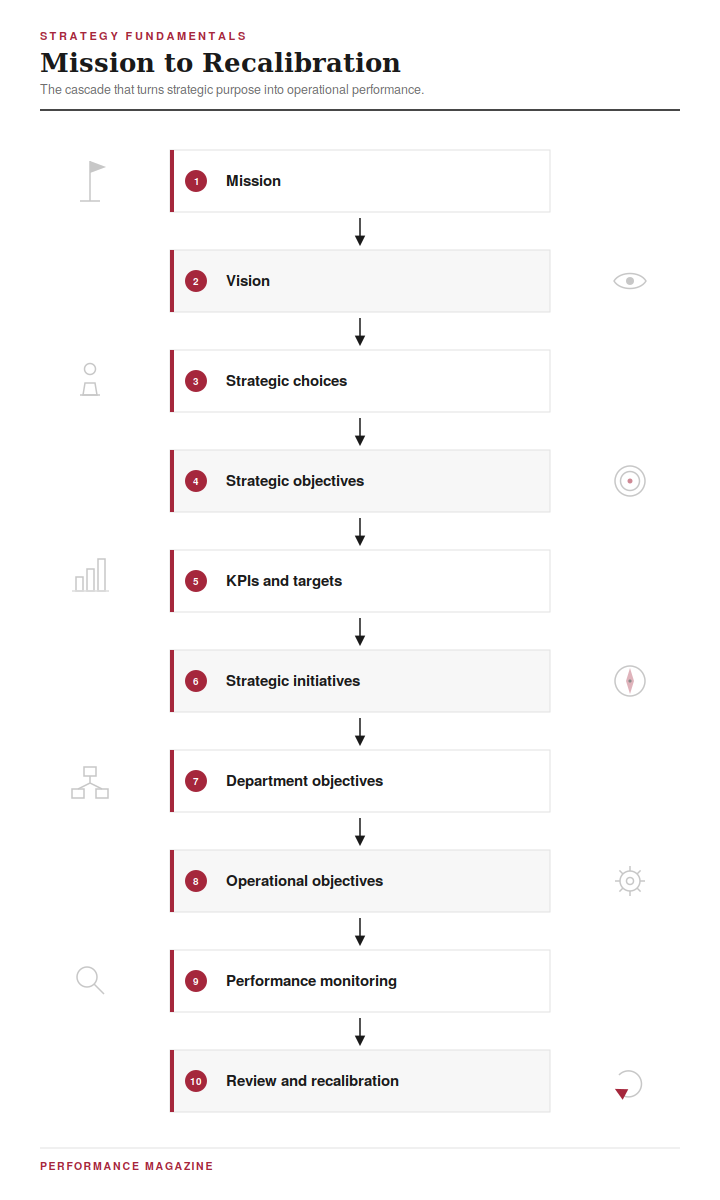
The CSBP deck explicitly places strategy inside the performance cycle and connects strategy with vision, objectives, initiatives, organizational structure, management systems, execution, review, and recalibration.
The OECD’s recent work similarly stresses the connection between long-term vision, priorities, implementation, and review within strategic planning systems.
Common Strategy Mistakes
1. Treating strategy as a document
A strategic plan can document strategy, but the document itself is not the strategy.
Strategy requires choices that influence organizational decisions.
2. Confusing operational improvement with strategy
Improving efficiency can be important. It does not automatically constitute a strategic choice.
Porter’s distinction between operational effectiveness and strategy remains useful here.
3. Treating SWOT as the strategy
SWOT can identify factors that deserve strategic attention. The CSBP framework specifically states that SWOT alone cannot create the strategy.
4. Creating objectives without a strategic logic
A collection of objectives does not automatically form a strategy.
The strategy tree addresses this issue by asking whether objectives are necessary and sufficient to support higher-level objectives.
5. Setting corporate objectives without cascading them
Departmental and individual priorities can drift away from corporate priorities when objectives remain at the top of the organization.
The CSBP planning model therefore includes objective cascading and interdepartmental alignment.
6. Ignoring resources
A strategy that requires capabilities or resources the organization does not possess needs further analysis.
The CSBP internal environment framework treats resources as both strategic inputs and potential constraints.
7. Assuming the external environment will remain stable
Strategic planning needs mechanisms for monitoring external change.
The CSBP framework recommends ongoing environmental scanning and an early-warning system that tracks emerging events and trends.
Strategy Example
Consider a fictional regional professional education organization.
Its vision is to become a leading provider of professional education across Southeast Asia.
Its strategic planning process could look like this:
1. Internal analysis
The organization identifies strong subject-matter expertise but limited regional distribution capacity.
2. External analysis
PESTEL identifies regulatory and technological changes affecting professional education. Five Forces identifies competitive pressure from universities, specialist training providers, and digital platforms.
3. Strategic choice
Management chooses regional expansion through digital delivery and selected local partnerships.
4. Strategic objectives
- Increase Southeast Asian revenue.
- Expand the number of markets served.
- Increase digital course enrollment.
- Develop regional delivery capabilities.
5. Strategic initiatives
- Launch localized digital programs.
- Establish regional partnerships.
- Build a multilingual content portfolio.
- Develop a regional marketing and distribution program.
6. Departmental cascade
Marketing, publishing, technology, finance, and learning teams establish supporting objectives and projects.
7. Performance measurement
KPIs track indicators such as:
- Regional revenue
- Digital enrollment
- Market penetration
- Course completion
- Customer acquisition cost
- Partner contribution
- Revenue by market
The example shows the basic logic of strategy:
Where are we now? → Where do we want to go? → What choices will take us there? → What must the organization achieve? → What must each function do? → How will we measure progress?
Frequently Asked Questions About Strategy
What is strategy in simple terms?
Strategy is a set of choices about where an organization wants to go, how it intends to compete or operate, what it will prioritize, and how it will use its resources to achieve its objectives.
What is strategic planning?
Strategic planning is the process of analyzing the organization’s situation, defining its direction, making strategic choices, setting objectives, and planning the initiatives and resources required to pursue them.
What is the difference between strategy and strategic planning?
Strategy concerns the choices an organization makes. Strategic planning is the structured process used to formulate and organize those choices.
What are the main types of strategy?
Common categories include corporate strategy, competitive or business strategy, functional strategy, and growth strategy.
What are the main steps in strategic planning?
A typical process includes defining organizational identity, analyzing the internal and external environment, defining the vision, choosing strategic directions, establishing strategic objectives, selecting initiatives, cascading objectives, allocating resources, executing the strategy, and reviewing performance.
The exact process varies by organization.
What is a strategic objective?
A strategic objective is a specific statement of an outcome the organization intends to achieve through its strategy. It can be linked to a KPI, target, timeframe, and responsible owner.
What is a strategy tree?
A strategy tree is a visual representation of cause-and-effect relationships among strategic objectives. It shows how lower-level objectives contribute to higher-level objectives.
What is SWOT analysis used for?
SWOT organizes internal strengths and weaknesses and external opportunities and threats. It can generate additional strategic objectives and strategic questions, but it should not be treated as a complete strategy methodology.
What is PESTEL analysis?
PESTEL is an environmental analysis framework that examines Political, Economic, Social, Technological, Environmental, and Legal factors.
How does strategy connect to KPIs?
Strategy establishes the outcomes the organization wants to achieve. Strategic objectives translate those outcomes into specific results, while KPIs measure progress toward those results.
How often should strategy be reviewed?
There is no universal review interval. Organizations need a review rhythm that fits their environment, planning cycle, strategic horizon, and rate of change. The CSBP framework includes execution, review, and recalibration as part of the performance cycle.
All About Choices
Strategy is ultimately about choices.
A strong strategic planning process connects those choices to organizational identity, environmental analysis, competitive and growth decisions, strategic objectives, initiatives, resources, and performance measurement.
The core sequence can be summarized as:
Define the organization → analyze the environment → define the future → make strategic choices → establish objectives → build the strategy tree → select initiatives → cascade strategy → execute → measure → review and recalibrate.
Strategic planning gives this sequence structure. Strategic management keeps it connected to organizational decisions and performance over time.
*********
Editor’s Note: This article draws on concepts, frameworks, and references covered in The KPI Institute’s Certified Strategy and Business Planning Professional (C-SBP) course. Learn more about the Certified Strategy and Business Planning Professional course