Applying agility in the workplace has become a trend during the past few years for its wide range of benefits, such as adaptability, faster work speed, and innovation. However, some companies fail to implement it in its correct sense and gain its fruits. This raises several questions: is it because agile is only successful for software companies? Or is it because some companies may have a limited or ambiguous understanding of the concept and its implementation?
What does Agile mean?
Despite the fact that agility is one of the most popular and challenging concepts, there is no one common definition explaining it. A study conducted by Moritz Petermann and Hannes Zacher (2020) explained that there are four main factors that most definitions highlight to define agile organizations. The first two are the organization’s ability to act to change in internal or external business environments at the right time and its response to act proactively on and predict change to make the most of it as an opportunity.
The third component involves learning and continuously expanding/accumulating skills, knowledge, and experience. Last but not least, agile organizations have to build a network structure, a people-centered and purpose-driven culture, as well as iterative processes to improve/enhance a product, service, and the like. Taking into consideration those factors, Petermann and Zacher define an agile organization as “a network of self-organized teams in which employees are able to autonomously make decisions and change the course of action”.
How to apply agility in your workplace
Although the rate of organizations applying agility in the workplace is accelerating, not all organizations are applying it in the right manner which might affect the employees’ performance in a negative way. This is not because agility works only in IT or software companies; agility can be implemented in almost all types of organizations. It is because companies are not embedding the concept in the right sense.
There are several building blocks for developing agility in the workplace such as strategy, values, agile team, organizational structure, agile leaders & managers, culture, and processes. These building blocks can be grouped into two categories: organizational level (strategy, organizational structure, culture, and agile leaders) and team and individual levels.
Organizational level
Strategy: For companies to successfully embrace agility, they should create an agile strategy that is aligned with their overall business strategy. This would create a clear roadmap for applying agility in the whole company.
Organizational structure: Having a long hierarchy that does not allow smooth decision-making does not allow for the successful implementation of agility.
Culture: Companies should embed agility and its components into their culture to successfully implement it.
Agile Leaders: In applying agility, leaders are not only knowledge experts or experienced managers anymore; instead, they are supportive leaders that allow decision-making and delegation within their teams.
Reward systems: Ashutosh Muduli (2019) recommends that allowing nontraditional rewards – like skill-based pay systems, improvement-based incentives, and nonmonetary rewards – do help in fostering workplace agility.
Information systems: They are crucial to boosting operational speed and flexibility within the workforce agility. Muduli pointed out that information systems will help in giving access to timely information associated with the customer, accounting, and business performance, as well as management, organizational leaders.
Team and individual levels
a. Team level (definition and characteristics)
According to Petermann and Zacher, agile teams are defined as “teams that use agile methods in their daily business”. Despite a wide range of agile methods and practices, most of them involve common characteristics. Those characteristics include self-organization, delegation, a quick exchange of information, rapid and continuous two-way communication, and feedback with the customers as well as within the team.
Based on those factors, agile teams are able to develop high transparency and a method to measure progress. They have the capability to use iterative processes and respond to changes efficiently and successfully. Agile teams will be able to direct their attention on simple designs that reveal incremental steps that are easy to understand for everyone included.
b. Individual Level (definition and characteristics)
There is not one common definition for agile individuals that is accepted by everyone. Petermann and Zacher describe agile individuals as “people who have the abilities, knowledge, and skills to proactively seek opportunities, and are able to quickly adapt to new situations.” They are also characterized as people who have the required skills to predict, apply, and make full use of and derive benefit from changes.
c. Individual characteristics and team formation
Since individual characteristics and team formation are critical for implementing agility, Petermann and Zacher suggest that companies should re-evaluate their recruitment and development practices. Recruiters should highlight agility skills in their job postings in order to attract candidates with an agile mindset and personality. During interviewing and selection phases, HR people should focus on personality characteristics and cognitive abilities that focus on change.
Training and development are also very important to help agile teams adapt rapidly to changing market requirements. Agile teams need to get updated with the latest skills and knowledge to respond successfully to market changes. Leaders should also be provided with training to lead their teams successfully and efficiently.
Moreover, organizations should train their employees about various methods and tools (such as scrum) that could aid them to apply agility in the workplace. However, it has to be noted that not all circumstances are treated with the same amount of agility and not all methods and practices can be applied in all workplaces. Companies need to ensure that the methods they are using do suit their environments.
There is no doubt that implementing agility is not a piece of cake and companies need to understand the concept and its implementation thoroughly. You can find below some ideas on how you can do that:
Start small: It is better to apply agility on a smaller scale. For instance, you can start with the research and development department. When the team members master agility, they can transfer the knowledge and methods to other departments.
Stop and review: During the implementation phase, you should always stop and assess the current situation to make sure that you are applying agility in the right way, whether in decision-making, meetings, processes, or others. This will also help in assessing whether the teams do really understand the concept of agility or not.
Communicate: Always allow for two-way communication and feedback within the team members and from top-down and down-top in the company. This will enable feedback and continuous learning across the organization.
To sum up, agility can be applied in almost all companies and in any industry, however, they need to make sure that it is applied in the right sense to gain its fruits. Moreover, companies need to make sure that they need agility in the first place before they go into the hustle of its implementation rather than just trying to follow a trending concept.
The holiday season is a time when everyone is looking forward to spending some family time, eating good food, and getting lots of presents. This can also be a stressful time for many companies. The holidays are often the busiest and most profitable time of the year for stores, restaurants, and even online retailers. However, this means that it can be challenging for a company to maintain high standards while keeping up with demand.
The holidays can also be the best opportunity to attract new customers. While the holidays are not yet on sight for most consumers, brands and retailers know that planning for those moments of success begins now. As the vacation season begins to gain traction, organizations need to consider what the season means for their business and how the holidays will affect their bottom line.
This is why it is important to start preparing for the holidays several months in advance. October may seem early, but the two-month pillow gives you plenty of time to check and make adjustments before the holiday hustle and bustle. When the holiday shopping season kicks in, you won’t have time for anything drastic.
Preparation for the holidays
This holiday shopping season could be just as important for small businesses in the retail or B2B sector, especially as customer behavior changes, aiming for a seamless shopping experience from online shopping to in-store shopping. Customers who have not decided yet on holiday food would most likely want to stock up on ingredients right away. People are also starting to consider where to go on vacation and when by looking up deals and packages.
Companies must be prepared to increase sales and match or outpace competitive offerings in a dynamic vacation market. Preparing for the shopping season will ensure you get the most sales and the most satisfied customers. Make sure you have a plan to quickly purchase additional inventory if your vacation sales are better than expected.
Planning ahead can help you stock up on everything your customers need while ensuring that your employees’ needs are met so they can better serve your customers. Experts advise that the sooner small business owners start developing a vacation plan, the better. In a small business, automation of work processes will significantly save time while on vacation.
Also, keep track of your inventory and make sure you have a good understanding of what buyers will be looking for while on vacation. Check out last year’s orders to anticipate the number of essential supplies that you and your customers will need, whether it’s shipping supplies and packaging, paper towels and toilet paper, or branded gift certificates for holiday shoppers.
If you are not launching a new product, you can use the planning phase to think about how to modify an existing product to make it especially attractive for a particular holiday. It’s also worth noting that you don’t have to completely change the product; instead, you can promote it in a way that is in line with the holiday.
Conclusion
If you take the right steps, you can capitalize on the holidays and grab the attention of your clients during this busy time of year. Companies can prepare for the holiday rush by meeting the expectations of all stakeholders. Overall, as a business, you need to prepare yourself to welcome a wide range of customers in order to maximize your success this holiday season.
Innovation entails coming up with something completely new or creating a huge concept. Nothing will change if you just fully accept the realities at work or in your personal life which is why innovation frequently begins with something that concerns and is important to you. This stems from the desire to alter certain things to be better because it is necessary.
Some companies out there are struggling without proper knowledge of innovation. You have a better chance of reacting to changes and discovering new possibilities if you innovate. It may also aid in the development of competitive advantage by allowing you to create better goods and services for your clients.
There are four types of innovation that can take place within a company:
Organizational innovation – this transforms a company’s business processes, as well as the way its workplace is structured as well as its connections with external stakeholders.
Process innovation – the implementation of a new or improved production or delivery is the approach with this type of innovation, including changes in operational processes, techniques, and equipment or software.
Product innovation – referring to the introduction of new or enhanced products or services, this kind of innovation may relate to enhancing technical standards, materials, or software, or even boosting user experience.
Marketing innovation – this refers to the development of a new marketing strategy such as the packaging or design of a product, as well as other pricing or promotional decisions.
Promoting workplace innovation
Rather than aiming to rebuild the entire company at once, consider developing ideas that can be tested in your own community first. As you prepare to take your idea to a much wider stage, this might be an excellent way to fine-tune your efforts and assess your performance. Setting up suggestion boxes around the office or hosting frequent seminars or company away days to explore ideas are just a few examples. This will also create a friendly environment for employees to express themselves without fear of being criticized or ridiculed.
Leaders should always have the courage to take risks and experiment with new ideas. They should also encourage their employees as well and not penalize them whenever they try new ideas and fail. Emphasizing the shared responsibility for innovation to employees at all levels of the organization will foster a feeling of involvement in the movement of the company. The fewer levels of administration or decision-making are in your organization, the more employees will believe their ideas are valued.
Approaching innovation
Business owners should examine the market and customers’ needs and not immediately create a big development to be released in a short period of time. Studying the market and learning how innovation may bring value to consumers is important, especially if you want to propel your firm ahead. By adjusting your product or service to the way your market is evolving, you may explore other possibilities for innovation.
For example, the current market is becoming health-conscious, even more so due to the COVID-19 pandemic. A food industrialist can try to launch new flavors, adjust your ingredients to be more health-conscious, and promote them in a better way to reach customers. For those in the education field, they could organize class conferencing apps like Zoom or Microsoft Teams to ensure the safety of students while continuing their education.
Making plans for innovation
Generally, innovation should be part of your company’s strategic vision of how you want your firm to evolve. Once you’ve spent time researching trends for your business sector, you can then focus your inventive efforts on the most significant areas. Not only will innovation help your firm survive, but it will also help it expand and generate more revenues.
There are a variety of practical methods for determining whether or not your ideas have profit potential. Studying the market or industry trends and being aware of the environment your organization operates will assist you in planning. You can find competitors via a number of ways such as local corporate lists, advertising, and exhibitions. You can also find those with similar products through online searches, information from customers, or pamphlets.
You may also support your innovation-driven development such as gaining financial investors or even through loans. Any route to external investment, however, will need a high-quality business plan that outlines your company and provides specific projections for its future. Depending on their borrowing needs, businesses frequently resort to their banks for a line of credit or loans.
Boosting innovation
Communication is very important to both your customers and suppliers. Building a good relationship with clients will make them realize that the company is providing effective products and services for them to make the business grow better. By communicating with them, you will be able to listen to their opinions and observe their behavior around your current products and services. From there, you can produce new ideas and promote improvements in your current products and services.
You can also expand your business by giving opportunities for suppliers and business partners to be involved in the company’s plans for innovation. This allows them to provide unique ideas as well. Merging your abilities with those of your suppliers or other business partners might help you generate and develop new ideas. Opportunities for business networking might also lead to the formation of potential collaborations.
Conclusion
Although innovation can occur in any department of a company, it has the potential to affect the whole corporation. To achieve innovation through creativity, you have to find the right amount of challenges and don’t be afraid to take risks; failure is not constant and every problem can have a solution. It’s also important to experiment with an idea first before implementing it by involving your employees in conversations so they can also provide better ideas to improve the company.
Organizations need to remain agile in this uncertain world, and one way to achieve this is to continuously improve processes. A maturity model indicates the capability of an organization to sustain and achieve continuous improvement. This is to assess and/or guide organizations to improve process capability by designing, managing, deploying, optimizing, and continuously improving processes. Although capability maturity models are developed at an enterprise level, such models have been developed at functional levels as well. HR Capability Maturity Model (CMM) is one such functional level model that is used to measure the maturity level of HR processes and improve the maturity level.
Five maturity levels of HR CMM
HR CMM has five maturity levels: initial, managed, defined, predictable, and optimized. The HR CMM is used to improve HR processes from the initial ad-hoc stage to the optimal level which can be treated as benchmark level processes.
Initial – This level describes a poorly-aligned function and has characteristics of non-documented strategies as well as a reliance on manual documents and excel sheets. Talent shortage, low motivation, poor workforce performance, and rare instances of training and development are usual attributes in an organization at this maturity level.
Managed – An organization at this level has informal policies for workforce and HR function and starts focusing on developing the skill sets of the workforce. It is also at an early stage of realization that they should have properly documented processes with guiding principles, deploying trained HR people to carry out HR processes. Work overload, workplace distraction, poor communication, and poor morale are a few characteristics of this level.
Defined – Workforce practices are consistent, documented, and linked to the strategic objectives of the organization. Workforce competencies development gets priority and workforce performance is aligned to key business activities. Overall, HR practices are now mature enough to give organizations competitive advantages.
Predictable – Organizations at this level have achieved the dynamics of reform, transform, and perform. HR-managed practices are now stable and employee engagement levels are high enough to motivate them to perform well. There is a quantitative measurement of performance that helps in the prediction of capability for performing work. Learning and development are at their peak, triggering improvements and breakthroughs.
Optimized– The HR team at this stage has long-term and short-term strategies cascaded from the organization’s strategy. They are now equipped to create world-class employee experiences. Continuous improvement, creativity, innovation, and thereby, competitive niche are the characteristics at this stage. Organizations at this level have many HR processes that can be considered at the benchmark level.
HR CMM model architect
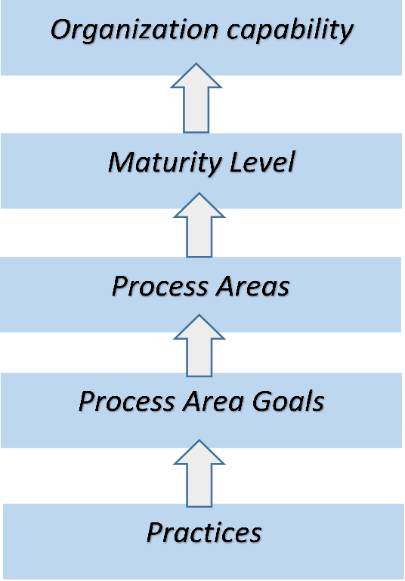
The HR CMM model has four components: practices, process area goals, process areas, and maturity level. As shown in Figure 1, these components eventually build towards the organization’s capability which is nothing but capability and skills of the workforce that is utilized to improve business results. The process area is a set of interrelated practices that, when performed properly, contribute to achieving goals of that maturity level. For example, Learning & Development is one process area that will have definite goals for that particular maturity level and associated set of practices to achieve those goals.
Figure 1. Image Source: The KPI Institute
HR CMM model appraisal
A process area model entails having a detailed checklist of goals, commitment to perform, ability to perform, practices to perform, sub practices, measurement, analysis, and verification. Based on the model criteria, an organization has to prepare a detailed report with documents. This long report would include documents and data presentation.
Subsequently, a discovery-based appraisal is conducted in which limited objective evidence is provided by the appraised organization before the appraisal. The appraisal team must probe and uncover a majority of the objective evidence necessary for model practices. After an appraisal, the organization gets feedback reports on its strength and weakness, as well as suggestions to improve from one maturity level to reach the next level.
Objectives and benefits of HR CMM
The HR CMM model has several benefits that can work towards an organization’s objectives. As such, the model can be imbibed for the following purposes:
Align HR strategies with the organization’s vision, mission, and values (VMV)
Align HR processes with the organization’s objectives and goals
Identify competency gaps and close the same for critical functions
Maintain continuity of effective leadership through the implementation of recruitment, development, and succession plans
Help the organization in developing and sustaining a high-performance culture
Improve HR processes to benchmark levels
Instill a system where capability is quantified/measured and enhanced based on measurement
Foster a culture of innovation and creativity
The HR CMM modelcan be considered as a specializedinstrument to improve HR processes in an organization. Since it is a generic model, it can be deployed in various types of industries such as healthcare, education, power/utility, consulting, insurance, banking, finance, IT, and more. The model can instill its approach of PDCA in HR processes so that process effectiveness is measured and modifications are done to achieve higher maturity levels. A maturity level at the predictable or optimized stage signifies that the organization is competitive and resilient.
In recent years, Generation Z represents the most diverse group to enter the labor market and is anticipating that their employers will place a high value on diversity. They, along with the upcoming younger generation, need leaders who support a diverse and inclusive work environment. As Gen Zers steadily enter the workforce, their cohort brings fresh and unique perspectives to all aspects of employment. It is an exciting potential for the future, but integrating Gen Z into the workplace culture will require some thought and planning.
Over the next few decades, two billion more people will enter the workforce. With baby boomers retiring in droves, Gen Z is poised to take on increasing numbers of key responsibilities in the workplace. Although this should be cause for celebration, the changing conditions is also cause for anxiety because Gen Zers will be expected to perform more duties compared to when previous generations were at their age. They will need new challenges and opportunities to learn.
Expectations in the workplace
Gen Z is the latest wave of young professionals to enter the workforce, and they will soon function mainly under the leadership of Millennials, which is a cause of concern because this means that they will have young mentors. While they tend to have a reputation for being more introverted and risk-averse, Gen Z workers are also incredibly technologically savvy; this brings a heightened need to have a mentor. Most of them haven’t had a mentor yet, so they are looking for guidance from experienced professionals. They are also looking for access to systems that will allow them to compete with other companies, especially in the business-to-business (B2B) market.
According to the Center for Generational Kinetics (CGK) study, while traditional workplace expectations are being adapted to suit Gen Z, Gen Zers want certain things in the workplace. Whether they’re working in a traditional environment or industry, Gen Zers want employers to implement policies that support their needs such as security and safety at work. While they don’t like the idea of an open office environment, Gen Z professionals don’t mind interacting with individuals they don’t know well, as long as their co-workers can relate to them. They also want to feel included in the larger conversation at work; they want to feel heard and they do not want to feel alone.
Unlike Millennial employees who prefer digital communication such as email, 53% of Gen Zers choose to chat in person; while technology is second nature to Gen Z, workers in this demographic crave a personal presence in their work interactions. Maybe this is why more than 90% of Gen Z employees say they prefer the human element in their professional teams with innovative peers and tech-savvy co-workers. It is not surprising that Gen Z wants “interpersonal interaction at work”; they prefer a work environment where new ideas can be proposed. Organizations that want to attract attention in this age group should strive to create a culture that welcomes and promotes team participation.
Expectations from Gen Z
Today, Gen Z is the most influential group in the consumer market. They are more tech-savvy and conscious about sustainability and environmentally-friendly products. Organizations should develop an understanding of what to expect from this generation so they can appeal to this group.
According to the CGK report, the most prominent jobs in demand for Gen Z are those that require interpersonal and leadership skills such as sales, marketing, and human resources. They are more likely to view their employers as providing an environment where they can learn and develop their skills. It also notes that they are less interested in job-specific qualifications and more interested in flexibility and personal values which may have implications for organizations that wish to attract Gen Z talent. The report also found that Gen Z prefers to work for organizations with strong moral and ethical values.
Organizations should expect complex demands from Gen Z employees because they know what they want and will not settle for anything less. Organizations need to be prepared for the new generation’s high expectations. This can be done by investing in their employee’s future career development and being transparent about their company values, mission, and culture.
Conclusion
In a digital world, it’s no surprise that the workforce will be facing new challenges. Organizations need to be flexible enough to adapt and find ways to retain and attract top talent. Leaders also need to create a culture that brings together their workforce and integrates technology to enhance the employees’ work experience. There is still a lot of change in store for Gen Z, and the best approach for any organization is to remain flexible and evolve to meet the demands of the next generation of workers.