According to the International Academy for Design and Health, the physical working environment can impact employee productivity up to 30%. A smart office design can enhance employee performance. In its article ”Top 20 most awesome company offices”, Income Diary presents some of the most impressive offices around the world.
Employee turnover represents a process that consists in the actions taken to replace one employee with another, no matter the reason for which this change is necessary. Related to this specific process, it is essential that the employee turnover rate is viewed as a key performance indicator, as it reveals the percentage of employees that an organization had to replace within a given time frame.
Performance management is about planning, doing, checking and acting. In other words, it involves formulating a plan of activities, establishing a set of objectives, setting key performance indicators (KPIs) to measure performance, and appraising actual performance. Therefore, managers direct the discussion towards key concepts such as objectives, goals, KPIs, desired state of evolution and outcomes. The ultimate goal is to help organizations reach top performance at different organizational levels.
Current dynamics and globalization have brought on companies that include innovation in their core values. A commitment for innovation is more and more often part of corporate culture and values. Companies emphasize hiring people through whom they can achieve innovation, more specifically, they are looking for those traits that are aligning with actual corporate values.
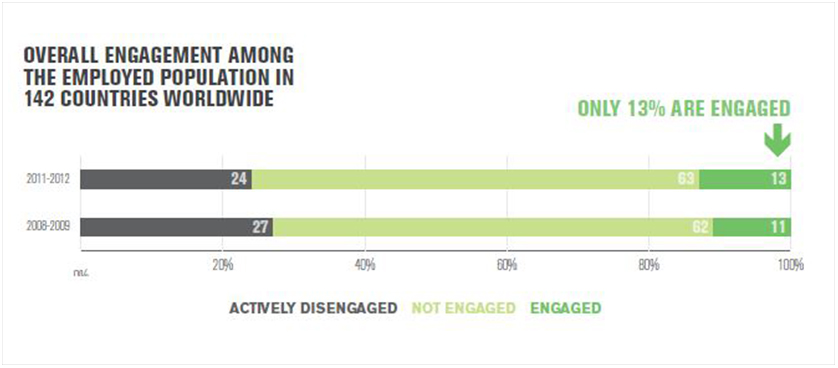
According to the Gallup research study “State of the Global Workplace: Employee Engagement Insights for Business Leaders Worldwide” (2013), only 13% of the employees are engaged at work and focused on creating value for their organizations, while 63% are not engaged and 24% are actively disengaged.