Artificial intelligence is often framed as something that will either replace human abilities or revolutionize them.
In this TED conversation, social psychologist Heidi Grant and NiCE CX Division president Barry Cooper take a more balanced view. Rather than focusing on what AI might take away, they explore how it can strengthen the skills that matter most, from communication and decision-making to continuous learning. Their discussion suggests that AI’s greatest potential lies not in doing the work for people, but in helping them improve how they think and grow.
A major theme throughout the conversation is the importance of maintaining a growth mindset. As technology continues to reshape the workplace, adapting to change and learning new skills may become more valuable than any single area of expertise.
The speakers highlight how AI can support that process via the following:
Delivering more consistent feedback
Providing personalized assistance
Creating safe environments where people can practice difficult conversations
Generating the medium through which new abilities can be attained without the pressure of being judged by colleagues or managers
Building confidence and expertise rather than simply boosting productivity
The discussion also emphasizes that getting the most out of AI depends on how it is used (duh!). Asking thoughtful questions, challenging assumptions, posing inferences, and treating AI as a partner in problem-solving can lead to better decisions and deeper understanding.
Yet even with all that, it is important to keep in mind that the technology is far from perfect. It can generate inaccurate information or reinforce existing biases if its responses aren’t carefully evaluated. That makes critical thinking and human oversight just as important as ever, even as AI becomes more capable.
Beyond professional life, the conversation explores how AI could help people develop healthier habits and make better everyday choices. Instead of encouraging distractions, future AI systems could provide timely reminders to take breaks, manage screen time, track chores, or stay focused on personal goals.
High performance rarely happens by chance. Someone has to build the systems, ask the difficult questions, and keep improving them long after the first results appear.
That has been a constant throughout Faisal Ba-Aqeel’s career. As the co-founder of Chartten, an AI-powered business support platform launched in 2025, he is applying more than 21 years of experience across procurement, operations, facilities management, and business transformation to solve a challenge he has repeatedly encountered throughout his career. The platform was born from his belief that while organizations already have access to powerful digital tools, routine operational work continues to consume valuable time because skills, technology adoption, and digital awareness vary across teams. By reducing administrative burdens and simplifying day-to-day business processes, Chartten is designed to help organizations focus on decisions that create real value.
Before co-founding Chartten, Faisal built and scaled procurement, operations, and facility management functions across industries including logistics, food, retail, and technology. Working with organizations such as FedEx, Supreme Foods, Al Romansiah, Delivery Hero, and Careem, he led complex projects in fast-growing environments where disciplined execution, data-driven decision-making, and continuous improvement were essential to delivering results.
What can leaders learn from someone who has built systems across industries, transformed business operations, and now channels those lessons into building an AI platform for modern organizations?
In this interview with Performance Magazine, Faisal reflects on the principles that have guided his career, the thinking behind Chartten, and the mindset required to build organizations that continue to perform as they grow.
Building something from nothing is rarely a straight line. How would you describe the mindset you bring into a role where the structure, the process, even the team, doesn’t exist yet?
A strong foundation comes from understanding the scope of work, knowing the purpose, estimating the required resources (tools, manpower, funds, technology, etc.), involving the right people, aligning stakeholders, consulting and benchmarking the market, and studying the obstacles and risks before execution begins. From there, execution is followed by continuous observation, regular updates to the involved team, and the application of continuous improvement.
You have developed procurement and facility functions from the ground up at more than one company. When you start a function with no existing structure, what do you set up first, and why does that piece come before everything else?
Gathering data (from there, I can see everything that is going on), then analyzing it, helps me make decisions in accordance with company policies and goals. As the widely recognized principle says, “You can’t manage what you can’t measure,” and, as W. Edwards Deming famously said, “In God we trust; all others must bring data.”
At Delivery Hero, you supported the expansion of dark stores, coffee shops, and cloud kitchens at the same time. How did you track performance across formats that differ so much from one another, and what numbers told you a location was on track?
Setting up SLAs (internal and external) based on internal clients’ (colleagues’) project deadlines. Once these boundaries are understood, I compare them with the tools I have, then hire the required manpower (qualified team members) who will lead the work and meet those deadlines on time. Then, I divide the tasks into SMART goals and start measuring them through all possible tools (MS Project, dashboards, and Power BI) to ensure we are on track.
Procurement and facility work often pulls in different directions, one chasing savings, the other chasing speed and reliability. How do you decide which one wins when a decision can’t satisfy both?
Completely agree, as one focuses on saving while the other focuses on spending to ensure business stability. My role is to understand the components and specifications in facilities, including the latest technologies to optimize the work, then secure and align such innovations in-house with a well-drafted contract. After that, I keep evaluating and monitoring performance and results while continuously improving wherever needed.
Your work has touched fresh chicken supply, dark store rollouts, and cloud kitchens, sectors with very different risk profiles. What changes in your approach to performance tracking when the product on the line is perishable versus when it isn’t?
Knowing the nature of the product and its challenges allows us to set up the right and well-agreed terms across all tiers (upstream and downstream). Then, putting in place a proper process (clear communication, real-time data sharing, buffer stock, strong relationships, technology, etc.) allows us to become more resilient from a business perspective. The nature of the product is certainly a challenge, but applying the above makes everything observable and keeps risks to the lowest possible level.
You moved from sales at FedEx into procurement and operations later in your career, a shift many professionals don’t make. What carried over from that early sales experience into how you manage supplier relationships and targets today?
The titles, techniques, and angles seem different, but believe me, sales and procurement are two sides of the same coin: value exchange. Sales taught me commitment, negotiation, contracts, relationships, numbers, and results, all to achieve business value through a win-win approach. Knowing sales absolutely helped me understand how procurement works and how both functions share the same value, allowing me to play my role properly while contributing to business success.
Digital transformation and Power BI tracking came up more than once in your background. Walk us through how a tracker actually gets used day to day. Who looks at it, how often, and what happens when the numbers slip?
Learning to use data and visualization has helped me lead the business, and I built Operations Trackers, Procurement Trackers, and others. I then shared those trackers with the involved parties (internal and external) to align and review them daily, weekly, or monthly (depending on data privacy and relevance), understand business performance, and stay on track to achieve targeted business levels. They also drive real-time decisions, accountability, and corrective actions before small gaps become major problems.
You’ve worked across SAP, Oracle, Microsoft Dynamics 365, and several analytics platforms. When a company already has legacy systems in place, how do you decide what to keep, what to replace, and how fast to move?
I start with a fit-gap analysis by mapping business processes against current ERP capabilities. I keep what supports the core business value and replace or remove what does not align with business needs (while considering costs, of course). The priority is to address the highest-impact areas first, followed by the lower-impact ones. I believe there is no perfect system that fits every business, but systems can be customized according to business needs.
KAIZEN workshops, process organization, automation projects: your background includes a fair share of internal restructuring. What signs tell you a department needs this kind of intervention before the problems become visible at the top?
When small issues interrupt time that should be spent on real priorities, it’s time to use tools such as Muda, Kanban, or Gemba to identify bottlenecks and unnecessary motion, find the root cause, and resolve it before it becomes a bigger issue. The goal is to stay on track with SLAs, policies, and KPIs while applying a continuous improvement methodology.
You’ve delivered projects in three months that other companies might plan for a year. What gets cut from the usual planning process to make that timeline possible, and what risks do you accept in exchange?
I focus on the strategic view, liquidity, and timelines, then accelerate the approval cycle and budget process. This includes combining and eliminating unnecessary steps, such as placing bulk orders for small, repetitive items or supplying new items before common ones, while predicting potential risks by understanding business needs. This approach makes us more resilient and able to closely monitor progress. The accepted risks include extra workload, additional audits, and rework for exceptions outside standard operating procedures (SOPs).
Across FedEx, Supreme Foods, Al Romansiah, Delivery Hero, and Careem, the industries shift but the pattern of building and fixing systems repeats. Looking back at that pattern, what do you think it says about how performance management should work in fast-moving companies versus established ones?
In fast-moving companies like Delivery Hero, performance management is daily: live dashboards, fast feedback, and leaders act as expeditors who fix systems on the go. In established firms like FedEx, Supreme Foods, or Al Romansiah, it is more structured, with quarterly reviews, SOP-driven KPIs, and stability as the priority. The pattern shows that both continuously improve systems, but fast-moving companies prioritize speed over policy, while established companies follow policy to ensure stable outcomes.
Looking at everything you’ve built across these industries, what do you hope the next chapter of your career adds to that story, and what kind of mark do you want to leave on the strategy and performance management space going forward?
To lead in a strategic role, eliminate the operational mistakes I have seen in previous companies as a priority, scale business potential across my network and the companies I have worked for, and drive integration that adds real value to society. The mark I want to leave is creating alignment, empowering people at all levels, sharing knowledge and experience, and driving innovation that integrates with society and creates lasting value.
What separates a performance management system that drives real results from one that simply produces reports?
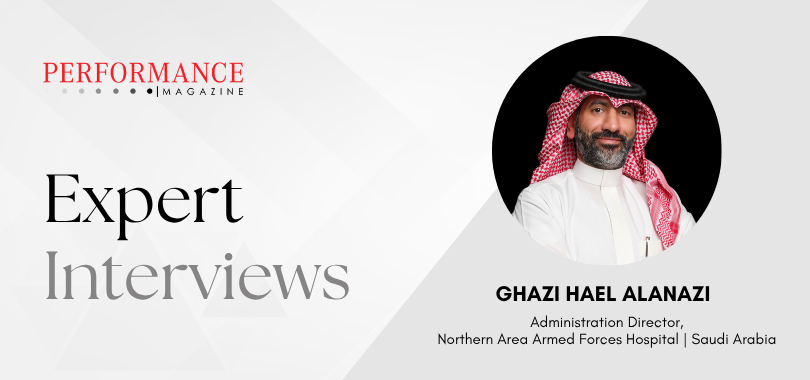
According to Ghazi Hael Alanazi, the answer lies in execution, accountability, and disciplined decision-making.
As the Administration Director of Northern Area Armed Forces Hospital in Saudi Arabia, Alanazi shares valuable insights on the future of performance management, the growing role of AI and sustainability, and why organizations must move beyond traditional KPI tracking toward systems that actively guide strategy and operational outcomes.
What key trends in organizational performance management have you observed emerging so far in 2026?
In 2026, performance management is shifting toward real strategy execution. Organizations are using real-time KPIs, clearer decision ownership, and AI-driven insights. There is also a stronger connection between performance, risk, and sustainability, making systems more practical and closely tied to actual business outcomes.
Which existing trends, topics, or aspects within performance management have lost their relevance or importance?
Traditional KPI reporting without action has lost relevance. Static annual plans, disconnected scorecards, and overengineered frameworks that fail to support decision-making are becoming obsolete. Focusing only on measurement without accountability, execution, and real business impact is no longer acceptable in today’s performance environment.
What does the corporate performance management system of the future look like?
The future system is fully integrated with strategy execution. It connects objectives, KPIs, initiatives, and risk within a unified framework. It operates on real-time data, supported by AI-driven insights and clear decision ownership. The focus is less on reporting and more on guiding decisions, enforcing accountability, and continuously improving performance.
What will be the major challenges in managing performance in the future, and how should organizations prepare?
The main challenge is maintaining discipline. Organizations often struggle to enforce accountability, align decisions, and sustain focus. Data overload is another growing issue. To prepare, organizations need strong governance, clear decision rights, simplified KPI structures, and leadership commitment to using performance systems as management tools.
How is technology impacting the way organizations conduct strategic planning and manage performance?
Technology is transforming performance management from periodic reporting into continuous monitoring. AI and analytics provide faster insights, while integrated platforms connect strategy, KPIs, and execution. Tools such as BI dashboards and AI copilots improve visibility, but their real value depends on how effectively organizations embed them into decision-making and governance processes.
How is sustainability impacting the way organizations conduct strategic planning and manage performance?
Organizations are integrating ESG factors into KPIs, risk management, and decision-making. This shift encourages a stronger focus on long-term value rather than short-term results. The challenge is ensuring sustainability becomes measurable and actionable, rather than remaining only a reporting requirement, while linking it directly to performance and accountability.
Practice
What should be improved in the use of strategy and performance management tools to make organizations more resilient to future crises?
Most tools need to become simpler and more connected. Organizations should reduce complexity, link KPIs directly to decisions, and integrate risk into performance systems. Flexibility is also essential, as systems must adapt quickly during disruptions. The focus should move from tracking performance to enabling fast, informed, and aligned decision-making.
While navigating challenging times, what would you consider a best practice in performance management?
The key practice is maintaining focus. Organizations should prioritize a limited number of critical KPIs, align leadership around them, and review performance frequently. Clear decision ownership is essential. During difficult periods, simplifying the system and enforcing accountability has greater impact than adding more metrics or complex frameworks.
How does benchmarking support the improvement of performance management and target-setting systems?
Benchmarking introduces external perspective into the system. It helps validate targets, identify performance gaps, and challenge internal assumptions. When applied effectively, it shifts discussions from opinion to evidence. Its real value emerges when organizations use benchmarking to drive decisions and continuous improvement.
Research
Which organizations would you recommend observing for their approach to performance management, and why?
Organizations such as Amazon, Microsoft, and Saudi Aramco are strong examples. They combine clear strategy, disciplined execution, and data-driven decision-making. What stands out is how leadership uses performance management to drive accountability and results at scale.
What aspects of performance management should be explored further through research?
More research is needed on how performance systems influence decisions and organizational behavior. The relationship between KPIs, incentives, and actual execution outcomes remains weak. In addition, the role of governance and decision rights in making performance systems effective requires deeper practical exploration.
What are the key competencies of a successful business leader or C-level executive?
A successful C-level executive must think systematically. They need strong decision-making skills under uncertainty, clear ownership of outcomes, and the ability to align the organization around priorities. Discipline in execution, governance awareness, and the ability to translate strategy into results are more critical than technical expertise.
What are the key competencies of a strategy and performance manager today?
They must be able to connect strategy to execution. Strong capabilities in KPI architecture, data interpretation, and performance analysis are essential. More importantly, they must enforce accountability, support decision-making, and understand how organizations operate to ensure performance systems function effectively in practice.
What are the recent achievements in generating value from performance management in your organization?
We shifted performance management from reporting to execution control. We redesigned KPIs to align with strategic objectives, introduced clearer ownership, and improved executive dashboards for decision-making. This increased visibility, reduced ambiguity, and helped leadership respond faster. The greatest value came from transforming performance management into an active management tool.
Meta To Roll Out Changes to Performance Review System in 2026
Tech giant Meta is redesigning the way it reviews employee performance in 2026, according to a report by Business Insider.
The revamp will incorporate a review platform dubbed Checkpoint, which will be used to re-examine employee performance biannually to determine if there are any changes. Checkpoint will hone in on identifying both top and bottom performers, rewarding the former with bonuses that could amount to up to 300% of their pay.
“While our employees have always been held to a high-performance, impact-based culture, this new direction allows for more frequent feedback and recognition in a more efficient way,” a Meta spokesperson said.
Meta is set to implement the changes in the middle of 2026.
Amazon Now Requiring Proof of Productivity for Performance Evaluations
Amazon’s annual review process, known internally as Forte, now reportedly requires employees to list three to five primary accomplishments for the year as proof of their performance. This information was gleaned from internal guidelines acquired by Business Insider.
The guidelines define accomplishments as “specific projects, goals, initiatives, or process improvements that show the impact of your work.”
Amazon’s mandate for employees to provide proof of productivity during performance reviews appears to be part of a larger cultural shift in the corporate sector. In September 2025, xAI employees were also asked to list their responsibilities and accomplishments to determine their future in the company.
AI Layoffs Continue to Impact Tech Sector
The technology sector has been hit with another round of layoffs. Quarterly reports indicate that one of India’s prominent IT services firms, TCS, has laid off around 30,000 employees over the span of six months. This massive downsizing was reportedly driven by widespread artificial intelligence (AI) adoption within the tech industry.
These layoffs are not localized phenomena. On the other side of the world, Silicon Valley has faced similar circumstances, as 2025 also saw several AI-driven layoffs.
The layoffs appear indicative of a trend, something many experts expected. In 2025, Goldman Sachs published a report predicting AI-driven layoffs to continue. .
Study Shows Employees Find Narrative-Based Performance Reviews Most Fair
A study conducted by researchers at Cornell University found that narrative-only feedback is considered by employees as the most fair form of feedback in the context of performance reviews. Published in December 2025, the study compared responses from 1,600 employees to performance feedback organized in three formats—numerical-only, narrative-only, or mixed.
The researchers attribute the study’s findings to the employees’ perception and interpretation of data. “We guess that the presence of a numeric component in the combined feedback may have been interpreted as evaluative or accountability focused [sic], rather than developmental. Employees may view feedback with numerical ratings as highlighting their weaknesses,” they wrote in the report.
Despite the findings, the researchers are hesitant to recommend exclusively using narrative-only performance assessments, stating, “…if you don’t have numbers, there can be some other disadvantages when you are trying to do things like administer bonuses or promotions.”
Key performance indicators (KPIs) have been the north star guiding business strategy for decades. These criteria measure not only sales and revenue but also customer satisfaction as well as employee engagement.However, as the business landscape continues to evolve at an unprecedented pace, the need for deeper insights and more agile measurement arises. This is where the potential of generative artificial intelligence (GenAI) shines, opening doors to a new era of KPI innovation.
GenAI goes beyond automation to produce entirely novel content. It is a creative catalyst, opening up unprecedented possibilities for KPI innovation. Forget rigid, one-dimensional metrics. Powered by GenAI, KPIs become fluent, adaptive, and poetic, capturing not only the whats but also the whys and what-ifs.
Reimagining KPIs for exponential growth
From static to dynamic: GenAI is capable of integrating dynamic KPIs, meaning they can evolve alongside the company that uses them. KPIs also fit seamlessly into a changing market, with trends and strategies naturally shifting along the way.
Unveiling the unseen: Traditional KPIs often fail to hit the nail on the head by overlooking key, intangible factors that could affect performance. GenAI, however, can delve much deeper. With the help of GenAI, it is possible to determine brand sentiment before a particular campaign is launched, anticipate employee engagement within remote teams, or even predict customer turnover before it happens.
Personalized insights, enhanced action: Data mountains no longer need to be intimidating.GenAI transforms data into personalized narratives, crafting stories tailored to individual stakeholders. Sales teams can access actionable insights, marketing managers can monitor real-time customer sentiment, and CEOs can explore what-if scenarios for strategic foresight. This data-driven storytelling fosters informed decision-making and ignites action across the organization.
A practical guide to unlocking GenAI’s potential for KPI innovation
To effectively utilize GenAI tools like Gemini and ChatGPT for KPI innovation, follow these guidelines:
Define goals and challenges: Clearly articulate objectives, whether uncovering customer sentiment or anticipating market shifts.
Frame specific prompts: Use concise prompts such as “generate potential KPIs for measuring brand sentiment on social media.”
Provide relevant context: Enhance responses by furnishing background information about your industry, business model, and existing KPIs.
Experiment and refine: Iterate prompts, rephrase questions, and provide feedback to improve AI understanding.
Collaborate with experts: Involve human expertise in evaluating and implementing AI-generated insights.
While GenAI’s potential for KPI innovation is undeniable, it thrives on synergy, not substitution. The point is this: human guidance is essential. Act now, invest in your future, and become a master of the new KPI era by enrolling in The KPI Institute’sCertified KPI Professional course.