Companies can no longer afford to ignore sustainability. It is not just a trend but a major factor that drives where most businesses are headed. According to Globescan’s The State of Sustainable Business 2019, reputational risks, consumer demand, investor interest, operational risk, and employee engagement are some of the catalysts behind the sustainability efforts of most organizations.
Manufacturing is one of the industries that are pressured to realign their activities with the mounting call for sustainability practices. Sustainable manufacturing refers to developing products with minimal negative environmental impacts and maximum contribution to the conservation of natural resources. These products are expected to be economically sound and safe for employees, communities, and consumers.
Sustainable manufacturing aims to reduce the intensity of materials use, energy consumption, emissions, and unwanted byproducts while maintaining or improving the value provided for society and organizations.
Some relevant key performance indicators that are often considered when evaluating the sustainability of manufacturing companies are:
Environmental performance KPIs, such as: # Air emissions, % Energy utilization, % Hazardous waste etc.
Economic performance KPIs: % Product reliability, % Conformance to specifications, $ Material cost, % Labor cost etc.
Social performance KPIs: % Occupational health and safety, % Turnover rate, % Supplier commitment etc.
Sustainability standards are observed to ensure quality, transparency, compliance, and results in terms of making organizations accountable for their economic, environmental, and social performance.
The GRI Standards
Among the internationally renowned frameworks is the Global Reporting Initiative’s (GRI) Sustainability Reporting Standards. The GRI Standards consist of Universal Standards, which apply to all organizations and report on human rights and environmental due diligence, the new Sector Standards for sector-specific impacts, and the Topic Standards that come with the revised Universal Standards and relate to a particular topic.
Their vision is to create a sustainable future enabled by transparency and open dialogue about impacts. In this regard, they are a provider of the world’s most widely used sustainability disclosure standards.
With GRI Standards, companies can publicly present the outcomes of their activities in a structured way. This allows their stakeholders and interested parties to better see their status of how they are responding to calls for sustainability. GRI Standards can be used by any type of organization, whether large or small, public or private, or from any location or industry.
As cited in the report “A Short Introduction to the GRI Standards,” the Reporting Process for organizations using the GRI Standards involves determining impacts and their significance, identifying material topics, or topics that are relevant to the organization’s activities, and reporting disclosures. The final stages are reporting the organization’s most significant impacts on the economy, environment, and people and publishing information and GRI content index.
The GRI Standards comprise three series of Standards: The GRI Universal Standards can be applied to your reporting. The GRI Sector Standards are for sectors while the GRI Topic Standards are used to report specific information regarding material topics.
Daimler’s Sustainability Report
An example of a sustainability report that is developed based on the GRI Standards comes from Daimler, one of the biggest producers of premium cars and the world’s biggest manufacturer of commercial vehicles.
In 2006, Daimler joined the multi-stakeholder network of the Global Reporting Initiative (GRI), where it initially was an organizational stakeholder. It later became a Gold Community Member and is now a member of the GRI Community.
Their report is based on the Daimler Group’s sustainable business strategies. It contains two conceptual levels: “Spurwechsel” section, which refers to the external sustainability developments and trends into a context with the internal strategies and measures and “Reporting” section which provides a detailed description of the goals, due diligence approach, measures, and achievements.
The Reporting section focuses on six areas of action: climate protection and air quality, resource conservation, livable cities, traffic safety, data responsibility, and human rights as well as on three enabler topics, which are cross-sector themes that can influence areas of action. The enabler topics are Integrity, People, and Partnerships.
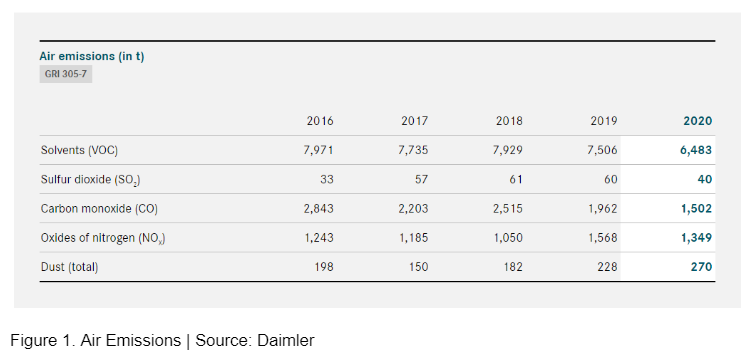
As part of the Climate protection & air quality area of action, the manufacturer frequently monitors the compliance with the internal and external environmental protection requirements. This way, they can take proactive actions to eliminate possible damage.
As a result, the reduction of air emissions is an important focus of their sense of responsibility for the environment (Figure 1).
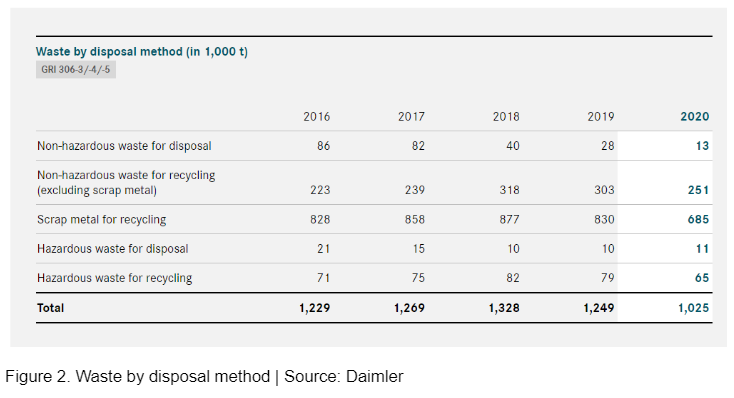
They consider the consumption of resources in production as an important factor in the environmental compatibility of their vehicles. Thus, they are working to make production more efficient and more environmentally friendly by using less water, energy, and raw materials.
Daimler evaluates in a consistent and transparent way the economic, environmental, and social impact in order to find the best solutions to remain climate-neutral and sustainable in the future.
In addition to this, they maintain regular contact with representatives of business, government, and other interest groups that advocate for the same goal.
Daimler also plays an active role in upholding the UN Global Compact, a voluntary initiative that encourages companies to integrate sustainability practices into their activities. Daimler shares on their website that they are involved in the thematic and regional working groups and initiatives of the pact.
“In the reporting year, these included the action platforms “Reporting on the SDGs” and “Decent Work in Global Supply Chains” as well as the UN Global Compact Expert Network and the German Global Compact Network,” Daimler states.
As part of its obligation, Daimler reports its initiatives on areas like human rights, labor standards, and environmental protection in its Sustainability Report
Reporting sustainability key performance indicators constantly, in a clear and transparent manner, can provide a clear overview of the environmental, social, and economic impacts, and based on this, the organizations can take proactive actions to reduce the negative impact.
In this context, The GRI Standards offer a consistent structure for companies to report information in a way that covers the most significant impacts on the economy, environment, and people.
To learn more about KPIs, visit the world’s largest database of documented KPIs: smartkpis.com.
Editor’s Note: This article is originally published in the 22nd PERFORMANCE Magazine – Printed Edition. To get your own copy of the whole magazine, visit – TKI Marketplace – to download the digital copy and – Amazon – for an additional printed copy.
Key performance indicators (KPIs) are essential in assessing the performance of smart cities, which are emerging as the main drivers of economic development in several countries today. The Organization for Economic Co-operation and Development (OECD) defines smart cities as “cities that leverage digitalization and engage stakeholders to improve people’s well-being and build more inclusive, sustainable and resilient societies.”
According to the paper “Smart Cities Evaluation – A Survey of Performance and Sustainability Indicators,” more than 60% of the worldwide population lives in urban areas. However, the negative impact of urbanization on the environment is increasing. The United Nations’ Sustainable Development Goals (SDGs) encourage the increased use of technology to provide efficient services, high quality of life, and alternatives for strengthening environmental sustainability.
Analyzing smart city performance enables policymakers at both the national and local levels to set achievable targets, determine where cities stand on their goals, track progress, and adjust policies. The Institute for Management Development (IMD) in Lausanne, Switzerland, and the Singapore University of Technology and Design (SUTD) cooperate to generate the Smart City Index (SCI). The study rates 118 cities from all over the globe based on inhabitants’ judgments of how technology may enhance their lives, as well as economic and social data from the UN Human Development Index. In July 2021, the report polled 120 residents in each city, totaling roughly 15,000 people.
The first three top-rated cities by IMD according to the SCI 2021 are Singapore, Zurich, and Oslo. The main aspects analyzed through SCI 2021 include priority areas that are perceived by the citizens as priorities to be improved. The second importance is based on Structures and Technologies, which are key survey data collected and organized into five categories: health and safety, mobility, activities, opportunities, and governance. Each indicator under these categories displays the score for the city and a comparison with the top four.
There are five characteristics that are desirable to users based on a quality model for a smart city designed in the paper “Metrics and indicators to evaluate the degree of transformation to smart city of a city. An ad-hoc quality model:” business and energy, transport and traffic, public security, inclusion and security, education, and innovation and development.
All these areas could be optimized through a specially developed set of metrics that can be adapted accordingly to the specific region/country. Some examples refer to: # Wi-Fi antennas, % Solar panels, # Intelligent interrelated systems, #State drones or # Intelligent garbage containers.
The Holistic Key Performance Indicators (H-KPI) Framework was developed by the National Institute of Standards and Technology (NIST) to assist municipal managers and other stakeholders engaged in governance and social development that analyze the benefits of smart city technologies. It was created to serve as a foundation for the development of measuring methods that allow for integration, adaptation, and extension across three interconnected levels of analysis: technologies, infrastructure services, and community benefits.
Strategic planning, system design and assurance, and operations management are all applications of the H-KPI technique. According to Smart Cities Connect, five metrics are used in the H-KPI Framework: across districts and neighborhoods, KPIs are aligned with community priorities; assets that are in line with the needs of the community; effectiveness of investment; density of information flow; and infrastructure service quality and social programs. This involves a baseline assessment, a comparative study of technology options, system design, and project sequencing for strategic planning.
The U.S. Department of Commerce’ National Institute of Standards and Technology (NIST) elaborated on the data collection in the H-KPI method in a special publication. The NIST paper shows that the data collection goes through five phases: data source selection (define city data sources); data gathering (turning raw data into information); modeling (develop data sharing models for city data); characterization (listing smart city data and goals); and quantification (comprehensive analysis based of previous steps.
In conclusion, performance metrics play a key role in assessing the ability of cities and communities to deploy sophisticated technology efficiently and effectively as well as the reliability and efficacy of systems and strategies used in developing and running smart cities.
To level up your knowledge and understanding of performance metrics, The KPI Institute is continuously delivering quality content through online and face-to-face classes on Certified KPI Professional and Practitioner. Through this program’s intensive and organized approach to measuring performance, you will be provided with the required knowledge and training to advance your skills among other professionals. Visit The KPI Institute’s website for further information.
The COVID-19 pandemic led to business closures and financial losses. As a result, the number of people quitting their jobs or getting laid off has increased. According to the International Labor Organization’s “ILO Monitor:COVID-19 and the world of work, “…there were unprecedented global employment losses in 2020 of 114 million jobs relative to 2019.”
For organizations monitoring this labor issue, it would reflect the % Employee turnover rate, a key performance indicator (KPI) that refers to the rate at which employees leave an organization in a given period. Consequently, % Employee Turnover Rate increased due to the effects of the pandemic. The increase was sustained by Involuntary Employee Turnover, which occurs when employees are terminated from their positions.
The economy-wide closures further disrupted the employment structure for all but essential workers. This caused an increase in the disparities between industries and social classes, with the turnover being greater among women, youth, and minorities. Moreover, the impact of the pandemic on the work system has a significant variation between regions.
The most affected were the low-wage industries requiring high human interaction, such as transportation, hospitality, food service, construction, retail, and creative industries. The State of Working America report revealed that between February 2020 and February 2021, the U.S. hospitality industry registered the highest employment loss in the nation. It is the hardest-hit sector due to a large period of restricted international mobility, losing nearly 3.5 million jobsor 20.4% by the beginning of 2021.
Changing jobs or moving to another employer seemed difficult during the pandemic. However, even if movement restrictions are subsiding and life seems to get back to normal, the employee turnover remains on an ascending trend.
Nonetheless, the job market is confronted with another challenge, and this time, it is generated by the Voluntary Employee Turnover. This type of turnover happens when an employee leaves a job mainly because they found a new job. However, the turnover can also result from promotion within the company or retirement.
Employee Turnover in the Hospitality Industry
In the hospitality industry, a bounce-back was expected as restrictions began to be lifted, but a shortage of employees countered the previsions. According to the U.S. Department of Labor, the number of employees from the sector who quit their jobs is on an ascending trend. In March 2020, 534.000 employees quit their job in the hospitality industry. The number raised to 703.000 in March 2021, while the preliminary data for March 2022 show that 889.000 employees from the sector quit.
The situation does not seem to improve as the results of the University of Central Florida study on the state of industry employment reveal that former hospitality employees are reluctant to return to work due to the pandemic and are seeking professional opportunities in different industries.
Going through the experience of a global pandemic has shifted people’s perspective of what work should be like. Although the reasons for leaving a job are subjective to each person, the most common changes seem to be oriented towards flexibility and well-being.
Even if employee turnover is seen as a result of poor business performance in an economy affected by restrictions or a change in priorities among employees, the effect of the pandemic is beyond doubt. It would continue to change the global work system and employee turnover. The change is characterized by the implementation of permanent remote or hybrid work policies, making job opportunities from around the world available, changing the jobs of essential workers, and even the phasing out of certain jobs due to automation.
Therefore, now organizations have to focus on employee retention. Together with employees, companies have to find ways to adapt to the new normal, reach a mutual understanding, and find a balance between employee expectations and business performance.
To overcome the impact of the pandemic on the % Employee Turnover Rate, organizations in the hospitality sector and even in other industries, especially in low-wage ones, could improve their compensation for employees. Meanwhile, employers could also go beyond the financial perspective and develop non-financial incentives by creating healthy and safe working environments, incorporating flexible working schedules and work-from-home options, and supporting employees as they pursue work-life balance.
To ensure employee retention, organizations must improve their communication with employees to better understand their needs, keep them motivated and engaged, create the right growth opportunities, and offer them deserved recognition.
The KPI Institute’s Professional and Practitioner training courses in Employee Performance Management are designed to help professionals in designing, implementing, and monitoring performance systems that are matched with the company’s strategic goals.
Agricultural practices have been continuously developing in the past years due to science and technology. However, progress comes with a cost. A 2021 study reports that food and agriculture are responsible for 25% to 35% of global greenhouse gas emissions.
Modern agricultural systems are different compared to organic farming systems. The former uses heavily agrochemicals that increase pollution and negatively affect the underground water supplies. Most nutrients in organic agricultural systems come from biological matter additions, including manure, compost, and cover crops. These supplements feed not only the plants but also the land’s microorganisms.
Technological advancements influenced the agricultural sector as well. A method to monitor the impact of technology on the agronomical field is the use of key performance indicators (KPIs). While designed to make farming efficient, modern machines require energy use and other resources that could generate high emissions levels.
By using KPIs in the monitoring process, every farm owner will be aware of both its positive impact on the environment and the damage it may cause. FAO estimates that emissions from animal agriculture represent 14.5% of annual anthropogenic greenhouse gas emissions. By measuring the inputs and outputs, farmers can control and implicitly reduce emissions.
According to The KPI Institute, a KPI is “a measurable expression for the achievement of a desired level of results in an area relevant to the evaluated entity’s activity.” In the agricultural sector, KPIs increase productivity and profitability, help manage daily operations, and contribute to informed business decisions.
KPIs in Farm Management
The increase in crop yields has been attributed to modern agronomy, plant breeding, agrochemicals such as pesticides and fertilizers and technical advancements but at the expense of ecological and environmental degradation. Selective breeding and advanced animal husbandry procedures have enhanced meat output, but these methods have generated concerns regarding animal welfare and environmental pollution.
Some of the KPIs that should be considered in the agricultural sector are:
These KPIs support the decision-making process and give an evolutionary overview of the farm. For example, monitoring the farm size over the years shows the dimensional growth of the initial placement (storage spaces, land, stables). Knowing the percentage of irrigated farming land gives insights into future costs (water supply, irrigation system). It can help approximate the time until the entire surface will be properly irrigated. Cultivated land area and costs for harvesting insights can predict future harvesting costs of a larger (or smaller) surface. Monitoring pesticide consumption indicates the level of soil degradation, water contamination, and the risks of accidentally killing beneficial insects and non-target plants.
Meanwhile, it is important to note that each farm type has specific KPIs based on their characteristics, goals, and operations. For example, farmers on a dairy farm should consider monitoring:
# Milk yield per cow
# Milk flow rate
% Dairy calves deaths under 1-month-old
$ Daily cow replacement cost
$ Concentrate cost per liter of milk produced
# Cows managed per person employed
Agricultural Productivity and Costs
A 2022 study affirms that through accessing finances, the U.S. agricultural sector sequestrated more carbon in 2020 compared to 2019. Overall, U.S. greenhouse gas emissions decreased from 2019 to 2020 by 10.6%. Thanks to technological advancements and innovation, farmers and ranchers maximized their productivity while using the same quantity of inputs.
When analyzing costs, a Market Intel article highlights that chemicals and fertilizer make up the largest share of on-farm expenditures, up to 17.5%. To optimize expenses and lower the contribution to environmental degradation, the use of these materials should be reduced.
In addition, a 2019 study concludes that effective scheduling of land preparation, plantation, and harvesting; use of early maturing crop varieties, seedbeds, and transplanting procedures for intensive land through crop rotation; selection of disease, insect, and weed control methods; and efficient irrigation and fertilizer use are all feasible measures to increase crop yield and production and revenue.
To monitor productivity and costs, farmers can use these KPIs:
# Unit production time
$ Energy costs per unit of production
# Energy used per unit of production
% Input waste materials
# Production per day
FAO describes productivity “as a ratio of a volume measure of output to a volume measure of input use.” It can be determined at any geographical scale for a singular instance (farm, commodity) or a group of farms. Most ranches produce multiple commodities with many inputs that generate costs.
As previously said, advanced technological solutions that enhance productivity without increasing costs have emerged on the market. If the farmer does not have the finances to invest in these technologies, another solution would be to decrease the commodities types and increase the quantity and quality of produced items. This way, the brand focuses on a few product types, gains customers, and increases sales. While constantly developing a customer base, the commodities price could be adjusted to increase profit.
To acquire an in-depth understanding of KPI measurement challenges and ways to address them, join The KPI Institute’s certification program in KPI measurement. The KPI Institute provides toolkits, templates, case studies, and good practice examples from some of the world’s most successful firms, as well as thought-provoking exercises. Enrolled participants will also get free access to the smartKPIs.com premium content, the world’s largest library of documented KPIs.
The business intelligence and analytics industry reached over $ 19 billion globally in 2020, albeit the derailed economic performance caused by the pandemic. The business intelligence market growth experienced a 5.2% increase, and the data analytic growth rate is expected to rise in the coming years as companies realize the need to manage data to make better decisions.
According to Angela Ahrendts, a former retail Vice President at Apple Inc., customer data is the most significant differentiator among businesses in this era. Companies that know how to maneuver heaps of data to create strategic moves usually succeed. To determine how companies adopt and implement data analytics, let’s first understand how data can make a company’s operations efficient.
Data Analytics: Four Ways to Increase Company Performance
As discussed earlier, data analytics is beneficial for making more accurate business decisions. Managers and executives can take action on the data insights they get to drive better competitive advantages in their markets. There are four ways data analytics can accelerate business performance:
The first way is by creating informed decisions. One of the key benefits that businesses look out for when dealing with data analytic solutions is developing better and more accurate decisions from the insights they get from analyzing data.
There are two processes that ensure the development of better decisions: predictive analytics and prescriptive analytics. Prescriptive analytics are utilized to project the way companies react to forecasted trends, whereas predictive analytics focus on events that might occur after analyzing collected data.
Improving efficiency is another route. Data analytics is highly beneficial especially in the operation management for streamlining operations. For example, companies can retrieve and assess their data relating to supply chains to discover where delays in their supply networks happen or to forecast areas where problems emerge and use these insights to prevent any issues.
Data analytics also enables risk mitigation. To cut down losses, data can be utilized to reduce physical and financial risks in business. Through collecting and assessing data, inefficiencies can be either identified or predicted. Also, potential risks are revealed to inform management on creating preventive policies.
Lastly, data analytics enhances security. As many businesses confront numerous data security threats in today’s era, it is essential to keep the company’s cybersecurity out of dangerous attacks that cause financial or brand image blow. A company can evaluate, process, and draw insights from its audit logs to showcase the source of previous cyber breaches. The outcome of this exercise would be to recommend possible remedies to the problem.
Join The KPI Institute’scertification course on data analysis today to learn more about data analytics, improve your analytical skills and make wise business decisions.