The Ecology of Performance: People, Systems, and Capacity


A forest can appear to thrive while the conditions beneath its canopy are steadily deteriorating. Trees continue to grow, seasons pass, and the landscape retains its appearance of abundance, even as the soil loses nutrients and water reserves diminish. By the time the effects become visible, the system may have been under strain for years.
Performance follows a similar pattern. Results can remain strong even as the resources behind them are depleted. Quarterly reports account for revenue, delivery dates and customer satisfaction, yet rarely capture the human energy, accumulated knowledge, institutional trust and operational reserves consumed in producing those outcomes. What appears as progress may, in part, be the result of drawing on resources faster than they can be replenished.
This raises a fundamental question: what allows performance to endure?
Personal and organizational performance are nested systems that draw on a common currency: capacity. A person holds capacity as energy, skill and attention. An organization holds it as routines, redundancy, shared knowledge and trust. The two levels differ in what they need: a person needs sleep and mental distance, while an organization needs spare room in its processes and depth in its capabilities. They remain bound together because each sets the rate at which the other is drawn down or replenished.
Capacity, however, is not sustained through effort alone. Consistency depends on the conditions in which people work, the routines they develop and the support their environments provide.
In a University College London study of eating, drinking, and exercise habits, the time that 96 volunteers needed to reach their limit of automaticity ranged from 18 to 254 days, and one missed day did little harm. Organizational routines can supply the fixed context that such repetition needs, an interpretation of mine. Meaningful measurement supports sustained progress when people know why an indicator is tracked and what action follows each reading, the test I set out in my earlier writing on KPIs. Targets backfire when they are pushed beyond a sustainable pace: Ordóñez and colleagues argued that aggressive goals narrow attention, invite gaming and erode intrinsic motivation.
Recovery is how individuals rebuild capacity. A review by Sonnentag, Cheng and Parker concludes that unwinding from everyday work sustains well-being, motivation and job performance, and it reports intervention studies in which deliberate training improved recovery. Organizations rebuild capacity through resilience, which Stephanie Duchek treats as a meta-capability across three stages: anticipation, coping and adaptation. Her paper is conceptual and offers propositions for later testing. I have argued that resilience pulls against efficiency because built-in redundancy looks like waste on a quarterly report. An overbooked calendar is the personal version of a supply chain with no buffer. I read recovery and redundancy as one principle at two levels, an interpretation of mine, since the cited research treats each level separately.
The link between the levels runs through job conditions. A meta-analysis of 55 longitudinal studies found that organizational-level resources, that is, how work is organized, designed and managed, predicted engagement over time more strongly than group-level or leader-level resources. A separate meta-analysis of 339 studies, which covered 1.88 million employees in 230 organizations from the Gallup client database, found that higher wellbeing correlates with productivity, customer loyalty, lower turnover and profitability, although its authors state that they cannot make strong causal claims.
Capacity has a life outside work. In a six-month trial, 2,896 employees at 141 organizations moved to a four-day week at full pay, and burnout fell while job satisfaction, mental health, and physical health improved, a pattern that 12 comparison companies did not show. The outcomes were self-reported and the organizations redesigned work beforehand. A resilient culture protects the capacity people bring from home, because the same person supplies both.
Learning connects the two levels over time. Edmondson and Bransby’s review concludes that psychological safety supports the ability of organizations to learn and perform in dynamic environments. Individual learning becomes organizational capability only when it settles into systems and routines. Where expertise sits in a few heads, a resignation exposes the organization; where capability maturity is high, newcomers can be trained into a system that already works. Feedback keeps that system honest: monthly check-ins that include wellbeing, quarterly KPI reviews, and weekly team alignment. Learning also needs a place in the calendar.
For senior leaders, the challenge is to look beyond the results that current systems reward and examine the conditions those results depend on. Productivity gains deserve closer scrutiny: do they reflect stronger processes and capabilities, or do they depend on people and resources absorbing demands that cannot be sustained? Recovery, redundancy and learning should therefore be treated as part of the infrastructure of performance, rather than as competing demands on organizational resources.
In a forest, the capacity for future growth depends on processes that extend well beyond the life of any single tree. Nutrients return to the soil, water moves through interconnected systems, and each generation of growth depends on conditions established long before it emerges. Organizations face a comparable responsibility.
Their future performance depends on what they preserve, replenish and pass on, not merely on what they produce in the present. The measure of leadership is therefore not only the results secured during one’s tenure, but also the capacity left behind for others to build upon.
References
- Lally, P., van Jaarsveld, C., Potts, H. and Wardle, J. (2010). How are habits formed: Modelling habit formation in the real world. European Journal of Social Psychology, 40(6), 998–1009. https://doi.org/10.1002/ejsp.674
- Ordóñez, L., Schweitzer, M., Galinsky, A. and Bazerman, M. (2009). Goals Gone Wild: The Systematic Side Effects of Overprescribing Goal Setting. Academy of Management Perspectives, 23(1), 6–16. https://experts.arizona.edu/en/publications/goals-gone-wild-the-systematic-side-effects-of-overprescribing-go/
- Sonnentag, S., Cheng, B. and Parker, S. (2022). Recovery from Work: Advancing the Field Toward the Future. Annual Review of Organizational Psychology and Organizational Behavior, 9, 33–60. https://doi.org/10.1146/annurev-orgpsych-012420-091355
- Duchek, S. (2020). Organizational resilience: a capability-based conceptualization. Business Research, 13, 215–246. https://doi.org/10.1007/s40685-019-0085-7
- Lesener, T., Gusy, B., Jochmann, A. and Wolter, C. (2020). The drivers of work engagement: A meta-analytic review of longitudinal evidence. Work & Stress. https://doi.org/10.1080/02678373.2019.1686440
- Krekel, C., Ward, G. and De Neve, J.-E. (2019). Employee Wellbeing, Productivity and Firm Performance. CEP Discussion Paper 1605, London School of Economics. https://cep.lse.ac.uk/_new/publications/abstract.asp?index=6172
- Fan, W., Schor, J., Kelly, O. and Gu, G. (2025). Work time reduction via a 4-day workweek finds improvements in workers’ well-being. Nature Human Behaviour, 9(10), 2153–2168. https://doi.org/10.1038/s41562-025-02259-6
- Edmondson, A. and Bransby, D. (2023). Psychological Safety Comes of Age: Observed Themes in an Established Literature. Annual Review of Organizational Psychology and Organizational Behavior, 10, 55–78. https://doi.org/10.1146/annurev-orgpsych-120920-055217
*********
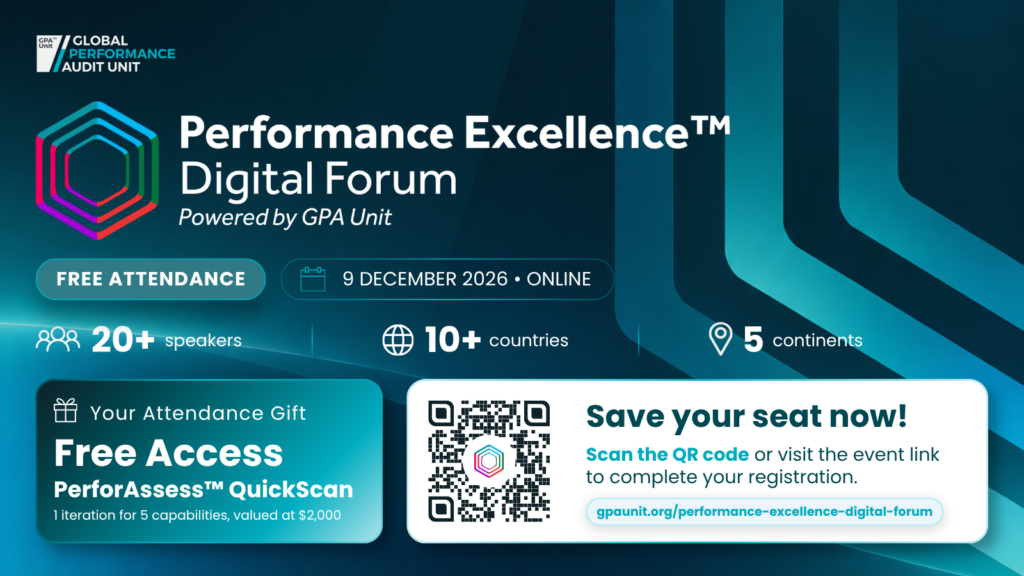
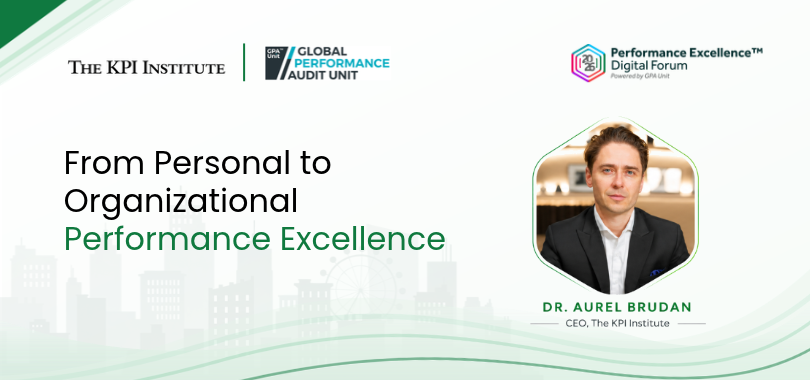
I will explore these themes further in my keynote, From Personal to Organizational Performance Excellence, at the Performance Excellence Digital Forum 2026 on December 9. I invite fellow leaders, researchers, and practitioners to join the discussion and exchange perspectives on sustaining performance at both personal and organizational levels.
Register for free and be part of the conversation: https://gpaunit.org/performance-excellence-digital-forum