A maturity model for Global Trade Management


A recent report analyzing the global trade companies’ performance released by the Aberdeen Group reveals that global importers and exporters need to reassess their Global Trade Management (GTM) practices in order to stay updated.
- with the latest supply and demand fluctuations;
- status of their growing global operations;
- increasing operational complexities and risk, and
- trade lane changes (Heaney, 2010)
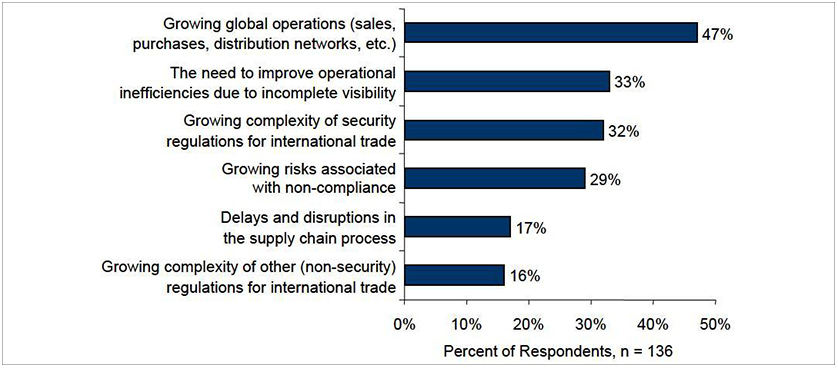
A ranking of the most important pressure points that drives the Global Trade Management framework reassessment, as outlined by the study survey respondents can be visualized below.
Assessment criteria
The study is based on a survey of 136 global exporters and importers, performed during August and September 2010 and assesses their performance against a maturity model that has at its core 5 Key Performance Indicators (KPIs) or criteria.
The maturity model or ‘Maturity Class Framework’, as it is named in the report, is structured on three maturity levels:
- Best-in-Class – Top 20% of aggregate performance scores
- Industry Average – Middle 50% of aggregate performance scores
- Laggard – Bottom 30% of aggregate performance scores
The five Key Performance Indicators (KPIs) or assessment criteria and the results for the Best-in-Class companies are outlined below:
- % Average trade compliance cost to value ratio – 8,2%
- % Perfect order rate received – 95%
- % Perfect order rate delivered – 96%
- % Improvement in average trade compliance cost to value ratio – 1,4%
- $ Total land cost per unit handled versus prior year – 0,6% (Heaney, 2010)
Assessment results
The results of the study show that companies enjoying Best-in-Class performance are sharing several common capability gaps when compared with their peers classified on the lower maturity levels, such as:
- They are 1,4 times as likely to have proactive and automated monitoring and resolution of General Trade Management exceptions and service disruptions;
- They were 1,3 times as likely to have the ability to meet all electronic external trade compliance requirements;
- They were 1,7 times as likely to automate total landed cost calculation. (Heaney, 2010)
Required actions for performance improvement
For reaching the highest capability maturity level in terms of Global Trade Management processes performance, the report outlines several directions, that the companies classified as Industry Average or Laggards need to pursue:
- Improve core processes and leverage automation in Global Trade Management;
- Establish or renew the corporate focus or strategic direction and ensure alignment with all applicable trade regulations;
- Use Global Trade Compliance (GTC) knowledge in terms of companywide sourcing, purchasing and supply network design decisions. (Heaney, 2010)
References
Image Source:
- Heaney, 2010

Tags: Maturity Model, Performance Measurement
Related Posts
 What Is the Balanced Scorecard? Definition, Perspectives, Framework, and Examples
 What Is a Key Performance Indicator (KPI)? Definition, Framework, Resources, and 1000+ Examples
 The Completeness Fallacy: When More KPIs Lead to Less Understanding